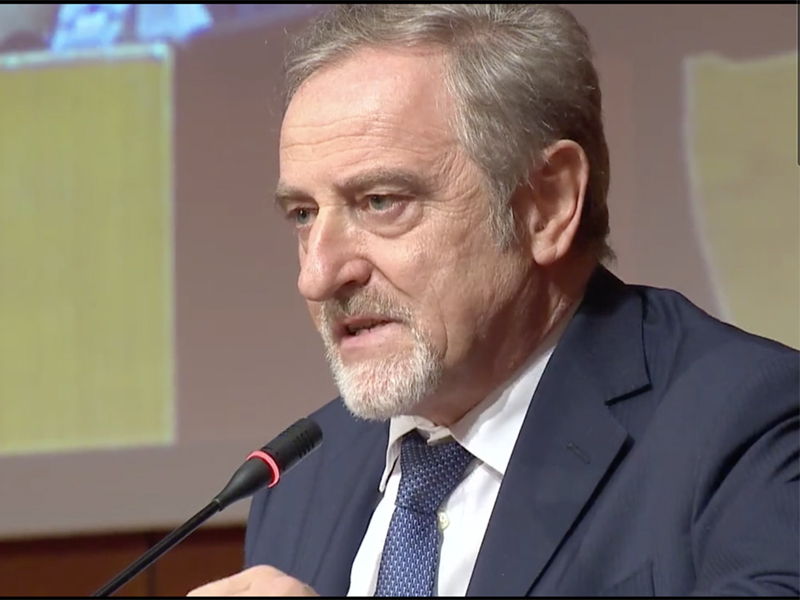
An appeal to the opposition to seek broader convergence on family, birth rates and parenting. This was one of the central points of Oscar Mina’s (Pdcs) address to the Grand and General Council (Consiglio Grande e Generale) on the bill under discussion. For Mina, these issues «belong neither to the majority nor to the opposition», while the measure represents a clear political choice: putting the family back at the centre of public policy. His full remarks follow.
«I too wish to speak to offer some considerations on this bill, even at the risk of repeating what those before me have already said, but I believe this is a particularly important moment, because we are being called upon to address one of the most delicate and decisive challenges for our future: the family, the protection of motherhood, support for the birth rate and, more broadly, the demographic future of our beloved Republic. I think it is essential to say this with absolute clarity: this is not simply a measure introducing new financial contributions or new tariff concessions for citizens, but a clear and precise political choice. It is the courageous decision to finally place the family back at the centre of our State’s public policies, officially recognising that supporting those who choose to bring a child into the world is the best possible investment in San Marino’s future. The demographic data, moreover, are unforgiving and leave us no room to look away or pretend otherwise. As Secretary Stefano Canti rightly recalled in his introductory remarks, in the first months of 2026 we recorded just eighty-eight births in our territory, compared with one hundred and six in the same period last year. These are worrying figures that must make us reflect seriously, but I believe we must not fall into the error of thinking that a single law, on its own, can magically solve the complex problem of declining birth rates. Low birth rates are, in fact, an extremely complex, multidimensional phenomenon that closely touches on the economy, labour market dynamics, the housing emergency, culture, public services and, above all, the general sense of confidence and expectations our young people have about their own personal and professional futures. For precisely this reason, I see this law as a fundamental piece of a much broader and coordinated strategy that will necessarily need to continue and be strengthened in the years to come. In this light, I consider the participatory process that has brought us to this debate in the Chamber to be of extraordinary importance: we are not facing a decision imposed from above by the institutions, but a project that has been constantly accompanied by a genuine process of listening and constructive dialogue with trade unions, trade associations, local institutions and citizens themselves. Even during the examination of amendments in the referring Commission, this dialogue never stalled or came to a halt; on the contrary, I believe this was the correct way to proceed politically – based on dialogue, mutual listening, the willingness to amend rules where necessary, and a constant effort to improve the quality of the bill’s final outcome. Many of the changes and improvements introduced go precisely in this direction: I am thinking, for example, of the significant financial strengthening of parental leave, which will from now on guarantee support equal to eighty percent of salary for the first three months, with a guaranteed minimum threshold set at one thousand five hundred euros per month, along with further support for subsequent months. I am also thinking of the doubling of paternity leave from ten to twenty days, fully paid at one hundred percent of salary; this is not only a concrete measure of support for fathers, but above all a powerful cultural message, because it firmly states that the daily care of children must not be considered an exclusively maternal responsibility, but that parenthood is, in every respect, an equal and shared responsibility between both parents. I also consider of great value the maternity allowance protecting women who are unemployed and meet the conditions set out by law, as well as the specific attention paid to young students, who will now be able to benefit from this allowance even if they are not employed; these are all measures with a clear common denominator, namely to prevent, in every possible way, motherhood from turning into an economic, professional or social penalty for women. Alongside this, there is another element of extraordinary importance that I wish to strongly emphasise, namely the formal recognition and institutionalisation of the figure of the family caregiver. For too long our society has treated as invisible the heavy, daily work of care provided by those who look after a non-self-sufficient, elderly, ill or severely disabled family member, often in complete solitude and within the walls of their own home; yet these people carry out a fundamental social and economic function for the entire family unit and for our whole community. Finally recognising the social and economic value of this caregiving work, providing targeted support, guaranteeing the payment of notional social security contributions, offering free training courses and introducing relief measures means telling these people, in a tangible way, that the State is there for them, that they are not being left alone, and that what they do has immense value for all of us. At the same time, I believe it was very important to examine the demographic phenomenon closely through scientific tools; the sociological survey promoted by the National Statistics Office, which collected around two thousand fully completed questionnaires from citizens, unequivocally shows that there is a very strong willingness to participate actively, and that Sammarinese citizens want to be heard and want to contribute personally on these issues. I am convinced that family policies must be built together with families, not merely for families; for this reason, I wish to make a heartfelt appeal for collaboration and dialogue to all the opposition forces who have voiced strong criticism of this measure. In Commission, some political forces chose the path of abstention, a choice we deeply respect, because we live in a democracy and everyone has the full right to express their political positions as they see fit; but today, with such an important measure before us, we have a real opportunity to look beyond individual party allegiances, because the issues of family, protection of motherhood, support for the birth rate and for parenthood belong neither to the majority nor to the opposition, but are shared assets of the entire Republic of San Marino. On these issues, which are crucial for our future, we must be able to seek and find a much broader political and social convergence; this does not mean giving up one’s own legitimate political views, but recognising with maturity that, faced with a challenge of this historic scale, we have a duty to place the general interest of our community and of future generations first, because supporting a family means, above all, building the San Marino of tomorrow. It means telling our young people, with conviction, that choosing to have a child, to build a family and to plan their future in our Republic must not be experienced as a penalising choice, but as a path that the State accompanies and concretely supports at every step. For all these reasons, I confidently announce my full support for this bill, in the awareness that, although we have not suddenly solved the dramatic problem of declining birth rates, we have nonetheless taken a concrete and significant step in the right direction. In the hope that this achievement represents only the beginning of a season of reforms and increasingly structural policies in favour of the family, we must find the courage to invest strongly in its future; the future of our Republic, even before the cold figures of state budgets or economic statistics tables, lies in the people, in the families and in the children who will be born in our territory».