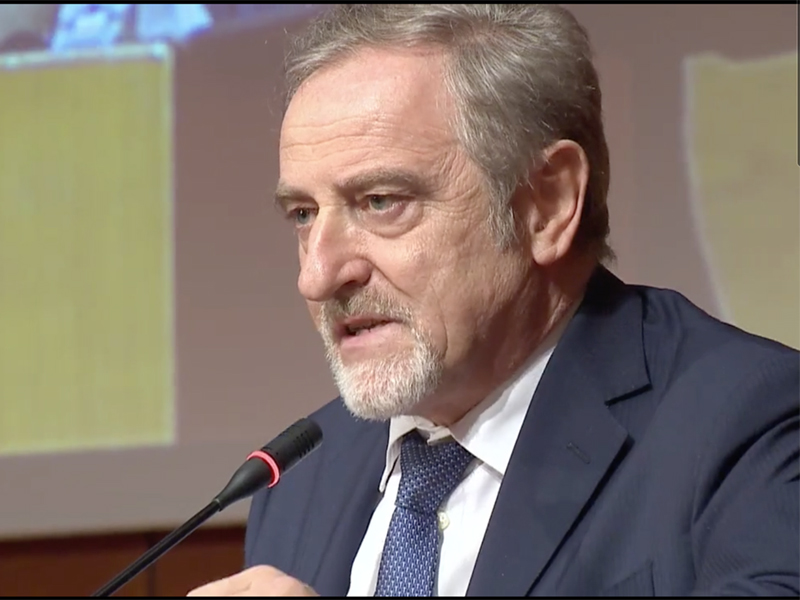
“If certain matters are highlighted, one must be honest enough to highlight the others too.” This was the appeal made by Gian Carlo Venturini (PDCS), speaking during the communications item of the Grand and General Council (Consiglio Grande e Generale). The councillor addressed the signing of the Association Agreement with the European Union, before responding to opposition criticism concerning Titano Games and the banking system, also recalling the proceedings involving Banca CIS, Cassa di Risparmio and Banca Asset.
The full speech by Gian Carlo Venturini (PDCS)
I too would like to offer a few considerations. First of all, I join what my colleagues have already said regarding the opening address to this Council by Their Excellencies, which was precise, well-targeted, and touched on issues of extreme general interest and great topicality.
I’d like to make a few remarks without repeating too much what has already been said about the Association Agreement. I believe that, as many have noted — indeed in almost every speech — the result achieved on Monday with the signing of the Association Agreement is the fruit of work carried out over more than eleven years, involving various political forces and different governments, all committed to pursuing the goal of signing the Agreement in order to secure greater European integration.
An integration that had by now become necessary, indispensable, and one that has been continually urged and requested by all employers’ associations, trade bodies, labour unions and, therefore, by civil society as a whole.
It’s obvious that this path has also been carried forward by many political forces and parties, because we too, in our own small way, within the European People’s Party, have always called for support from the countries belonging to that organisation and for constant assistance in achieving this important result.
As I said earlier, this Agreement certainly offers a further opportunity for growth and development for our country, for our citizens and for our businesses. Of course, the instrument has now been signed, but the real work begins now.
This is not a finish line — it is a starting point on which we will all need to work, seeking to find the best solutions to make full and effective use of this Agreement, which, after so much time and so much effort, we have finally managed to secure.
We are confident it will bring significant results for our businesses, our workers and our young people. We do not deny that, on certain issues, it may also create some difficulties, since we will inevitably have to align ourselves with certain European Union directives and regulations.
The fact that we chose to finalise an Association Agreement, rather than a membership agreement, is an important element. On membership, we had already held a popular consultation with the 2013 referendum, and had that referendum been held under the current rules — which do not provide for a quorum — we would probably have submitted a request for membership.
However, we have always maintained that, at this stage, for a small country like ours, in order to safeguard our sovereignty and our peculiarities as a small State, it was appropriate to maintain an associative profile. A profile in which certain matters fall outside the Agreement and in which, therefore, we are not required to transpose all EU directives.
I heard earlier mention of the provisional application of the Agreement. I believe work should already begin in this direction in the coming months. Some work has already been carried out by the relevant bodies, but we will need to complete it further.
I think it is important to begin provisional application already in the early months of next year and, naturally, to carry out all the necessary steps to ensure it.
This would offer a prospect and a possible solution to some of the issues faced by companies operating in San Marino — including those that also do business in Italy and abroad — as well as to issues relating to the labour market and the free movement of our citizens.
So I won’t dwell further on this topic, since we will certainly have other opportunities to discuss it, especially in light of the result achieved.
I did, however, want to offer some considerations on points raised by colleague Renzi and some of his fellow councillors. If I understood correctly, in his speech the councillor criticised statements made by certain majority councillors regarding the results achieved in recent years.
He disputed those assessments, arguing that they did not reflect reality and describing them, if I recall correctly, as an idyllic and unrealistic picture of our country. He referred to the banking issue, the Banca di San Marino affair, the Titano Games matter, and various other situations.
A couple of words on Titano Games. I believe the update given this morning by Secretary Gatti provided a clear picture of the current state of affairs.
In light also of the documentation available to the government, I believe the Most Excellent Chamber has entered the proceedings as a civil party, and I think that, as Secretary Gatti has already said, we will need to follow and monitor closely all the aspects that have emerged at this early stage.
We must already move forward with the measures necessary to ensure continuity of operations, while at the same time assessing, as time goes on, how the matter may develop and whether further action will be required.
That said, while this is an issue on which colleague Renzi and colleague Carattoni have voiced criticism, it is certainly not one that the majority or the government intend to underestimate.
At the same time, however, I believe other matters that have appeared in the local press in recent days have been conveniently forgotten.
Because there have been articles revisiting cases such as Banca CIS, Cassa di Risparmio and Banca Asset, in connection with proceedings that are still ongoing at the criminal level.
Proceedings in which, in fact, the Fiscal Prosecutor’s Office (Procura Fiscale) and the State Advocacy (Avvocatura dello Stato), in defending the State’s interests, have pointed to probable irregularities or possible liabilities on the part of certain governing and administrative bodies of these institutions, as well as certain supervisory authorities.
I believe that, on these matters too, some reflection on the part of our opposition colleagues would have been appropriate.
Because if these problems and hypotheses — highlighted, as I said, in local press reports as well as in the positions expressed by the State Advocacy and the Fiscal Prosecutor’s Office — were to be confirmed today, I believe this would reveal responsibilities for actions whose consequences have weighed, and will continue to weigh, on our citizens for many years to come.
Because from those reconstructions, it appears there was a clear intent to shut down Banca CIS, and an intent to put Cassa di Risparmio in difficulty, stripping it of certain assets and resources.
This cannot simply go unmentioned. If certain matters are highlighted, one must be honest enough to highlight the others too.
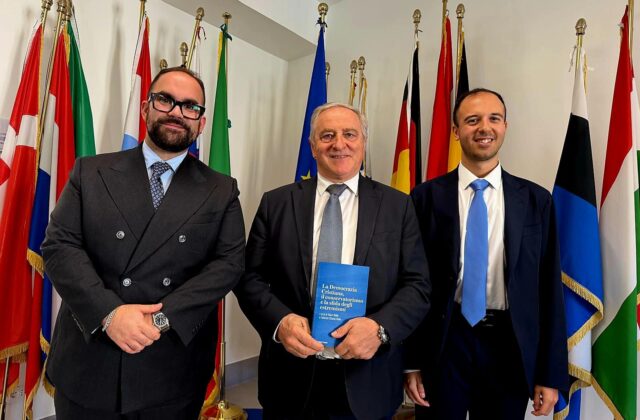
Finally, I’d like to spend a couple of words — as I see time is running short — on my recent participation, together with colleague Andruccioli, in the European Conference of Presidents of Parliament, held in Rome last week, which saw the participation of numerous delegations from almost all European countries and various international bodies.
This participation was naturally an opportunity for discussion on highly topical issues, such as resilient democracies united against hybrid threats, artificial intelligence, and the labour market.
These are all issues that concern every country equally, regardless of size or particular characteristics, and which we will need to continue addressing in the years ahead.
Another topic addressed by my colleague was that of women’s rights and equality. We had the opportunity to discuss these aspects as well — issues that affect, to some extent, every country.
We too, as representatives of San Marino, were able to take part in the various debate sessions and contribute to this important initiative, held in Rome at prestigious venues such as Montecitorio and Palazzo Madama.