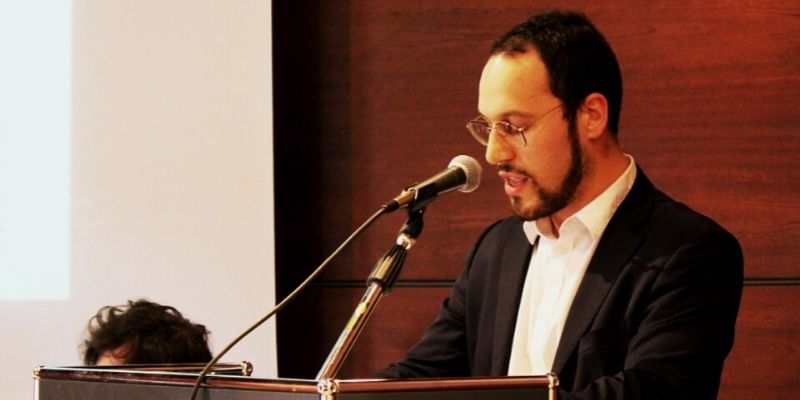
Creating scholarships for young Sammarinese and making the most of the skills of those living abroad – including to prepare the public administration for the association agreement with the European Union. This is the proposal put forward by Commissioner Marco Mularoni (PDCS), who spoke during the joint committee session on 12 October. Below is his speech in full.
“I would like to thank the opposition for pressing us, asking a number of questions and sharing considerations that, in some cases, I share and will refer back to. But let me start with the point raised at the outset by my colleague Rossi: the 19th is a historic date for us. Our culture tends not to dwell on historic milestones or to remember everything that has been achieved, yet the 19th marks the conclusion of a journey that began back in 2015 – eleven years ago. I have not forgotten that, just a few months ago, the debate in this chamber centred on a very different question: whether the agreement would actually be signed, and what might happen to it, given some worrying reports at the time. I therefore believe the first thing to do is to thank the Secretary and everyone who worked towards this date, including in previous terms and under different governments. This is a historic date because the agreement will revolutionise our country. Very often we struggle to agree even on a simple piece of legislation or a decree, whereas this agreement will change almost our entire world and carry it into a completely new dimension. That is why I welcome every challenge and observation as food for positive reflection. Today, a bill is being presented to the Committee that answers one of the questions raised by the opposition. I recall that, recently, beyond individual measures, the question being asked was how we would transpose the agreement. The Government and the majority were often criticised because it was not yet clear which approach would be used. Today, however, we are presenting a bill built around a clear idea: an annual law, an omnibus law in which everything is included in a structured, programmatic way, also indicating which legislative instruments will be used for the measures to be adopted the following year. I therefore thank the Secretary of State, because this question had been raised several times, and today we have a bill in response. Personally, I would even go further and be bolder still, because the concerns raised earlier by Commissioner Carattoni about the sheer volume of decrees are indeed real. I believe the Secretary of State and the Government, together with the Committee for Institutional Reforms, could consider a new framework. I have read the bill and, apart from a few minor variations, it is broadly aligned with the Council’s current regulations. Perhaps a bolder approach is needed, because the concern is that the Grand and General Council (Consiglio Grande e Generale) could end up overloaded with a whole series of regulations. The problem is that many of these stem from European regulations which politics cannot amend, and which must simply be transposed with the adjustments provided for. This is why we should perhaps think along different lines. When we draft a law based on a directive – that is, on principles and guidelines – politics comes into play, and the Grand and General Council can put forward different visions and perspectives. When, however, we are dealing with regulations, lists, standards or compliance requirements, the legislative body cannot amend a European regulation. Of course, there are areas we have negotiated for which adjustments are envisaged, such as freedom of establishment and the law on residency. I therefore believe this annual law is useful and productive, above all because it introduces a concept that does not always find room in our country: planning and designing ahead, knowing as early as 31 October what measures will be needed the following year. Another suggestion came from Commissioner Mularoni, regarding the possibility of identifying a single point of contact – even just an administrative officer – to act as a reference point for the various parliamentary groups. This could open the door to debate on European matters where, in reality, there is no room for manoeuvre, because they stem from a regulation or something we simply cannot change. Otherwise we risk creating the usual political clash without any real grounds for it, simply wasting time. An intermediary figure performing a technical-administrative role, providing guidance to the parliamentary groups and helping them reach agreement, could therefore be useful. For us, politics is not a full-time job, and I think this should also be taken into account. I therefore find myself in agreement with Commissioner Mularoni’s proposal. I agree that the 19th is a landmark date, but from this point on, all the Secretariats of State must be involved, as indeed they should already be. The entire Government must be engaged, not just the Secretary for Foreign Affairs: every Secretariat must put the European dimension on its agenda for the matters within its remit. We also need to think seriously about the public administration, going beyond the report presented to the Council more than a year ago, which I appreciated at the time. We must address this issue concretely, because the real challenge of the agreement will be the public administration itself. We cannot simply wait for things to come to us: we must start planning, especially in terms of resources and professional skills. We can hold competitions and hire young people, but these young people need to be properly trained. A broader approach is therefore needed, one that can go beyond the existing rules of the public administration. I have been saying for some time now that we should create scholarships for young Sammarinese, giving them the chance to bring their skills back to San Marino while also spending time in other European countries to learn how they have approached these same challenges. I speak of going beyond the rules of the public administration because we cannot expect to integrate into the European Union while clinging to somewhat conservative concepts and dynamics overly tied to fixed contracts. We need to make an extra effort here, and I believe young people are capable of doing so. We have a great many young Sammarinese abroad with considerable skills who, faced with an opportunity like this agreement, could come home and contribute to the Republic of San Marino, bringing with them a broader, often more competitive outlook and valuable expertise. Too often we appoint consultants who do not actually know San Marino’s reality.”