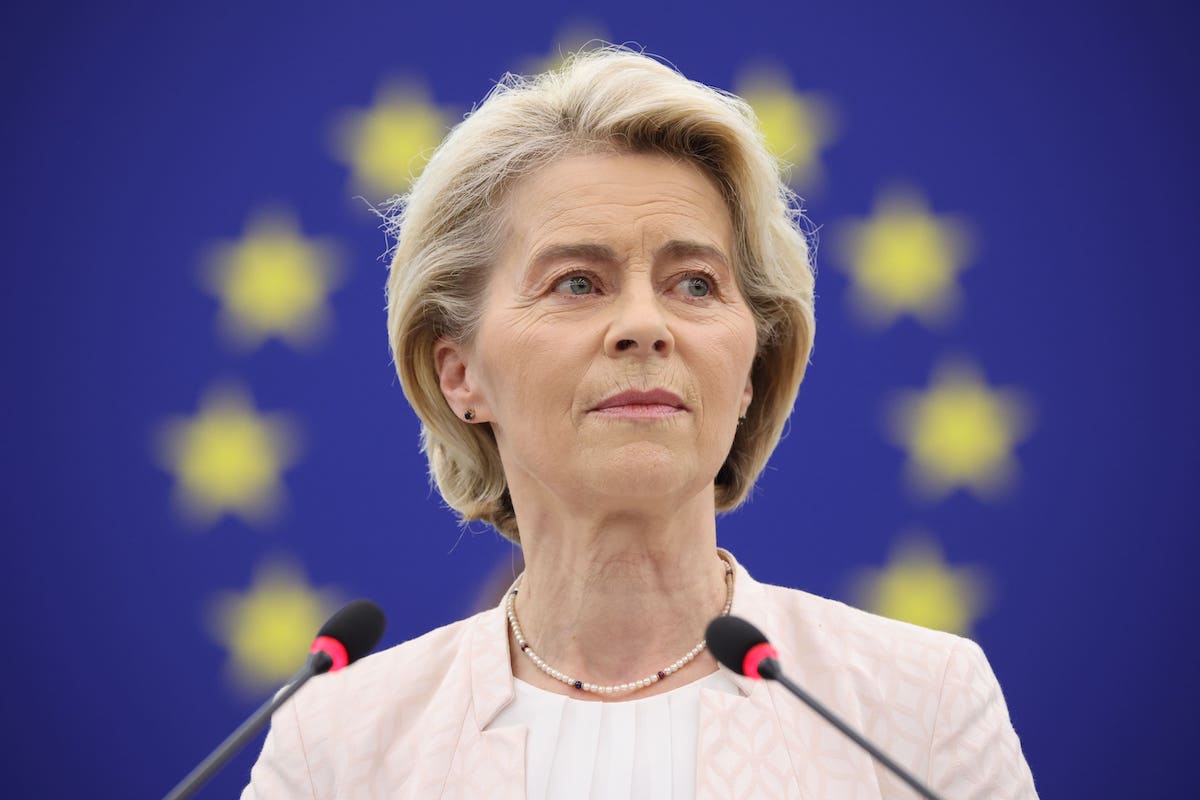
On 27 August, in Paris, speaking to French industrialists at the Medef employers’ association, Ursula von der Leyen said that Europe has ten trillion euros in household savings sitting idle in bank accounts, that this money is “lazy,” and that it needs to be put to work for European businesses.
The quote is genuine and can be verified in the text of the speech. For three days now, translated versions have been circulating in dozens of posts presenting it as the disguised announcement of a seizure of current accounts, and one of the most widely shared texts uses that very word: confiscation.
The quote is real. The confiscation is not.
In between lies a piece of editing worth examining closely, because it follows exactly the same pattern that recurs on every European dossier.
Let’s start with what is true – and there is quite a lot of it.
The project is called the Savings and Investments Union. It has existed since March 2025 and is one of the flagship initiatives of this Commission. The figure of ten trillion euros is real: according to Commission data, around 70% of European households’ financial wealth sits idle in bank deposits. The stated goal is to persuade part of that money to flow into European businesses instead of American markets, where much of the continent’s savings currently ends up. Von der Leyen wants to close the deal by the end of 2026, with all twenty-seven member states or “with whoever is on board,” and estimates 470 billion euros in additional investment. And yes, all of this stems from the Draghi report of September 2024, which calculated a funding need of 750–800 billion euros a year.
Now for the part that doesn’t appear in the posts.
There is no mechanism whatsoever to withdraw money from people’s accounts.
It is not proposed, it is not written anywhere, it is not under discussion.
The concrete measures adopted so far number three, and all three are voluntary.
The first is a recommendation to member states – an act that binds no one – encouraging them to create savings and investment accounts with tax advantages, modeled on the British ISAs or the Swedish ISKs. The second is a regulation to revive securitisation, which concerns banks, not account holders. The third is a package on market integration and supervision. None of the three touches your bank account. Moving a single euro still requires your signature, exactly as it did last year.
Put simply, without needing a degree in economics: it’s as if the mayor said that the town has three hundred garages full of bicycles nobody uses, and that people would be better off riding them. So he opens bike lanes, scraps the bicycle tax, runs a bit of advertising. He does not walk into anyone’s garage. If you want to leave your bike there to rust, it stays there and rusts.
There is also a detail that completely overturns one of the most widely quoted passages.
The circulating text claims the Union might “stop guaranteeing the safety of deposits.”
The opposite is happening: EU Directive 2026/804, which came into force this year, has actually strengthened the guarantee, confirming coverage of one hundred thousand euros per depositor per bank and adding temporary protection that in certain cases reaches two and a half million euros – for example, after the sale of a home. Deposits under one hundred thousand euros remain legally excluded from any loss, even if the bank collapses.
It’s worth taking the piece apart bit by bit, because the pattern is always the same, and recognizing it is more useful than any single rebuttal.
It starts with a genuine quote, which props up everything that follows. An intention that no one has ever declared is then added, dressed up in a formula that sounds cautious: “of course, the word confiscation was not used.” Next comes the invented mechanism – halting interest-rate indexing, scrapping deposit guarantees, forcing people to buy bonds “like in the USSR” – presented as hypothetical but written in the future indicative tense. Then comes the purpose, designed to frighten: financing a war. And it closes with an authoritative source, badly mangled.
In the text, Mario Draghi is described as “former president of the European Commission for financial security,” a post that does not exist and that he obviously never held, having been president of the ECB and prime minister of Italy. By the end, the reader is left holding one true fact and five false ones, all glued together.
And then there is the line that gives the whole thing away. At one point the author writes that savings will be confiscated to finance “a war against us.” Against whom, exactly? That “us” is not European. The piece talks of Russophobia, cites Prime Minister Mishustin, and reasons from a perspective that is not that of the Italian reader receiving the already-translated text. This is not an accusation against those who share it. It is simply what is written there, plain to see.
None of which means one should stay silent. Serious objections to the Savings Union do exist, and they stand on their own, without needing an imaginary confiscation. The political point of the operation is to shift savings from zero risk toward risk: deposits earn little but don’t lose value, investments earn more but can lose value, and it is the saver – not Brussels – who bears that difference. The revival of securitisation brings back into circulation instruments that did not exactly cover themselves in glory in 2008. The Commission recommends that member states consider automatic enrolment in supplementary pension funds – the kind you’re enrolled in by default and must actively opt out of – and one can debate whether that amounts to a gentle nudge or a small sleight of hand. And the first beneficiary of ten trillion euros being set in motion is, of course, the asset management industry, which is openly cheering the plan on. All of this is debatable, documented, and true.
For readers in San Marino, the matter is not as distant as it might seem.
Those posts land in the same feeds, often from the same pages that comment here on the Association Agreement, and they find a country without fact-checking, without anyone monitoring online campaigns, and with an electorate small enough to be swayed by a few hundred misplaced convictions.
Anyone who wants to criticize Europe has plenty of genuine arguments at their disposal. The problem is that the false ones perform better.