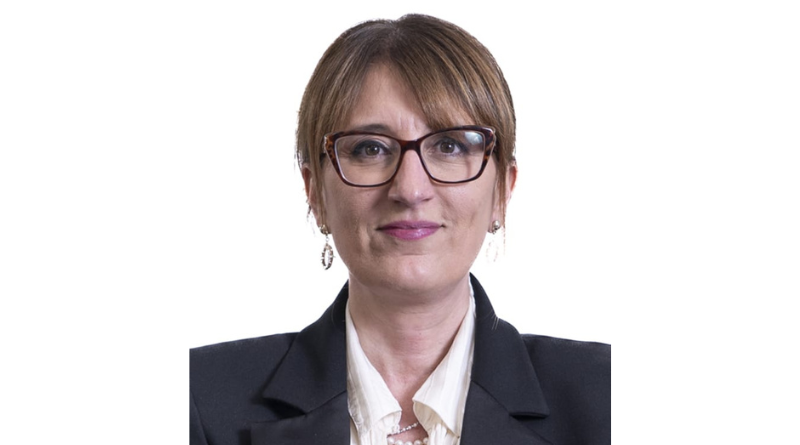
We report in full the speech given by Francesca Civerchia (PDCS) in the Grand and General Council (Consiglio Grande e Generale) during the communications session.
Francesca Civerchia (PDCS): First of all, I wish Their Excellencies a successful term for this six-month period, and I thank you for the wonderful message you delivered to us. On the subject of bad behaviour, I would like to offer a few reflections, because I believe everyone was struck by what happened in major Italian and European cities. What took place deserves serious, in-depth consideration and clearly cannot be reduced simply to smashed shop windows, burned property — both movable and immovable — assaulted police officers, and all the people, all the lives, that were put at risk. Unfortunately, what we are witnessing is not the legitimate exercise of a right, but conduct that must be condemned and prosecuted. All of us move within the Italian Republic, and these are events that could affect any one of us, and our family members, who also live, study and work in Italian contexts. Freedom to protest is certainly a fundamental right, but it cannot become an alibi for violence. Dissent is legitimate, devastation is not. Criticism of the government is legitimate, but assaulting someone wearing a uniform is not. We must have the courage to say this clearly. Responsibility does not lie only with those who physically break, burn and attack. Where concrete evidence exists, it is necessary to establish the responsibilities of those who coordinate and incite violence. While fully respecting fundamental rights, procedural guarantees and the principle of personal criminal responsibility, it is right to consider introducing adequate and effective legal tools — ones that may well concern us too. Thinking about safeguards is therefore becoming increasingly essential. There is undoubtedly a political and cultural problem here. We cannot condemn violence in words and then justify it in practice, turning those who destroy into heroes and those who restore order into enemies — because that is exactly what certain political forces in Italy are doing. Those who hold public responsibilities have a duty to help calm tensions, not to fuel confrontation. This applies equally to parliamentary chambers, including our own, which should be a place for debate, not insults — a place for ideas, not personal attacks. One can be an opponent without becoming an enemy. One can firmly challenge a position without humiliating the person who holds it, as often happens, unfortunately, even in this very chamber. When a representative of the institutions systematically resorts to provocation, personal attacks and self-serving reconstructions of events, they damage not only their political rival but also weaken citizens’ trust in the institutions themselves. The same principle must apply in schools. Schools have the task of forming free citizens capable of reasoning, comparing ideas and developing critical thinking. They must not become instruments of propaganda, whether from the right or the left. Educating does not mean imposing a worldview, but providing the tools needed to understand it. Pluralism, freedom of conscience, and respect for families and students must always be protected. Consistency must also guide our judgment of history. The crimes of fascism must be remembered and condemned without ambiguity. With the same rigour, we must recognise and condemn the crimes committed by communist regimes — the persecutions, the repression of freedom. There can be only one principle: freedom, human dignity and the rule of law have no political colour. I believe in security, in responsibility, and in respect for the rules. I believe rights are fundamental, but they must always come with duties. I believe in integration, but I am convinced that genuine integration requires respect for the law — laws that must be applied to everyone, without discrimination and without exceptions granted on the basis of political or ideological affiliation. Only last week, within this very chamber, we approved a motion precisely on violence, on behaviour that must be condemned starting from the places where abstract concepts are discussed, bringing it back to the practical, everyday reality of actions. A strong state is not one that arbitrarily restricts freedoms, but one that protects them, enforces the rules, and ensures that no one is above the law. I would also like to extend my congratulations to Secretary Beccari and to everyone who made the signing of the Association Agreement possible, because we can finally mark this long-awaited historic moment. An agreement between San Marino and the European Union that represents a historic step forward and a significant opportunity for our country. It is the result of a process built on dialogue, cooperation and mutual recognition, which strengthens our State, our San Marino, and our relations with Europe, while at the same time safeguarding the specificity, identity and autonomy of our Republic.