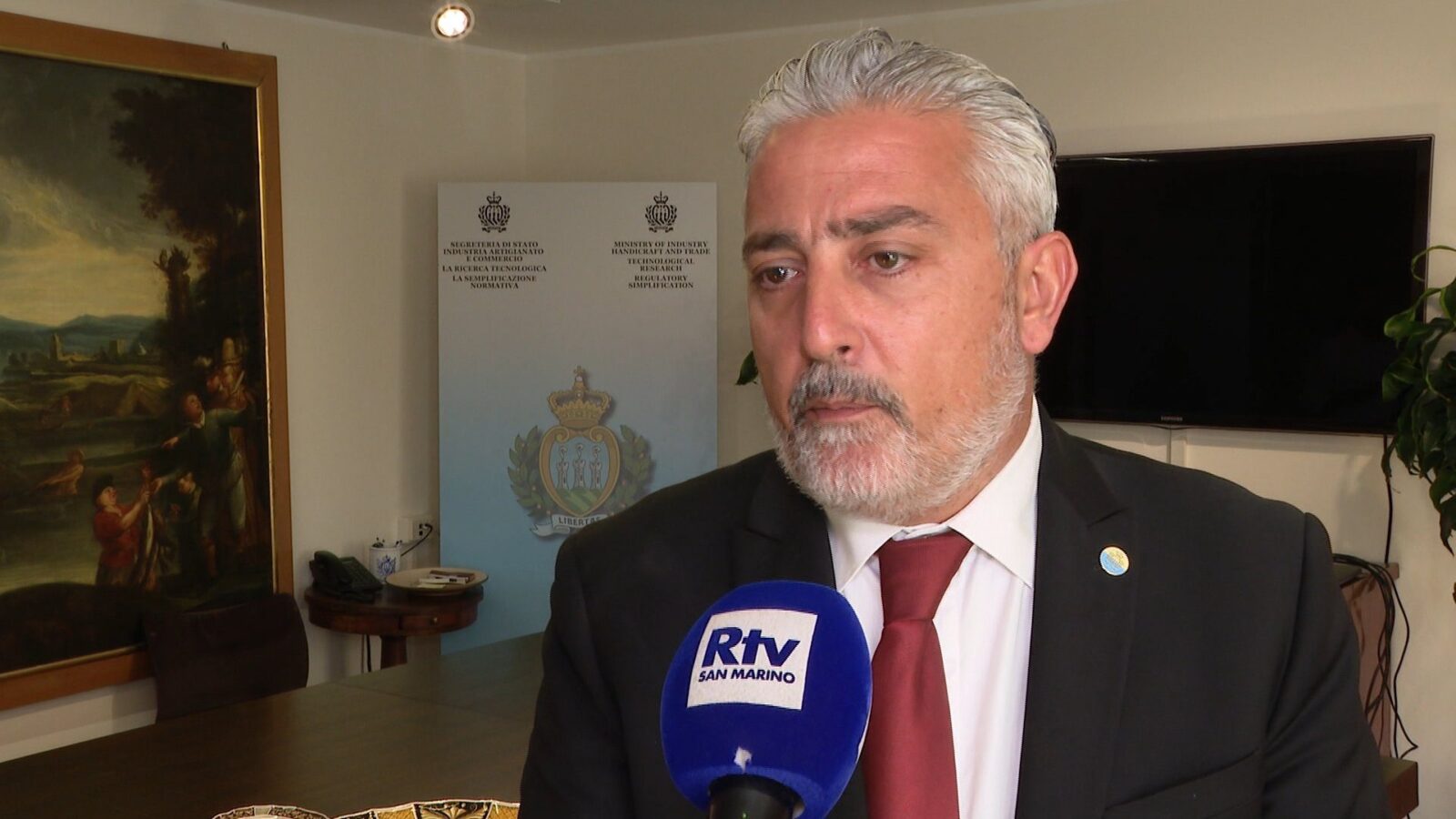
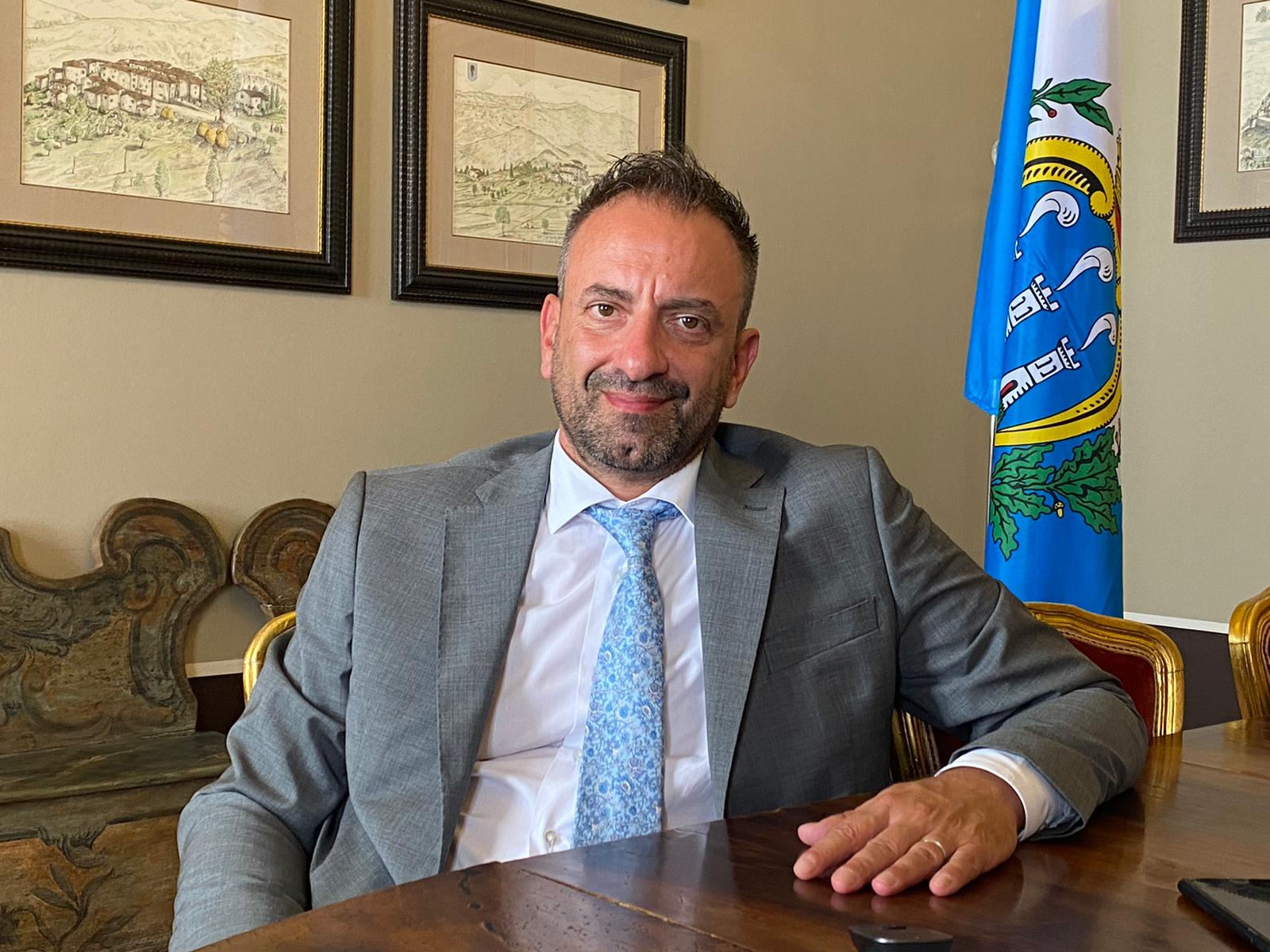
We publish in full the remarks made by Secretary of State Rossano Fabbri before the Grand and General Council (Consiglio Grande e Generale) during the communications item on the agenda.
Secretary of State Rossano Fabbri: Allow me a few reflections, because I believe this historic moment deserves them, to reiterate the government’s great satisfaction with the path we have undertaken. It has been said time and again that the signing is certainly an important milestone, but it is only a starting point. I believe we should take pleasure in this great achievement, as we all did, albeit briefly. I am sorry if it bothered anyone that, for a very short period, the government celebrated something the country had been seeking for four legislatures. I reiterate how pleased I am with the path we have completed, even though it is only a beginning. I reiterate that the Republic of San Marino will remain a third country in relation to the European Union. I also reiterate that it is the duty of San Marino’s institutions to sign treaties with the world around us. At one time, when Italy was not part of the multilateral organisation, the 1939 agreements — along with all their additional protocols, naturally — were sufficient. Today they no longer are. I believe this process gives the Republic of San Marino solid foundations from which to look to the future with confidence.
Colleague Gatti has already reported on the mission to Bangkok, to the International Monetary Fund, the World Bank, and all the meetings we had the honour of holding during that mission. I, too, return once again thoroughly satisfied with the outcomes of that mission. I understand that internally the dynamics are often different, and it is right that institutional bodies press the majority and the government on every issue. However, I observe that, at the international level, in this historic moment the country is well regarded, well structured, and — given its peculiarities, its resilience and its characteristics — probably held in higher esteem abroad than at home. After all, the pride of being a country with unique characteristics reflects directly on how our interlocutors see us. We are unique on the international landscape of microstates. Our economy relies on manufacturing for a third of its output, and our gross domestic product shows macro figures much closer to those of large states than to those of other microstates, whether European or global. This, if anything, should make us reaffirm just how essential the signing of the Association Agreement was, precisely because of our peculiarities. We export to Italy, we work with Europe, and we need to regulate these relationships more than economies whose main source of sustenance lies in services and the banking and financial system — which is not the case for us. We needed, as we have done, to put these relationships on a regulated footing.
I believe it is important to offer some reflections on Giochi del Titano. I think we need to carry out a very simple exercise: restoring the facts to their real proportions. In recent weeks, including during this very communications item, we have witnessed a narrative suggesting that a gigantic irregular system was born in San Marino and then spread elsewhere. The elements of the investigation have become public, and they tell a profoundly different story. As I understand it, the inquiry originated in Italy, from checks carried out by the Guardia di Finanza, coordinated by the Prosecutor’s Office of Ravenna, under an operation named “Mani d’Oro”. The main strand concerns a system of false invoicing and unlawful labour supply. According to reconstructions, as many as 155 companies were identified as shell firms, spread across various areas of Italian territory, among which invoices for non-existent transactions worth around 130 million euros reportedly emerged. That part of the investigation involves 16 individuals and a great many companies, none of which are linked to the Republic of San Marino. Only part of these sums, according to the prosecution’s hypothesis, would have been transformed or otherwise laundered as apparent winnings at Giochi del Titano.
I say it is essential to restore the real proportions of this matter — certainly not to downplay the 7.5 million euros involved, which is a significant figure, but one that deserves to be placed in its proper context. It has already been reiterated that the company suspended the individuals involved and replaced them, while at the same time ensuring the continuity of its operations. This is a fact worth reiterating, just as it is worth reiterating the clear cooperation between Italian judicial authorities and the Republic of San Marino, which I believe is working at its best — and this episode proves it. It is symptomatic of how the two legal systems cooperate and respect each other’s competences. This very case should be used to demonstrate how much relations between our two states have changed, rather than to revive, as I have unfortunately heard, old stereotypes. Someone even wrote that the case “makes Titano tremble.” I believe, instead, that this matter should be approached exactly as the Saint-Vincent casino case was handled in Italy just a few months ago — a case that, incidentally, bears characteristics entirely mirroring what happened in the Republic of San Marino. There, an investigation into money laundering and corruption involved more than 30 people. A company that is almost entirely publicly owned was placed under judicial administration for a year by the competent court, which identified shortcomings in its control and governance systems. The Italian press rightly covered those events with rigour, but no one ever wrote that the investigation made the entire Aosta Valley tremble. No one automatically turned an investigation into the Saint-Vincent casino into a trial of the entire Italian system.
We are simply asking for a fair standard, one that gives the matter its proper proportion. The government has, moreover, already announced that important measures are being put in place to strengthen controls, and we will be able to see them in the coming days. I believe the government has not taken the situation lightly, within its own remit, nor has Giochi del Titano. This is the context. It is quite another thing to expect that, from an investigation originating in an Italian system involving dozens upon dozens of shell companies and hundreds of millions of euros in disputed invoices, a single segment reaching San Marino can be isolated and turned into a trial of the San Marino system as a whole. I do not consider this fair, out of respect for the truth and for the facts as they actually occurred. The Republic has nothing to hide. The individuals involved have been suspended, the continuity of the company has been ensured, and we are working to strengthen controls and future governance — not only in relation to what has happened, but as part of a broader review of procedures, timelines and the duration of appointments, as someone has already pointed out. San Marino’s judiciary is cooperating with its Italian counterpart, and we will continue to do whatever is necessary to protect the company, its workers, and above all the credibility of the Republic of San Marino. Full transparency, then, no cover-up for anyone — but equally, no exploitation of individual responsibilities yet to be established, in order to put the entire country in the dock.