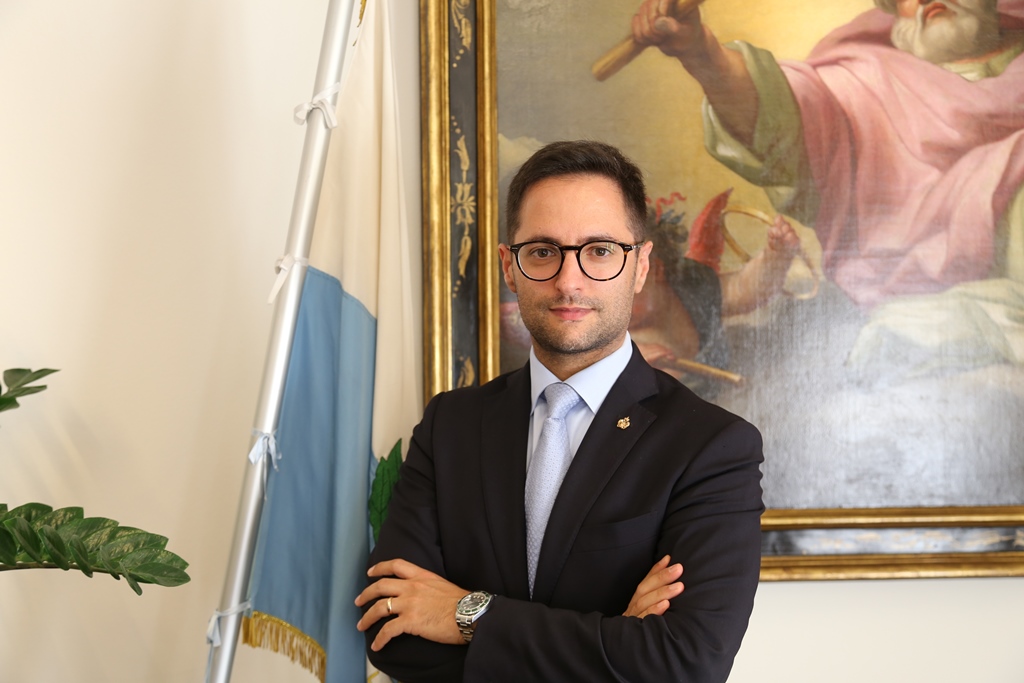
We report in full the speech given by Fabio Righi (D-ML) in the Grand and General Council (Consiglio Grande e Generale) during the communications item, in which he presented a motion on the implementation of the association agreement and on defining a national strategy for its transposition and development.
Fabio Righi (D-ML): Naturally, I too wish to extend my best wishes to the new Captains Regent for this six-month term. I must also say, Excellencies, that the address with which you opened your mandate in this chamber deserves serious consideration, as it showed a genuine ability to set aside the political role and truly embrace the institutional one. I found that speech remarkably courageous, because you touched on important themes: respect for the rules, seizing opportunities, working for the country, thinking of future generations. So much so that, after that address, I expected it to spark some reflection within a majority that reflects none of those principles. Still, I believe that must be our guiding path, and that we should work precisely in that direction. Today’s topic, in this communications item, can hardly be anything other than the association agreement. If time allows, I won’t limit myself to this subject alone, but certain considerations must absolutely be made. I must say that, speaking towards the end of this communications item, after a full day of debate, I cannot deny that some of the remarks still being made in this chamber continue to deepen the concerns and doubts that have been raised and underlined so far.
You see, the concern is that the instrument keeps being confused with the objective. This is something we have always pointed out, and I’m pleased that others in this chamber are now waking up to realise, and to acknowledge, that virtually all of the preparatory work — all the work that will need to be done from now on — is essentially non-existent. Hearing today that we still need to figure out how to proceed, how to implement it, which sectors, what prospects, what kind of development, feels like living in a completely surreal world. Because any ordinary citizen, for matters infinitely smaller in scope, would have analysed and verified these elements before signing any agreement. Yet today we are told that a population still full of doubts must be informed — after an agreement has already been signed in the exercise of sovereignty through representative functions. This gives me the opportunity to restate, once again and very clearly, the position of my political force. We have no objection whatsoever to greater integration with the European continent, because that is the path the Republic must necessarily follow. But we remain extremely concerned about this particular agreement, negotiated under such constraining conditions. You say you negotiated competitiveness and opportunities, but, in the absence of any vision for the country’s development, I wonder how that could possibly have been negotiated. The result, in fact, is that nothing was negotiated, and even today you come before this chamber utterly unaware of how these opportunities, and the implementation of this agreement, should be managed in the national interest.
The surreal part is that anyone who says what I am saying now — things that would be considered obvious in any country, in any context — is branded in this chamber as being opposed to who knows what. I’ll borrow the words of my party leader, who I believe gave an extremely lucid speech in yesterday’s debate, stating clearly that our problem is not Europe, but the sheer improvisation, unpreparedness and inadequacy of those who have managed, and continue to manage, this agreement and this process. Today I hear people say: “The process starts now.” Which process? There’s constant emphasis on the idea of “becoming normal.” Allow me a few words on this too, because evidently, for a political class that has led the country away from normality, normality itself becomes some kind of achievement. But forgive me — for my political force, being normal is not up for debate. Do we want to debate whether to be normal? Do we want to debate whether to follow the rules of the world? Do we want to debate whether to seize opportunities for our country? What we need to worry about is how to be competitive in the context we are about to face, under an entirely different model that will transform the country. Doesn’t this strike you as a reasonable, serious approach? No — instead, you have lulled the public by saying: let’s sign, because a letter can always reverse things; there’s no need for your opinion, because you don’t understand anyway. You’ve said that more than once. Then you say it’s not urgent, because it won’t apply for another two or three years. We will not accept, especially now that you have put that fateful signature on the dotted line, this continued attitude of mockery and populist evasion. This is no longer a game, no longer idle talk. The answer cannot be: we’ll think about it, we’ll see.
There are numerous issues and matters that remain unresolved to this day. Impact assessments: how much will it cost us, how will we manage it, what skills are needed, in which offices, in which sectors will we be able to carve out a competitive edge? Is it the maritime registry sector, or not? Is it services, technological development, new economic models? What is your vision? What are we betting on? What do we implement first? Don’t forget that the entire business community will also face an increase in related bureaucracy. And I’m not even talking about those who already work for, within, or in connection with the European market. This, by the way, ties into another great myth: that from now on, the European market opens up to us. But where exactly do our businesses operate — within 61 square kilometres? Our market is already 98% Italy. And where is Italy — in Africa or in Europe? I’m not talking about the companies that are already multinational, but about all the smaller ones, the self-employed professionals, the service providers: it’s a ship adrift. This is the concern we have, and one that you yourselves confirm and certify today through your own remarks.
This address is full of celebration over a signature. I would have expected to come here and hear: excellent, starting immediately we will move forward in this sector, along this path, with this specific action. Where is that? Nobody knows. You don’t even know yet whether we will need to amend the Constitutional Charter or not, in order to guarantee the transposition of the acquis communautaire, nor by what means. If this strikes you as a serious way of handling things, it is not our method, because we consider it entirely unserious.
What is also troubling is the mindset with which you continue to approach this whole process. We cannot ignore everything else happening within our borders — beyond this issue, which alone would be enough to mark the total failure of a certain approach and style of political management. The DES currency issue, the Banca di San Marino affair involving the Bulgarian case — now apparently unblocked, after having stalled the Coreper process: you said there was no negotiation taking place, yet it very much looks to me as though one was indeed under way. Whatever happened to the arbitration? We were accused of lying while a negotiation was quietly taking place. The money has gone back to the investor, it’s been released. On what basis? The Titano Games affair, international money laundering involving state-owned companies, international court rulings against us that continue even today, if I understand correctly, although I haven’t read the details yet. This too is another chapter. The problem is that these things land on us, and you claim to know nothing about them — even though the dynamics surrounding these affairs make it virtually impossible that you were unaware.
These are all the issues we want to confront as part of this process, without even mentioning everything related to the healthcare sector and other aspects that have been set aside and never properly addressed. Are you aware that messages are circulating in chat groups among young people attending schools in the Rimini area, organising to set fire to high schools in that region, or plan actions similar to what we’ve seen in Milan, Turin, and elsewhere? That kind of thing might well reach us too, just as Covid did in its time. Are we even asking ourselves how to deal with it? Is there a plan to manage these aspects as well?
Allow me, Excellencies — we do our utmost to contribute constructively. In fact, if I may, at the end of this speech I will read out a motion on this very point, aimed precisely at offering a constructive contribution. We are on board with putting the country on a certain track, but it must then be done seriously — something that, up to now, has not happened. If you’ll permit me, Excellencies, I will now read the motion.
Grand and General Council, motion on the implementation of the association agreement between the Republic of San Marino and the European Union and on defining a national strategy for transposition and development.
Whereas on 19 October 2026 the association agreement between the European Union, the Republic of San Marino and the Principality of Andorra was signed, initiating the phase following signature, aimed at finalising the required procedures and preparing for its implementation;
whereas the agreement will necessarily require a complex process of legislative, administrative and organisational adaptation;
whereas signature alone does not conclude the institutional process, and the internal procedures necessary for ratification must be supported, while, in accordance with the agreement, the conditions and stages for its entry into force and possible provisional application must be verified and planned;
whereas the concrete ability to seize the opportunities offered by the agreement will depend on the timeliness and quality of its transposition, on the preparedness of the public administration and the economic system, and on the availability of resources, expertise and monitoring tools;
whereas, given the scope of the agreement, full engagement of the population has always been deemed essential, including through a direct and informed expression of the citizens’ will on the matter, prior to its entry into force. I recall that sovereignty always resides with the people, in accordance with our Declaration of Rights: it does not belong to this chamber or to anyone else, who may exercise it only in a representative capacity;
considering that a complete review is required of the acquis measures covered by the agreement, together with the related obligations, deadlines and margins for adaptation, distinguishing between legislative measures and those of a regulatory, administrative or organisational nature;
considering that transposition requires coordinated planning among the Secretariats of State, relevant offices and bodies, with clear identification of responsibilities, priorities, deadlines, and the financial and professional resources required;
considering that this adaptation cannot be reduced to a mere formal exercise, but must be accompanied by assessments of its effects on businesses, workers, citizens and public finances, as well as by measures to support competitiveness and make the most of the opportunities arising from access to the internal market;
considering that it is appropriate to integrate the transposition programme into a national development strategy featuring measurable objectives, indicators and periodic reviews, while preserving the specific characteristics of the Republic and making use of the flexibility and gradual implementation mechanisms provided for in the agreement;
considering that this process must be carried out with transparency and the involvement of the Grand and General Council, political forces, economic and social stakeholders, professional associations, the University and the public;
having determined that it falls to the Congress of State to ensure the operational coordination of implementation, reporting regularly and with full documentation to the Grand and General Council;
having determined that it is necessary to make publicly known the transposition timetable, the progress of the various measures and any critical issues, fostering internal public debate;
having determined that the development strategy and adaptation programme must be capable of being updated over time, in line with the evolution of the agreement, its governing bodies and the needs of the San Marino system,
commits the Congress of State:
first, to urgently prepare and submit to the Grand and General Council a roadmap for the implementation of the agreement, indicating, for each area, the relevant European measures, obligations and deadlines, the San Marino legislation to be adopted or amended, the responsible administrations, the resources required and the current state of progress;
second, to establish a cross-sectoral coordination structure and designate a point of contact within each Secretariat of State and administration involved, ensuring coordination between legislative, organisational, financial and technical preparation, as well as monitoring of deadlines;
third, to present a progressive assessment of the impacts of the agreement and the costs of implementation, including effects on public finances, businesses, employment, citizens and public services, and to indicate the accompanying measures, training and support deemed necessary;
fourth, to submit to the Grand and General Council a programme of legislative and regulatory measures with priorities and a timetable, distinguishing between measures essential to fulfilling the agreement’s obligations and those aimed at seizing its opportunities;
fifth, to promote structured dialogue with political forces, economic and trade union organisations, professional associations, the University, public bodies and other interested parties, particularly regarding the sectors most affected and the accompanying measures;
to guarantee accessible and ongoing public information on the content of the agreement, the ratification and entry-into-force procedures, the implementation stages, and the implications for citizens and economic operators;
to report periodically to the Grand and General Council, at least every six months, on the progress of the roadmap, any delays or critical issues, and the corrective measures adopted, making the relevant documents available;
to develop, in coordination with the roadmap, a medium- and long-term national development strategy that identifies the Republic’s positioning within the European market, the priority sectors and directions, the enabling investments and reforms, measurable objectives and performance indicators, submitting it for discussion and direction to the Grand and General Council.
Let us proceed, Excellencies, to formally submit this motion, which naturally remains open to all other political forces — who, it seems to me, have expressed similar views during today’s interventions. It closely resembles a motion already submitted some time ago. I would ask, if possible, that it be put to a vote before the close of this item, so as to immediately provide the government with a clear tool, and the Council with a clear expression of its will, moving precisely in this direction.