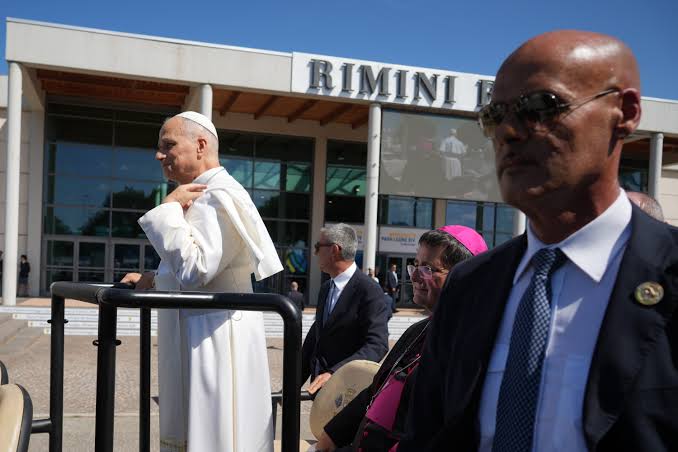
«Even today, peace is guarded and spread by people who love to meet one another and are not afraid to engage in dialogue». Pope Leo XIV’s address at the Rimini Meeting, delivered before thousands gathered in the Fiera’s Grand Auditorium, began with peace and the ability to encounter others.
It was a highly anticipated speech, not least because of the historic significance of the Pontiff’s presence at the Rimini gathering: 44 years had passed since a Pope last addressed the Meeting. Leo XIV touched on themes of fraternity, social friendship, war and inequality, extending his reflection to the role of the economy and technology, with a direct appeal to personal and collective responsibility.
The first part of his address was devoted to human encounter and the possibility of building, through dialogue, a form of coexistence capable of overcoming divisions and conflicts. In this context, Prevost recalled the teaching of his predecessor, Francis.
«Pope Francis, through his encyclical Fratelli Tutti, taught us to cultivate social friendship, which represents the public, dynamic and concrete face of fraternity. By recognising ourselves in our dignity as children of God, we come into contact with what originally unites all human beings, beyond every difference, separation or conflict», said Leo XIV.
From there came his call to place the person above allegiances and divisions: «We can put ourselves in each other’s shoes, listen to one another and become friends — between individuals and therefore also between peoples. Before borders, definitions and institutions, there are always people».
The Pope: «Some rekindle dreams and visions»
The speech then turned to the tensions running through the present moment and the risk that fear, mistrust and division might become fertile ground for further conflict.
«Let there not only be those who fan the flames of exhaustion and despair; let there also be those who rekindle dreams and visions! The two paths are incompatible, because one exploits division, alienation and despair, while the other serves the Kingdom of God and his justice», the Pontiff warned.
These words were followed by one of the sharpest passages of the address, aimed directly at the mechanisms that govern society, labour and the economy.
«Let us free coexistence from suspicion, culture from arrogance, education from ideology, work from the idolatry of profit, technology and finance from the business of death», Leo XIV declared.
For the Pope, change must also involve the structures and organisations within which each person operates. «Starting with the organisations we have created and in which we work, let us expose the unjust power relations that lie at the root of poverty and inequality, of war and environmental disaster. Let us disarm technological development when it becomes pervasive and destructive».
He then made an appeal to individual responsibility: «We need courageous pioneers, who begin with their own change of course to make the conversion demanded of everyone convincing and credible».
«There can be no enemies»
In the part of the address most directly concerned with war and the divisions marking the international scene, Leo XIV also warned against language and a culture that end up preparing the ground for conflict.
«To the false realism that rearms minds, words and nations, Catholic culture today must oppose the realism of mercy, for which there can be no enemies, and all people — even adversaries — are brothers and sisters to be looked in the eye and met in truth», he stated.
This is a perspective which, in the Pontiff’s words, does not mean ignoring evil, but confronting it by starting with a profound examination of one’s own choices.
«Sin exists, certainly, but Christ’s redemptive love is stronger, and it calls us to purify our thoughts, interests, habits, relationships, projects, investments — every aspect of life — from all that the culture of power has contaminated».
In his address at the Meeting, Leo XIV thus linked the building of peace to everyday economic and social choices, calling for resistance to the power relations that generate poverty and inequality and for a halt to technological development whenever it becomes destructive. Underlying it all was the principle the Pontiff put forward as the starting point for rebuilding relationships between individuals and peoples: before borders, definitions and institutions come people.