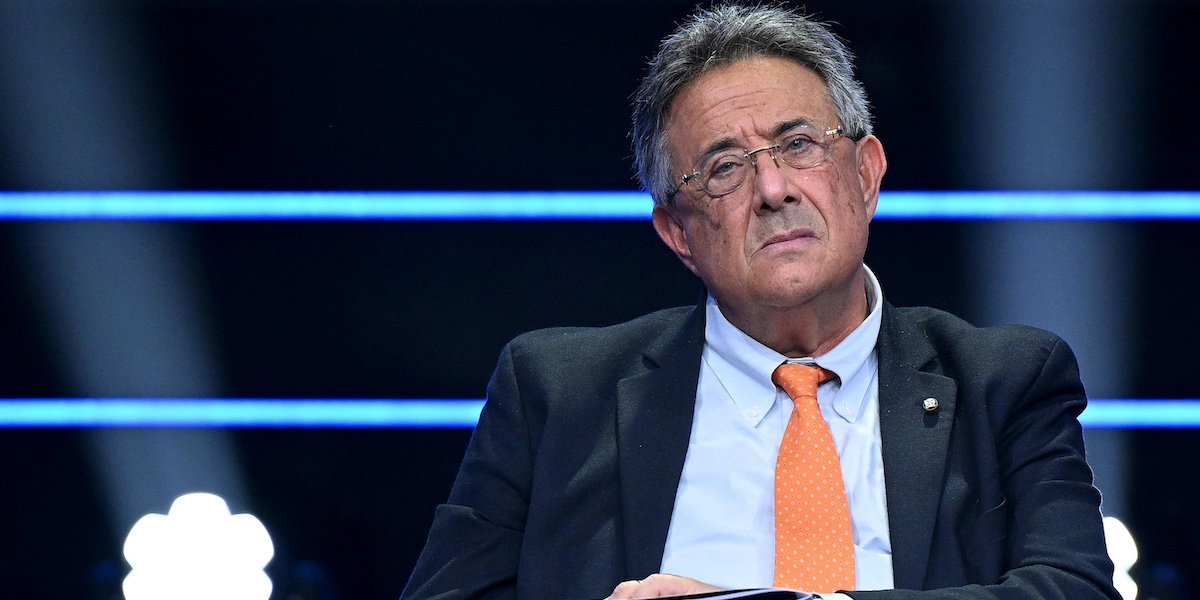
On the afternoon of Wednesday, 28 October 2026, during a sitting of the Standing Council Committee on Foreign Affairs, Emigration and Immigration, Security and Public Order, and Information, the director general of San Marino RTV, Roberto Sergio, answered questions from committee members.
Below is the second part of his remarks, reported in full.
Director General Roberto Sergio: First of all, I thank you for the various words of appreciation expressed in the earlier contributions. You evidently appreciated a number of actions that I tried to describe in my report.
Let me give a few answers: on the industrial plan, we’ve already covered that. While the chairman was speaking, I received the exact figures on staffing, so I can now give you a precise number.
Staff numbered 64 units when I took office, in November 2024. Today, following retirements and the subsequent public selection process, we stand at 71 employees.
Not only have we not laid anyone off, but we have replaced those who retired and increased the workforce to 71 people.
Currently, San Marino RTV’s employees comprise 45 Sammarinese and 26 Italian nationals. I believe this was the answer you were expecting.
As for my own position, please bear in mind that the person before you today spent twenty-two years inside RAI and held every possible position of responsibility within the company: I was simultaneously chairman and chief executive, and later director general.
What I’m telling you today therefore stems from an in-depth knowledge of a reality that is sometimes misrepresented, including by the Italian press.
You won’t be surprised to hear that appointments to RAI’s board of directors, like those of many public boards, are political. This means that board representatives are allocated among various parties. The dynamics between parties often lead to debates and public positions that are not consistent with what subsequently happens.
Let me give you an example: the confirmation of my appointment. I should clarify that RAI does not appoint — RAI nominates, while RTV appoints, and it is RTV that can terminate a role which, under the company statute and shareholder agreements, has no fixed term.
The nomination was approved by a majority of five to two, with a favourable opinion from all three members of the board of auditors and from the Court of Auditors magistrate. Three opposition representatives and two majority representatives voted in favour of confirmation.
This means that, within Italian political dynamics, two majority parties chose to vote against, even though everyone — myself included — knew I would remain in the role regardless. Everyone knew this, except for those newspapers that wanted to suggest there were doubts about my continuing in the post.
Since I was appointed by RTV, it could not be RAI’s decision to change me: that decision would have had to come from RTV, exercising its own autonomy, by voting no confidence in me on grounds which, in light of what we’re discussing here today, I don’t believe would hold up. So I intend to stay.
RAI’s board resolution states that the next board will take up the matter of the nomination again. The current board’s term expires in June 2027, meaning a new board could take office either before the summer or, more likely, after the elections that will have taken place in Italy by then — so around October-November 2027.
Reasonably speaking, since I have no intention of resigning, I believe I will remain in post at least through the whole of 2027. What happens after that we’ll see when the time comes, because frankly I wouldn’t want to impose on either myself or you the idea that I must continue indefinitely.
The relationship with RAI is a relationship, not a bond. As San Marino RTV, we have no binding constraints of that kind.
We have a 50% shareholder that appoints three board members, on equal footing with ERAS, the Republic of San Marino’s state company. The chairman has a casting vote in the event of a tie, so the Republic of San Marino, through ERAS, effectively holds a majority on the board.
There are no constraints — there are important relationships, which must be held in high regard.
I can also reassure you on another point. It’s true that my dual role may have contributed to the better results achieved along this path.
However, I can assure you that these results will hold even going forward, even without my holding that dual role, because everything that has happened is above all the product of a history, a trajectory and a network of relationships within the company and across the wider Italian broadcasting world — relationships that created opportunities which we then put to use.
What’s the challenge now? To make these opportunities structural — opportunities born at a time when I held a dual role and could have an impact regardless of my own person. To ensure that the company’s solidity can continue even through a change of leadership, should one occur, ideally with someone possessing similarly broad competencies.
If we were to go back to having purely journalistic rather than managerial skills at the helm, it’s clear we could slip back into less desirable situations.
I happen to have, for better or worse, the fortune — or misfortune — of being both a manager and a journalist. By now, we all care a great deal about this broadcaster.
As for the trade union communication and the complaint we just discussed, shortly afterwards I met with the signatories, we talked at length, and I demanded a strictly independent and pluralistic approach. As they recounted the facts to me, I did not find, in those same people who had signed the statement, the same level of tension they had expressed in writing.
They then raised a broader point: that when a press release arrives, there’s an expectation it will be published immediately, or that a headline isn’t right and should be changed. So I asked: is this interference from the majority, or from the opposition as well? Because it sometimes happens with opposition statements too.
I demand that journalists be independent and answerable to no one. It must also be said that some individuals, due to personal and historical ties, may tend to favour one side over another.
What I don’t like is this: that people who, in this company’s history, also have ties to political parties might take up the causes of those parties at the expense of their own journalistic independence. That is something I do not like.
Beyond that, I am simply giving instructions to ensure total independence and that pluralism is always guaranteed. In Italy, within RAI, there’s a well-known saying: 30% to the government, 30% to the majority, 30% to the opposition. That means 60%, in some measure, aligns with the majority.
I instead demand equal dignity — so much so that all the programmes we’re producing, including the new ones we’re putting on air, must feature representation from both majority and opposition. Both voices must always be present, so that there is genuine, pluralistic debate.
Of course, when the government puts out content or events occur that need to be communicated, this adds airtime beyond what the traditional majority receives. I will carry out a precise check of the minutes allocated within San Marino RTV, though I don’t believe the ratio is sixty-forty either.
I believe the balance between opposition and majority is better than that. We will verify this, so that I can give you a more precise and accurate answer next time.
Turning to the millions of contacts for the San Marino Song Contest: I’m not talking about likes, I’m talking about Auditel ratings, certified figures provided by accredited bodies that tell us how many people, at a given moment, listened to that message, watched that broadcast, or heard Carlo Conti talk about the San Marino Song Contest during the Sanremo Festival. I am not talking about likes, which are a different matter altogether.
I’m talking about advertising contacts — the kind that translate into commercial revenue. Sometimes people talk about likes or Instagram, as I did when discussing the Pope, but when we talk about the San Marino Song Contest, we’re talking about something else entirely, something with certified, serious, substantial value.
I’ve just said that I need to deliver important products and output, because we provide a public service without burdening the State. I therefore have to turn to the world of communication and advertising to cover costs.
But I’m not the only one who does this. When the Holy Father attended the Meeting for Friendship and the footage — both ours and RAI’s — covered the visit, we saw a whole world of advertising around the Pope: Banca Intesa first, then Enel, then Eni. All the Meeting’s sponsors were highly visible whenever the Pope passed by.
The same thing happened with BYD, with whom we have a commercial relationship to support this broadcaster and avoid further requests for public funding. I don’t want those requests, because I believe this broadcaster should be self-sustaining.
In that specific instance, during the Pope’s passage, one image showed a sponsor placed in a corner of the frame. It’s part of the commercial dynamics of a broadcaster that doesn’t live on public funding alone, but must also generate commercial revenue.
I don’t believe the Vatican took offence, just as it didn’t take offence at the visibility given to sponsors at the Meeting. I therefore consider this a commercial policy that makes sense and deserves further exploration.
I can confirm that the agreement with BYD had nothing to do with either the Foreign Affairs secretariat or Secretary Fabbri. It arose from my own personal relationship with the company’s chief executive, whom I wanted to involve not only in this project: he will also be involved in the San Marino Song Contest and as a supporter of many other initiatives.
What else is missing? Ah, I have no salary. I do this for free.
My predecessors were not paid by RAI, but by RTV. RTV reimbursed RAI the €240,000 for Vianello’s salary — RTV paid it. The director general of RTV’s salary has never been borne by RAI: RAI disbursed it, and RTV reimbursed the amount.
In my case, since I am also director general of RAI, the maximum amount reimbursed has been equivalent to one month’s salary — around €20,000 in the budget. I arranged for only a single month to be counted, given that I was not here on a daily basis, though I could also work remotely, using RAI’s facilities.