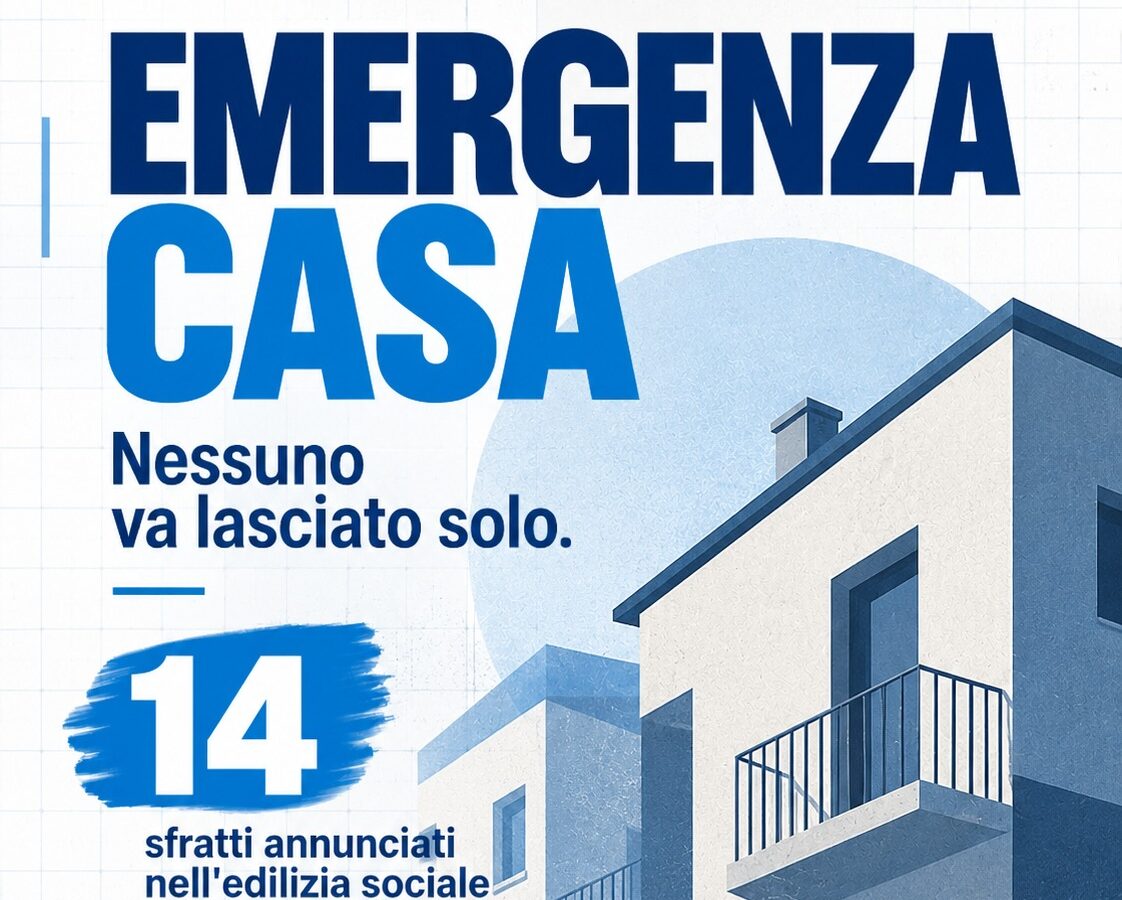
Fourteen evictions from social housing units are due to take place in the coming weeks, raising fears that some families could be left without any alternative housing solution.
This is the alarm raised by the Confederazione Democratica Lavoratori Sammarinesi (CDLS, Democratic Confederation of Sammarinese Workers), which is calling on the institutions to intervene urgently by revising the criteria for the allocation and continued occupancy of public housing, and by reviewing the financial circumstances of those affected by the measures.
At the heart of the issue are families who, despite having an income from work, do not earn enough to cope with private housing market prices. These so-called “working poor” risk being excluded from public housing without having the financial means to rent a home at market rates.
“The prospect of 14 evictions from social housing in the coming weeks raises a question San Marino can no longer put off: what happens to families who no longer meet the requirements to keep public housing, but lack the resources needed to access the private market?” the CDLS statement reads.
The union does not dispute the need to periodically verify tenants’ eligibility, both to ensure the proper use of public housing stock and to protect those still waiting for a home.
However, it is calling for assessments that do not rely solely on income, but also take into account household composition, the presence of minor children, dependants requiring care, and genuine conditions of vulnerability.
One of the most contested points concerns the annual household income threshold of €20,001, set out in the draft law “Support Measures for Social Housing” as the limit for remaining in public housing.
According to the CDLS, this threshold should be periodically updated to reflect inflation, the loss of purchasing power, and rising housing costs. A nominal pay rise, the union notes, does not necessarily mean a family has more disposable income, especially when rent, utility bills and other essential expenses absorb most of their earnings.
“A nominal increase in income does not necessarily translate into better living conditions, particularly when essential expenses absorb a significant share of family earnings,” the Confederation stresses.
The union also criticised the €250 monthly housing allowance provided under the same draft law for those renting private accommodation at a monthly rate not exceeding €750.
The CDLS agrees in principle with the idea of financial support, but believes the rent cap is no longer realistic given current prices on the Sammarinese market. Compounding the problem are upfront costs, which are often difficult for those with limited financial means to cover.
Security deposits, potential estate agency fees and advance rent payments can represent an obstacle even before the first month’s rent is paid.
For this reason, the union is calling for an increase in the maximum rent eligible for the allowance, as well as the introduction of additional support measures to help cover the costs of moving into a new home.
In the immediate term, priority must be given to the fourteen cases currently facing eviction. The CDLS is urging a case-by-case review, with particular attention paid to the most vulnerable families, and is asking authorities to assess — where permitted by law — the possibility of postponing eviction and supporting those affected in finding an alternative solution.
“In cases of demonstrated hardship, it is necessary to consider, within the limits allowed by law, postponing the handover of the property and to activate concrete support pathways towards alternative solutions,” the statement reads.
The union is also proposing the involvement of relevant social services, the activation of possible financial support, and guarantee mechanisms that could make it easier for tenants to sign new rental contracts.
Another key issue concerns the public housing stock. Before proceeding with evictions, the Confederation argues, there should be an up-to-date overview of available properties and their potential uses.
Specifically, the CDLS is asking for a review of properties owned by the Eccellentissima Camera (the State) that are currently leased to private parties, to determine whether any could instead be used for social housing purposes.
The Confederation acknowledges the value of structural projects already underway or in development, such as cohousing initiatives, the renovation of vacant properties, and the redevelopment of unfinished buildings. However, it points out that these solutions require timeframes incompatible with the urgency faced by those at risk of losing their homes in the coming weeks.
“The timelines of structural policies do not match those of families who risk losing their homes today,” the union observes, calling for long-term programmes to be paired with immediate measures to prevent new cases of housing hardship.
Hence the call for urgent talks with the institutions, addressing simultaneously the fourteen announced evictions, the review of income thresholds, and the management of public housing stock.
“An effective housing policy cannot simply determine who is entitled to a home: it must also consider what concrete prospects exist for those at risk of losing one,” the CDLS concludes.