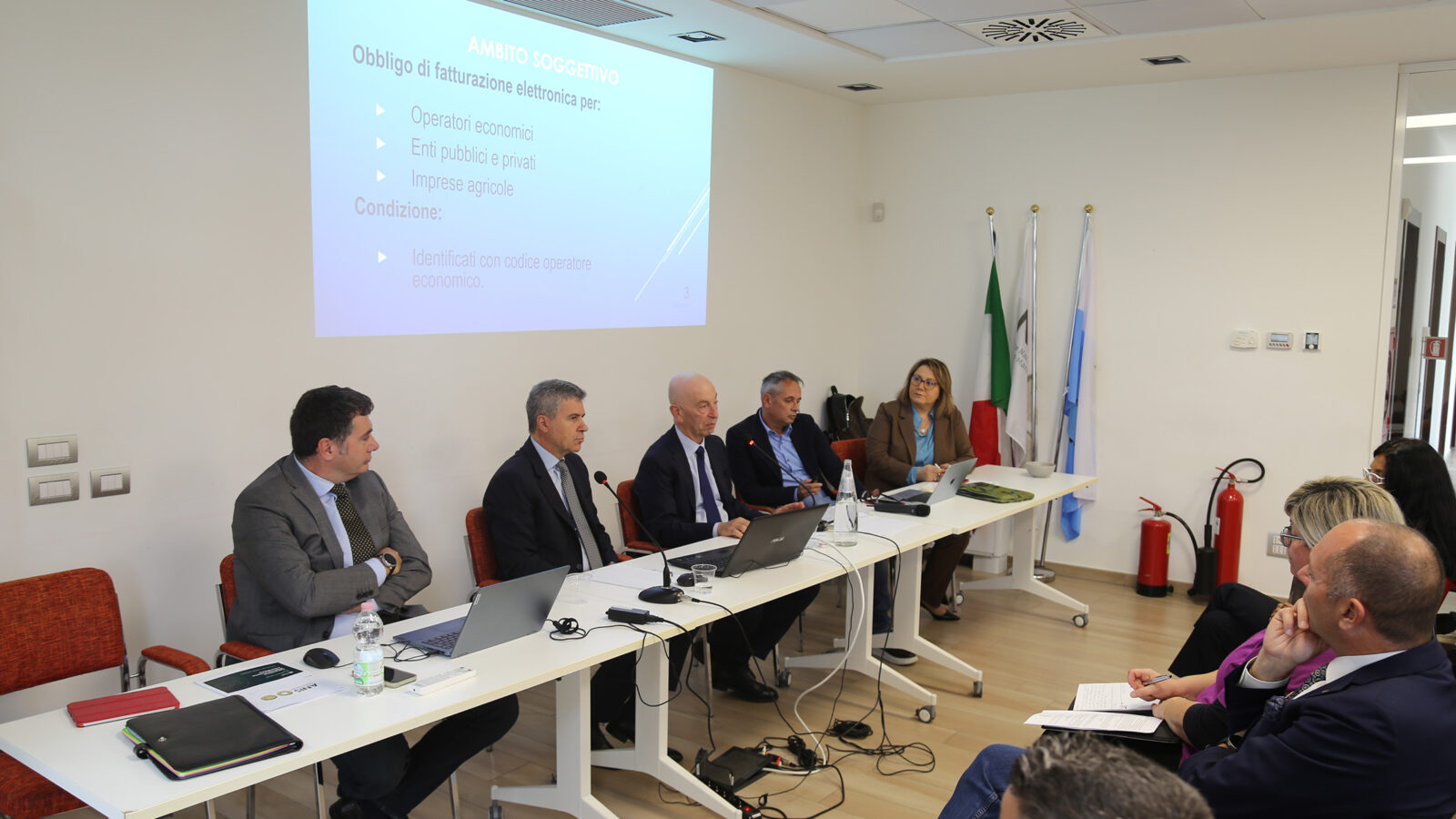
More than 160 participants, split between a morning and an afternoon session, attended the seminar on domestic electronic invoicing held on Wednesday, 21 October, at the headquarters of ANIS (National Association of Industry) for member companies. The meeting focused on the rules governing transactions between San Marino-based operators and the technical steps required to prepare and transmit invoices.
Speakers included Gianpaolo Giuliani, advisor to the Secretariat of State for Finance, who addressed the regulatory framework; Davide Casadei Valentini of Kreosoft, who covered the technical and operational aspects; and Fabrizio Cremoni, tax expert and ANIS consultant.
During the seminar, speakers used concrete examples to illustrate Delegated Decree no. 133 of 2026, which regulates the issuance of invoices for transactions between parties holding an Economic Operator Code (COE). “These are operations in the broad sense — not only the sale of goods and services — and there are no territorial restrictions even when such sales take place in another country, provided they remain between San Marino operators,” the association clarified in its statement.
Part of the meeting addressed which entities are covered by the new rules and which are exempt. “The legislation applies to economic operators, agricultural businesses and other entities identified by the decree, but it also provides for an important exclusion: small businesses, meaning those that declared revenues below €100,000 in the previous calendar year.”
Companies below this threshold may opt in voluntarily through a specific election. However, doing so means committing to the system long-term: “These businesses may still choose to voluntarily adopt the new system through a specific option, but — just like companies that later exceed the revenue threshold — they cannot subsequently opt out and will remain within the mandatory digital regime.”
Public bodies and the public administration are currently excluded, pending specific implementing measures. As ANIS explained, “as customers, they will nonetheless be able to receive electronic invoices for services provided by private businesses.”
On the operational side, the experts reviewed the process from preparing the document in XML format to transmission to HUB-SM. This final step is crucial for meeting the deadline, which falls within two months of the transaction. “Naturally, if HUB-SM’s checks detect errors leading to rejection, the invoice is considered not to have been issued,” the statement notes. Hence the advice given to businesses: “carefully plan your production and transmission timelines, and don’t wait until the last days before the deadline.”
The system will be rolled out in phases. According to what was presented at the seminar, the obligation will take effect on 1 January 2027, while penalties will apply starting 1 January 2028. “This transitional period, participants were told, offers an opportunity to become familiar with the new procedures, including by using the simulator on TRIBWEB and the accompanying manuals.”
Many attendees raised specific cases with the experts and sought clarification on both regulatory and operational matters. The seminar slides will be made available in the members-only section of the ANIS website.