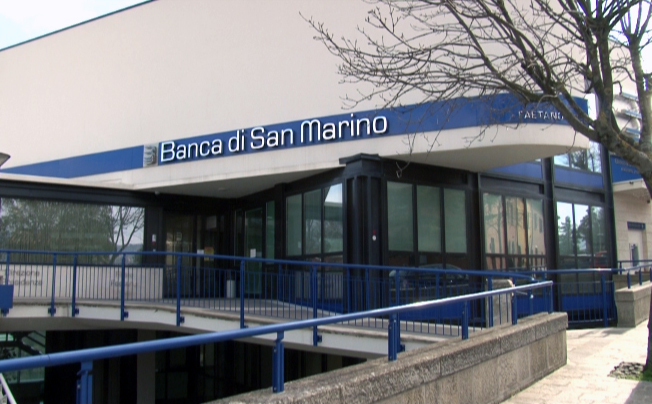
Seventeen lawyers, a packed courtroom and just two defendants present. The trial into the so-called Bulgarian affair opened before San Marino’s Tribunal — the judicial case born out of businessman Assen Christov’s attempt to take control of Banca di San Marino, which later expanded to include alleged pressure on the Republic’s institutions.
The proceedings involve seven individuals and two companies, IBC and San Marino Group, and already at the first hearing produced a sharp clash between prosecution and defense. However, the merits of the charges will have to wait.
Only Andrea Delvecchio and Franco Norri appeared in court. The other defendants were absent, including Bulgarian businessman Christov, represented by an unusually large legal team: seven lawyers, five of whom were present in the courtroom.
Norri’s case, in which he faces a single charge of perjury after the aiding-and-abetting allegation was dropped, was separated from the main proceedings.
The first hearing focused on preliminary matters, starting with the admission of civil parties. The defense raised several objections, but all requests to join the case as civil parties were accepted.
Among those now entitled to take part in the trial to pursue their claims are Banca di San Marino, Ente Cassa di Faetano, the Central Bank, the Financial Intelligence Agency, and the Most Excellent Chamber and the Congress of State.
At the heart of the investigation is, first and foremost, the attempted acquisition of Banca di San Marino by San Marino Group, a company linked to Christov. According to the prosecution’s reconstruction, the operation was allegedly accompanied by agreements and money transfers intended to facilitate the takeover.
One of the central episodes concerns €500,000 that Andrea Delvecchio — at the time a board member of Ente Cassa di Faetano — allegedly received through IBC, a company registered to his wife, Marina Manduchi.
Investigators believe that sum was payment to facilitate the Bulgarian group’s entry into the San Marino bank. The money is said to have come from the holding company Starcom, linked to Christov himself, channeled through a Bulgarian law firm.
It wasn’t just money. Delvecchio was also allegedly promised a future appointment as the bank’s director as part of the acquisition plan.
These are the circumstances underpinning the charges of private corruption and disloyal administration, for which Banca di San Marino and Ente Cassa di Faetano have joined the case as civil parties. The allegations will of course have to be proven during the trial.
But the case is not limited to the attempted bank takeover. A particularly sensitive part of the investigation concerns the so-called “parallel plan,” allegedly set up after the financial operation collapsed.
The takeover attempt had stalled after the Financial Supervisory Authority blocked it, followed by the seizure of the €15 million Christov had paid as a deposit.
At that point, according to the prosecution, a different strategy allegedly came into play, aimed at putting pressure on the San Marino authorities involved in the investigation.
This is also the context for an alleged media campaign said to have been intended to influence the institutions and undermine San Marino’s path toward association with the European Union.
It is on this front that the charge of undermining the freedom of public authorities has been brought — one of the most significant counts in the proceedings.
For this charge, the Most Excellent Chamber and the Congress of State were admitted as civil parties, represented by attorney Simona Ugolini of the State Advocacy Office.
There is also a further chapter, concerning certain press articles deemed offensive toward public officials. For this part of the proceedings, which involves the charge of offending a public official, the Central Bank and the Financial Intelligence Agency were admitted as civil parties.
The first hearing, however, was dominated mainly by procedural challenges. The defense teams contested several elements of the investigation, raising objections that the judge must examine before proceeding to the taking of evidence.
One point concerns the wording of the charges. According to the lawyers, some counts are too vague, making it difficult to pinpoint exactly what conduct is being alleged and to prepare an adequate defense.
Another point of contention involves the forensic examinations carried out on Delvecchio’s and Manduchi’s electronic devices. The defense disputes their validity and is asking for the related procedures to be declared null.
Also significant is the question of telephone and environmental wiretaps, which the defense is seeking to have ruled inadmissible. In essence, they argue those recorded conversations cannot be used as evidence in the trial.
The challenge extends to San Marino’s legislation governing wiretaps. Lawyers for the two spouses have raised a question of constitutional legitimacy, arguing that certain provisions of the law violate the principles of the right to defense.
This is far from a secondary issue, since rulings on these objections could affect what evidence may ultimately be used during the trial.
It will fall to Law Commissioner Adriano Saldarelli to resolve the issues raised by the defense. The judge has decided to give the parties time to file their briefs and further examine the preliminary matters.
The next hearing has been set for December 10. Only after rulings on these objections can the case move to the next phase — the submission of evidence requests — and address the substance of the charges relating to the attempted bank takeover and the alleged pressure on San Marino’s institutions.