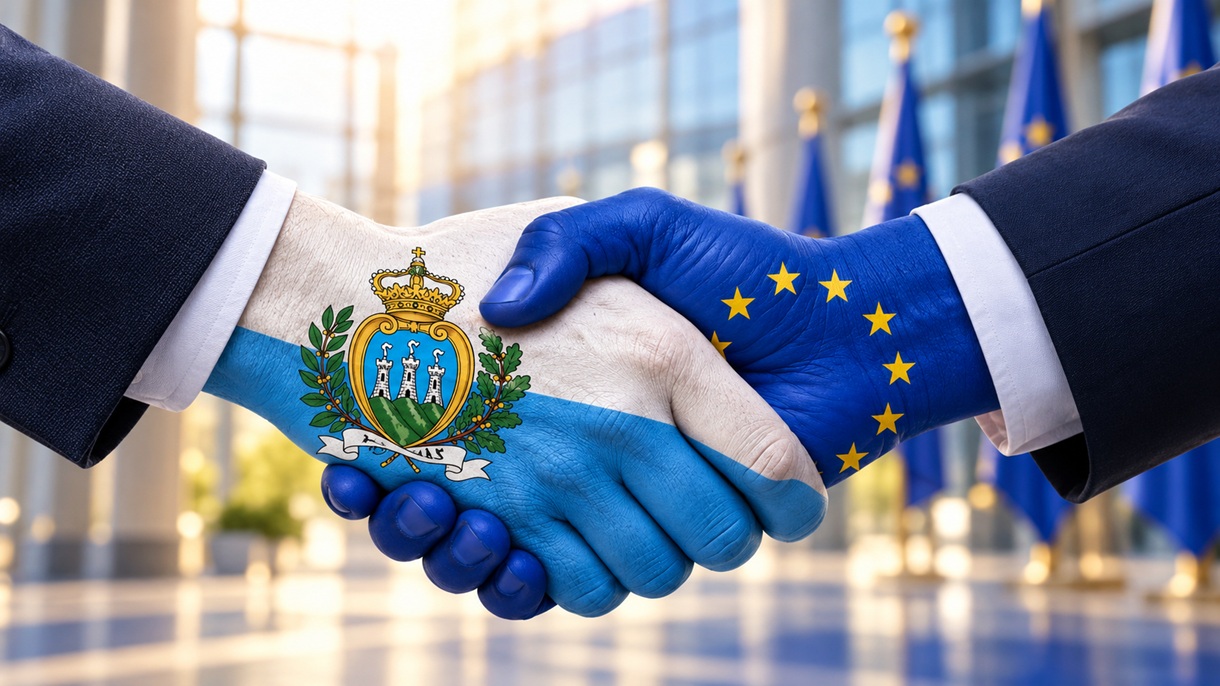
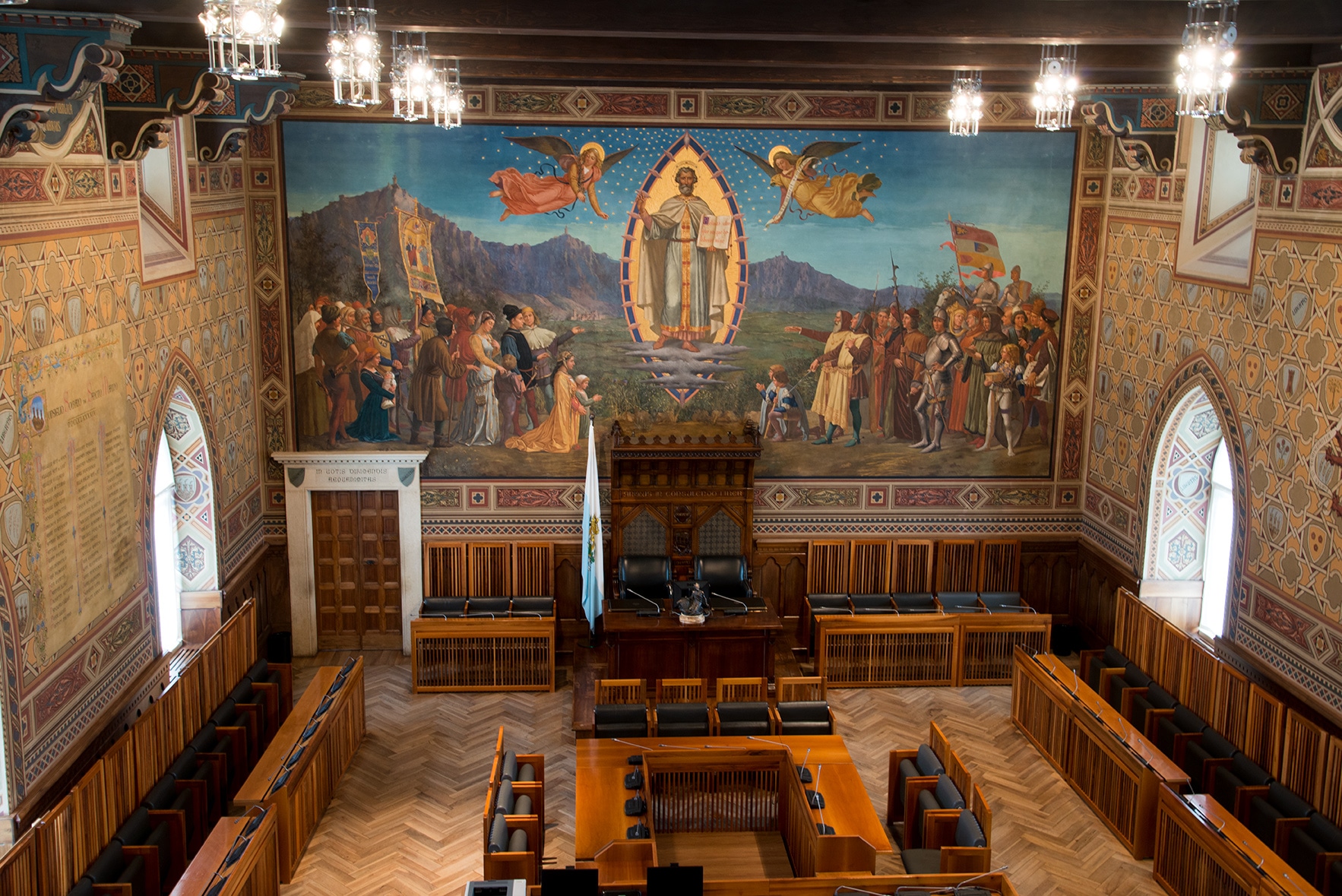
A historic signature, a new relationship with the European Union, and a fresh chapter opening for San Marino’s future. Following Monday’s milestone in Brussels, the Grand and General Council (Consiglio Grande e Generale) reconvened on Wednesday, October 21, with the association agreement at the center of political debate. The mood was one of cross-party recognition of the achievement, even as parliamentary forces expressed differing views and sensitivities about the road ahead. Discussion focused above all on how to turn the agreement into tangible opportunities for citizens, businesses and future generations.
The session was opened by the Captains Regent Gerardo Giovagnoli and William Casali, who stressed the institutions’ responsibility toward the Republic’s future. The agreement, they noted, “is not the finish line of a journey, but the start of a new season.” A passage that demands renewed political commitment, capable of steering economic and social change and building “a genuine pact with citizens.”
The government is now moving to speed up the institutional process. Secretary of State for Internal Affairs Andrea Belluzzi announced his intention to bring the agreement forward for ratification at the Council’s next available session. This opens a phase of work that will involve the public administration, government offices and Parliament, all tasked with aligning San Marino’s regulations with those of the EU.
“The Association Agreement means no longer being discriminated against,” Belluzzi said, pointing to new prospects for the economic system and for citizens. Among his priorities, the secretary listed staff training, the reorganization of public offices, and the use of new technologies—including artificial intelligence—to improve the efficiency of public services.
Among the most significant outcomes highlighted was access to the European single market under more favorable conditions and shared rules. A change expected to benefit businesses, professionals, students and all those looking to expand activities and projects beyond the Republic’s borders.
Matteo Rossi of the PSD traced San Marino’s long path toward international institutions, from joining the Council of Europe to its removal from blacklists—a journey supported over time by various political forces and now reaching a decisive turning point. “We thought about the future,” Rossi said, framing the choice as one made above all in the interest of young people and those seeking new professional opportunities.
Giuseppe Maria Morganti of Libera identified reciprocity as one of the central elements of the agreement. San Marino citizens will be able to benefit from rights and protections within the European market, overcoming some of the disparities that have long characterized relations with EU member states. “A privilege that is actually not a privilege, because it isn’t one for European citizens—and for us, it finally becomes a right,” he observed.
The councillor also underlined the agreement’s political significance, calling it the most important achievement of the legislature, and pointed to Europe’s role in upholding international law and social rights.
Silvia Cecchetti of the PSD focused on the economic outlook. She pointed to the removal of trade barriers, the introduction of a VAT system, relations between the Central Bank and the Bank of Italy, and the evolution of the financial sector as key areas for development. The councillor recalled her party’s longstanding support for the European path, “without fear, even paying a political price for this uncomfortable—because visionary—position.”
For Luca Della Balda of Libera, opening up to the European market represents a chance to showcase the skills and competitive strength of the San Marino system. The councillor used the image of moving from fishing in Faetano’s lake to fishing on the open sea to illustrate the change in market scale. “What makes the difference in deep-sea fishing is the equipment and who uses it,” he said, pointing to training and professional quality as the tools needed to seize the new opportunities.
The question of the country’s readiness also ran through the opposition’s remarks. Carlotta Andruccioli of Domani Motus Liberi acknowledged the historic nature of the signing but stressed the importance of carefully organizing the implementation phase, from staffing levels to the public administration’s skills.
“Opportunities must be built, not simply proclaimed,” the councillor said, borrowing the metaphor used by the Captains Regent to explain that an ambitious project requires “a well-equipped shuttle, a clear course, and a prepared crew.”
Nicola Renzi of Repubblica Futura urged lawmakers to focus on results citizens will feel directly. Among his examples were access to international financial services and digital platforms; he asked the government to identify an initial set of concrete benefits and to clarify the timeline for regulatory alignment and any provisional application of the agreement.
Another issue concerned public involvement and the possibility of a referendum. Mirko Dolcini of Domani Motus Liberi described a popular vote as a tool to strengthen democratic participation and the legitimacy of decisions. The councillor also asked for an estimate of the resources needed to upgrade public administration and oversight bodies.
Gaetano Troina, also of Domani Motus Liberi, cited Andorra’s experience and stressed the need to give citizens thorough information before any referendum. “It makes no sense to hold a referendum with the data we currently have,” he said.
Dalibor Riccardi of Libera instead stressed the institutions’ responsibility in managing the European process. The councillor noted that association does not mean giving up San Marino’s independence, but can become a tool to strengthen the Republic’s capacity to operate internationally. “The real urgency is to understand, analyze and manage the concrete effects this agreement will produce,” he said.
The preparatory work will also directly involve the Grand and General Council. Lorenzo Bugli of the Christian Democratic Party (PDCS) called for stricter planning of parliamentary activity, with a work schedule able to anticipate legislative needs. “There can be no more room for improvisation,” he said, pointing to the work awaiting committees and councillors alike.
Oscar Mina, also of the PDCS, said it was essential to accompany the agreement’s implementation with ongoing dialogue with the public. “The real challenge starts now,” he said, highlighting the value of public meetings and information initiatives.
Michele Muratori of Libera cited a University of San Marino survey finding that 33% of San Marino residents still do not understand the difference between association and full EU membership. According to the councillor, this makes a more far-reaching communication effort necessary. Muratori also highlighted the opportunities offered by territorial cooperation and the future Parliamentary Committee that will bring together San Marino and European representatives.
Michela Pelliccioni of the Mixed Group also voiced her support for the European path, recalling that she chose to become an independent councillor specifically to help advance this goal. “Signing was important, but knowing how to implement what we signed will matter even more,” she said, naming the strengthening of the banking system and cooperation with neighboring territories among the priorities.
Giovanni Francesco Ugolini of the Christian Democratic Party linked the European milestone to the economic stability the Republic has achieved. The improvement in public accounts, credit rating and international credibility was described as a foundation from which to pursue new investment. Among the sectors to focus on, he named financial services, wellness tourism, the art market, startups, trusts and cryptocurrencies, with particular attention to opportunities for young people.
The debate also touched on the population’s economic and social conditions. Giovanni Maria Zonzini of RETE drew attention to wage purchasing power, rental costs, and the hardships pushing some young people to seek prospects outside the Republic. Andrea Menicucci of Repubblica Futura, meanwhile, argued that a state’s sovereignty is also measured by its ability to guarantee citizens economic autonomy, access to housing, and adequate healthcare services.
The next step will be the agreement’s passage through the Council for ratification. From that point, work will focus on legislative alignment, preparing government offices, and identifying the first opportunities to be made operational—a process that will involve the government, Parliament, the public administration and the economic system, all tasked with turning the diplomatic achievement reached in Brussels into concrete change for San Marino.