“We thought about the future, about the young people who are leaving San Marino in search of one.” That was one of the key passages in the speech delivered by PSD councillor Matteo Rossi during the communications session of the Grand and General Council (Consiglio Grande e Generale). At the centre of his remarks was the signing of the Association Agreement with the European Union — described as a historic turning point for the Republic — and recognition for all those who worked to achieve this milestone.
The full speech by Matteo Rossi (PSD)
As always happens at the start of a new term, I wish Their Excellencies a fruitful and excellent semester ahead. I’d like to borrow some of your own words as an introduction to my remarks, because I believe they are extremely fitting. I’m referring to the theme of our responsibility towards future generations, and to what His Excellency Casali touched upon at the end of his speech, when he stressed that it is not up to us to decide for those who will come after us. We must be capable of understanding how the world is changing and what kind of future would be best, but it is not for us to clip the wings or close off paths for those who will follow.
I believe this point is extremely significant for what we are called to do today, in this first session of the Grand and General Council held as a country that has signed the Association Agreement with the European Union. This is a historic first Council session, because it coincides with an event that all of us — or at least the vast majority of this Parliament — have awaited for many years. An event for which, I must stress, the overwhelming majority of this Parliament has built government programmes, fought election campaigns, and governed — because we have all, at one time or another, been in government — and so that signature has finally arrived.
That signature today comes as the culmination of a vision of the world, a vision of the future that, given the facts of our history and the milestones of our path as Sammarinese, can be divided into two parts. On one side there is a vision that looks only at pressing short-term needs and avoids paths that seem, at the moment, difficult, impossible or less advantageous. On the other, there is a path that bets on the future, that is capable of expressing a vision, of understanding how the world will evolve, and that therefore tries to push fellow citizens, public opinion and politics in that direction.
I consider myself very fortunate to belong to a party, the Party of Socialists and Democrats (PSD), which, since its earliest days, has had the European Union’s star right on its flag, in its symbol. A party born with a clear vision, a vision for the country, a vision that — at a time when it went against every prevailing trend — insisted that we had to integrate, because this country could no longer go on as it was. And we won that bet, thanks to the many men and women who were, and still are, active within the party.
But I’m also referring to those who, before this party was even founded, took fundamental steps forward. Let us remember the left-wing government and the year 1983, when San Marino, with Foreign Minister Giordano Bruno Reffi, obtained observer status at the Council of Europe. A hugely important first step. We thus left behind the period following Rovereta, which had made protective friendships and direct relationships with individual allies the foundation of our foreign policy, and we began embracing the idea of multilateralism. This was a fundamental turning point and deserves to be remembered today, on such an important day.
In 1983, diplomatic relations with the European Union began; in 1991 came the cooperation agreement and the customs union; in 1992, accession to the United Nations. San Marino has not been an isolated country for a very long time now. San Marino took this path with great determination, thanks to important figures who had vision.
Unfortunately, we also made mistakes, and this must be acknowledged. The greatest of all, as highlighted by the Commission of Inquiry, was the failure to sign the agreement with Italy in 2005–2006. That was the most drastic error, because it represented the first step towards integration into a much broader system. A mistake that led to blacklisting, economic crisis, unemployment and a loss of direction, because, clearly, we were adrift.
Then came 2007, with the letter to [European Commission President José Manuel] Barroso, requesting the start of an accession process. Another fundamental moment was San Marino’s presidency of the Council of Europe in 2007, from which the Republic emerged to applause, demonstrating on the great international stage, to the entire world, its worth and the importance of its presence, despite being one of the smallest states on Earth.
Then there was a crucial turning point in 2010. We were in the harshest period of the blacklists. It’s clear that, once you send [then Italian Foreign Minister] Fini home, Italy’s reaction towards San Marino was brutal. In 2010, as a party, we decided — from the opposition — to support the government of the day, led by the Christian Democrats, in order to undertake what became a true paradigm shift. A change that later bore fruit.
It took time, but that is where San Marino’s new future began — the change in pace, the abandonment of the old paradigms of corporate anonymity and banking secrecy. All of this led, in 2014, to our removal from the blacklist. We remember that moment well, and the joy we felt.
From 2014 to 2026, twelve years have passed, and San Marino has signed the Association Agreement. What are the benefits? The main benefit is the status of a State which, the day after signing the Association Agreement, hosted the Italian Joint Commission here in San Marino to discuss the future.
Think back to when we used to wait in the corridors of ministries, looking for some official who could give us an explanation, when we were still a small country living off the fortune of being able to say we handled invoicing or some other niche activity, and ending up on Italian satirical TV shows because of our affairs. Today we are a country that, thanks to this signature, saw the top figures of the Italian government arrive in San Marino the very next day to talk about the future.
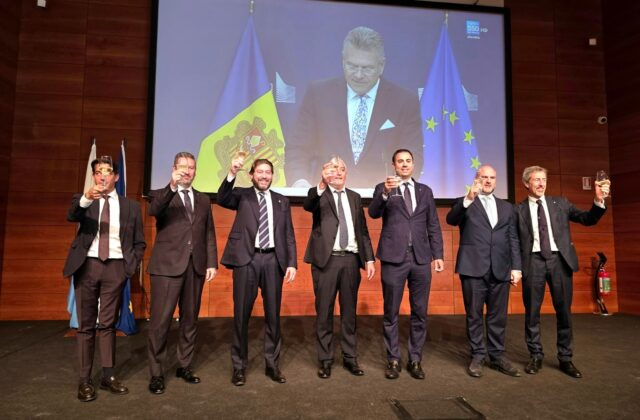
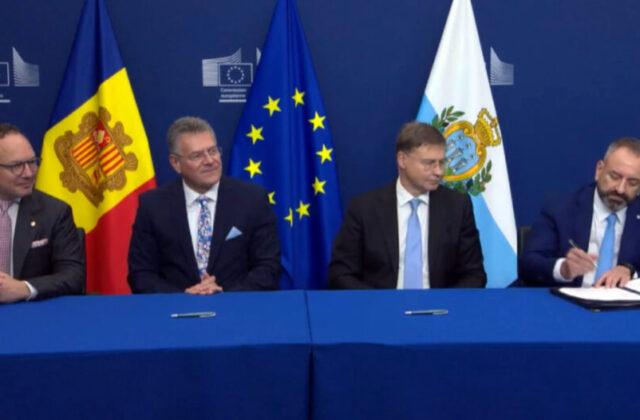
What have we become? What is this Association Agreement? This Agreement matters for us, but it also matters for Europe at this particular moment in history. Alongside our Secretary [of State] Luca Beccari — whom we congratulate for his tenacity, his vision and his strength in pushing forward even through extremely difficult political moments, and to whom we extend our solidarity and a handshake — stood two major figures of European politics. There was Maroš Šefčovič, who served as chief negotiator for the European Union. And there was [Valdis] Dombrovskis, the European Commissioner for the Economy, the man who holds the keys to Europe’s economy.
I rather enjoy these little quirks of history. In San Marino we have a street named Via Dombrovskis, home to the Directorate for Children and Nurseries. So, in a way, Dombrovskis already had a place in our history. Two major politicians, at the very top of the European Union, stood alongside our Foreign Minister and Andorra’s Foreign Minister to sign something that may seem small, but which in reality carries an incredible significance.
And this is happening at a historic moment when multilateralism and supranational organisations are living under the shadow of figures like Trump and Putin, and of the great economic powers. For the world, San Marino represents, in its own small way, a great note of hope and vision.
Look at what Canada is doing with the European Union. Look at England. England has had ten governments in ten years since leaving the EU, and young people there are now asking to rejoin, because the world is moving in that direction. Europe — to which San Marino is now associated — must have the strength to ensure that law and multilateralism prevail over arrogance and attempts at oppression, which then echo in the wars we are witnessing today, wars that certain actors are waging around the world.
So what has Europe shown? Europe has shown that, even in a moment like this, it managed to take its grand European garment and tailor a bespoke version for the two smallest countries on this continent. It was an incredible effort. An Agreement that only we and Andorra have the privilege of holding — an Agreement that safeguards our prerogatives, our status as a small state, our economy, our history, while at the same time integrating us into that market.
So it will be the young people who should thank us — the young people for whom we took this step forward, setting aside what might once have been comfortable, vested privileges of the past, privileges that no longer exist. Clearly, some in San Marino still claim such privileges remain. We chose to think about the future.
We thought about the young people who are leaving San Marino in search of a future, because we want them to return to a country that is integrated, where there are many opportunities, many rights, many freedoms, and where no one has to feel ashamed to belong to the oldest republic in the world.
It is therefore with tremendous enthusiasm, on behalf of myself and the Party of Socialists and Democrats, that I wish to express our gratitude to everyone who worked to make this journey possible. Forza San Marino.