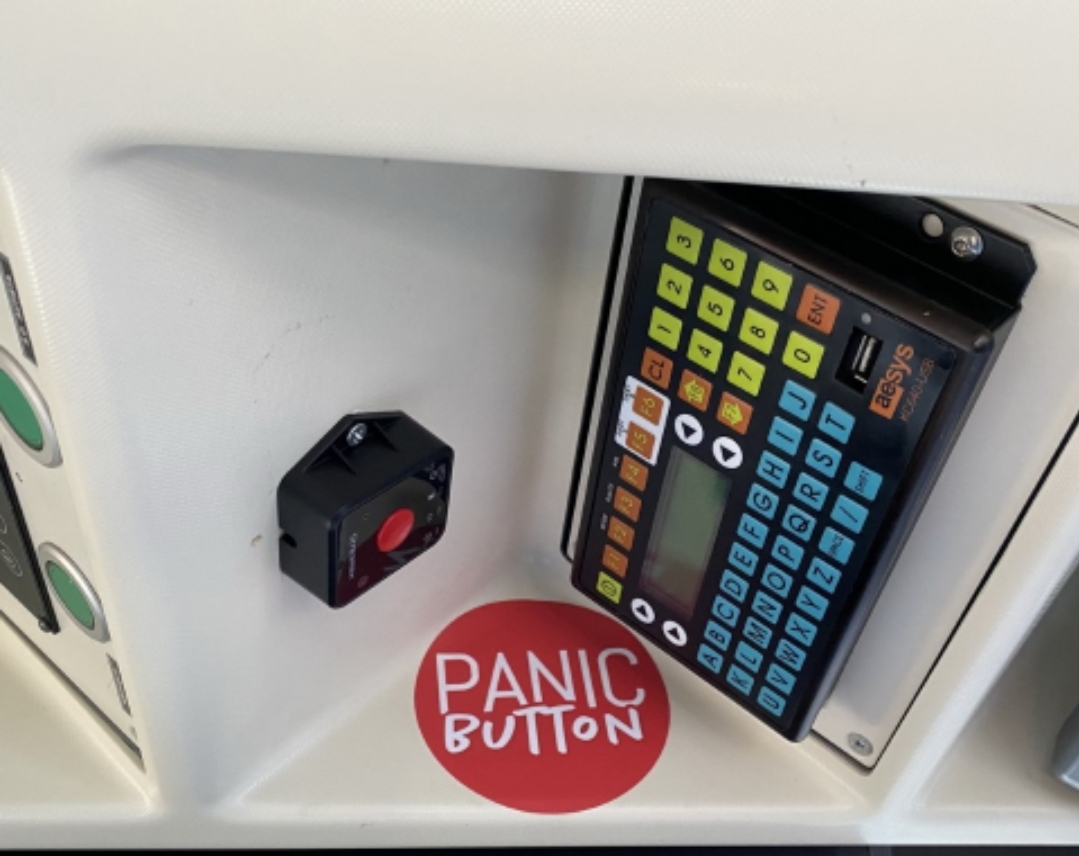
A button in the driver’s cab to alert police and carabinieri in the event of an assault, showing in real time what is happening on board the bus. In Rimini too, Start Romagna drivers will be able to rely on the “Panic Button,” a system that allows law enforcement to receive onboard camera footage, locate the vehicle and decide whether to dispatch a patrol. On Friday, October 9, the agreement was signed by the Prefecture, the Police Headquarters (Questura), the provincial Carabinieri command and the transport company.
The button is already installed on the buses. What is being extended to the Rimini area is the connection with police control rooms, following the model launched in Forlì-Cesena in 2021. The signing paves the way for activating the service in the Rimini network as well, where around 200 buses are already equipped with video surveillance.
The system works from the driver’s station. If an assault or a serious danger occurs on board, the driver presses the emergency button. The system immediately sends an alert to law enforcement and transmits footage from the internal cameras. At the same time, it communicates the bus’s position via geolocation.
Operators can thus see what is happening on the vehicle and know where it is, without having to wait to reconstruct the incident afterward. Based on the images and information received, police and carabinieri assess whether to send a patrol and where to direct it.
This is the central point of the agreement: connecting the driver with those managing the request for help. The cameras, already used to reconstruct assaults and vandalism after the fact, now also become a tool for following an emergency as it unfolds.
The technology follows the model of anti-robbery video alarms, used to protect businesses such as jewelry stores. In the case of buses, the vehicle’s location is added to the footage, which is essential for reaching a bus that might be at a stop or along its route.
The agreement sets out how the system will be introduced and the procedures for managing alarms. Costs will be covered by Start Romagna, while the use of footage will have to comply with personal data protection regulations. No specific date has been set for the connection to go live in Rimini.
The precedent in Forlì-Cesena dates back five years. In February 2021, the Panic Button was already operational on part of the fleet, as part of the “Safe Travel Bus” protocol, coordinated by the Prefecture with the involvement of the Questura and the Carabinieri. The button triggered an alarm at the Cesena control room and allowed the transmission of onboard footage and the bus’s location.
At the time, the project was also part of measures adopted during the health emergency, aimed at controlling crowding and ensuring compliance with public transport rules. Protecting drivers and passengers was already one of the system’s goals, which is now being extended to the Rimini area to allow for a faster response to dangerous situations.
“With the Panic Button, we are also bringing a cutting-edge tool to our buses in the Rimini area, adding an important piece to the work we are doing to ensure the safety of drivers and passengers,” said Andrea Corsini, president of Start Romagna.
The company highlights the investments made in recent years, from protective partitions for driver cabs to vehicle upgrade projects. “This is an issue we care deeply about and have chosen to invest in concretely, even anticipating ministerial regulations, as in the case of installing protective partitions in driver cabs and carrying out vehicle upgrades,” Corsini continued.
For Start Romagna, the new connection should also serve to discourage violence and vandalism. “Our goal is, on one hand, to respond in real time to emergency situations, and on the other, to prevent them, discouraging and reducing the risk of dangerous behavior,” the president added.
The agreement comes just days after an assault on a driver of line 9, which took place on October 5 in Santa Giustina. The driver, a 48-year-old Italian man, was struck on the arm with the cab’s telephone receiver following an argument over the departure time. The passenger reportedly complained about the wait, while the driver explained that the stop was scheduled and that he had to keep to the timetable. The driver was given a 20-day prognosis.
The Mobile Squad identified the suspected perpetrator, a 38-year-old man from the Dominican Republic, who was reported for aggravated assault, threats, aggravated damage and obstruction of a public service. Footage from the bus’s cameras helped identify him, through cross-referencing with police database records.
The new agreement, by contrast, concerns the possibility of using that footage from the moment help is requested, making it available to control rooms to decide on intervention.
“This protocol represents an important and concrete result of the cooperation between law enforcement, Start Romagna and local stakeholders,” commented Rimini’s prefect, Giuseppina Cassone. “Citizens’ safety is a priority that requires a shared commitment, combining prevention, territorial control and innovation.”
“With this agreement, we are strengthening the tools available to law enforcement to ensure increasingly timely and effective responses, helping to make local public transport safer as well,” Cassone concluded.