Thomas More, canonised by the Church as the patron saint of politicians, wrote in the 16th century, in a celebrated metaphor, that in England sheep were devouring men.
He was referring to the profound transformations then under way in the English countryside: the great open tracts of land known as commons, which allowed poor peasants to farm independently, were progressively enclosed by large landowners to create vast pastures for wool-bearing sheep.
Stripped of their means of subsistence, peasants were gradually driven off the land and flooded into the cities, impoverished, forming vast slums on the outskirts.
For a couple of years now, San Marino has been witnessing another kind of expulsion, one that is taking on ever larger proportions: the expulsion of citizens who do not own property.
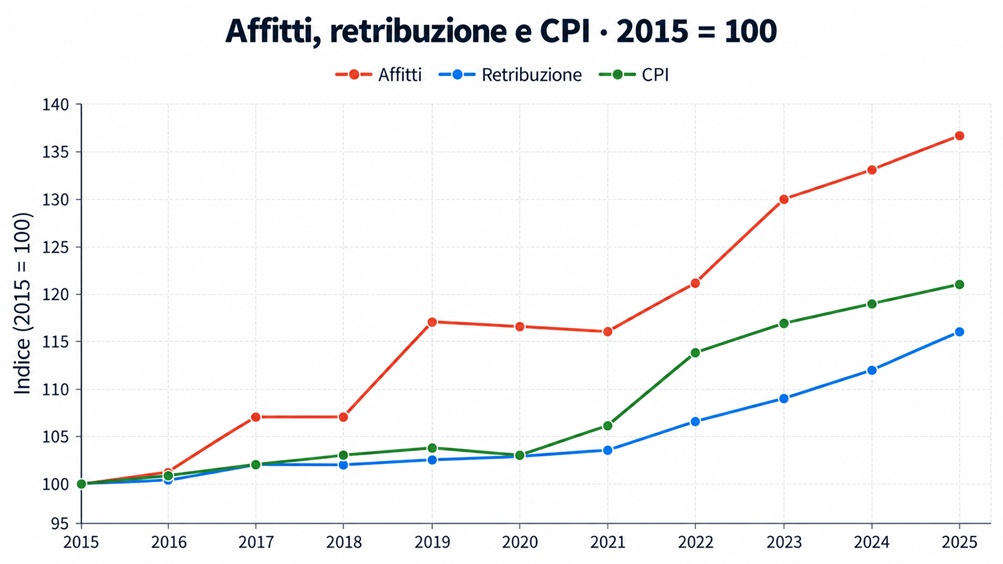
The figures speak for themselves: between 2015 and 2025 average rents rose by (at least) 36%, while average territorial pay grew by just 20%.
Over the same period, prices rose faster than average wages, which over the decade lost roughly 5% of their purchasing power: on a net salary of €2,000 a month, that means €100 less in goods and services each month.
The situation becomes dire for those without the good fortune of owning their own home: rent, even more than inflation, is eating away at wages. Indeed, rents have risen 15 percentage points more than salaries.
And the available data don’t even tell the full story. A search on immobiliare.it turns up a 45 m² studio flat (semi-furnished) in Cailungo for “just” €800 a month, or — for anyone rash enough to want to start a family — a 110 m² four-room apartment in Dogana for the modest sum of €1,500 a month. It takes no sophisticated calculation to see that figures like these are unsustainable, not only for those already struggling financially, but even for those earning an average salary.
The result is a general impoverishment of anyone who lives off their wages. We have reached the point where many Sammarinese are moving to neighbouring municipalities in Italy simply because they can no longer afford to live in San Marino — even though they were born here and work here!
While Sammarinese citizens, especially younger ones, are effectively exiled from their own country, foreign tax dodgers are welcomed in, euphemistically rebranded as “atypical” or “elective” residents: sports stars, wealthy heirs and affluent pensioners who, unwilling to accept the solidarity demanded by progressive taxation in their home countries, find in our Republic a convenient tax haven.
All perfectly legal, of course.
As the (scarce) available data show, the tax revenue these individuals bring to the Sammarinese treasury is thoroughly marginal: the state could do without them and barely notice the difference in tax receipts.
So who actually benefits?
First, the tax exiles themselves, who pay lower rates than local workers do, but on much higher incomes. Second, the big property owners benefit: the very same apartments once rented to ordinary citizens are now let to these new arrivals for two or three times the price. Third, banks and real-estate companies benefit, watching the value of their assets rise without lifting a finger.
For young Sammarinese of “ordinary” means — those without a family property to fall back on — only two options remain: stay with their parents and wait for their grandparents to die so they can inherit a home, or look for a roof elsewhere.
I’m reminded of something billionaire Warren Buffett said a few years ago: “There’s class warfare, all right, but it’s my class, the rich class, that’s making war, and we’re winning.”
Things don’t seem to be going much differently in San Marino. The country’s major property owners, in a holy alliance with Italian tax exiles, are waging that war with cynicism and determination — and they’re doing so with the backing of the governing parties: the Christian Democrats (DC), the chief guarantor of their interests, and the governing left, which waves the red flag with great fervour on symbolic occasions but, on every other day, defends rent-seeking at the expense of wages, content and comfortable in the seat it has been granted at the government table.
The ruling majority’s thinkers take refuge behind an ideological notion of private property, divorced from any social obligation: if someone can speculate, the thinking goes, then they are entitled to do so, regardless of the consequences for society. “Private property is sacred and the state must let speculation run free: so decrees the god Market, and woe to anyone who blasphemes against it!” — or so they seem to say, even as the law taxing properties left vacant by banks and real-estate firms can be ignored and left unenforced despite being on the books. For these ladies and gentlemen, it seems the rule of law applies only insofar as it serves the interests of the wealthy.
Meanwhile, citizens are being whipped up by certain media outlets (partly funded by the government itself through the purchase of advertising space) against a handful of Palestinian refugees and against the spectre of Europe: it is imperative, for those in power, to prevent citizens — impoverished by the cost of living and crushed and driven out by sky-high rents — from directing their justified anger toward those who are truly trampling on one of their most basic rights: the right to live in the country where they were born and where they work.
In the next instalments, I will offer a more detailed analysis of the data and its socioeconomic consequences, and I will also set out some proposals for changing a situation that has become intolerable on economic, political, social and moral grounds.