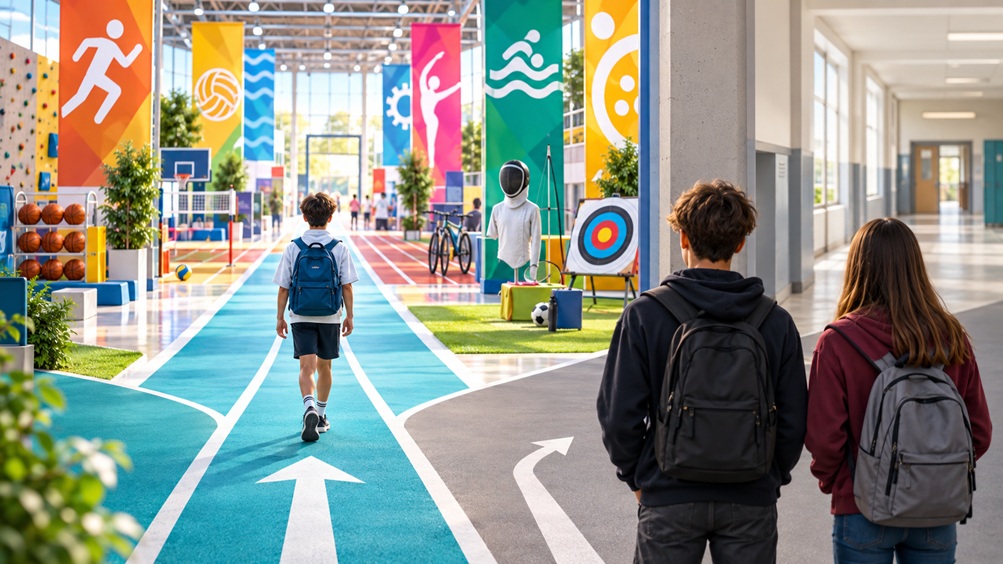
The Teaching Staff Council (Collegio dei Docenti) of the Middle School has confirmed its decision: only first-year classes will attend the 2026 edition of SportinFiera, scheduled for 18-20 September. Second and third-year students will stay home – roughly six hundred out of nine hundred pupils. CONS president Christian Forcellini called it a defeat for the event’s tradition and tried to reopen the discussion; the Secretary of State for Education, Teodoro Lonfernini, expressed disappointment without addressing the substance. The decision stands, and the reasoning behind it deserves close scrutiny, because it is the weak point of the whole affair.
The first justification is organizational: nine hundred students together wouldn’t allow the day to run smoothly, whereas three hundred would. It’s a fair objection, and anyone who runs a school knows what they’re talking about.
But this is a logistical problem, not a matter of principle, and logistical problems have solutions: shifts, time slots, different days.
All the more so since this year the event was extended from two to three days precisely to spread out school participation better. The tool to let everyone in already existed: it was built this year, and it wasn’t used.
The second justification is the one that doesn’t hold up at all. Second and third-year students, the reasoning goes, aren’t attending because they’ve already had the experience and many of them have already made their sporting choices. Anyone familiar with the world of sports federations knows the exact opposite is true.
Dropout from sport doesn’t happen at eleven: it happens between thirteen and fifteen, when the schoolwork piles up, routine turns boring, kids face someone better than them for the first time, and their friends start doing other things. It’s in the second and third year of middle school that teens quit, not in the first.
Excluding from a sports-promotion day precisely the age groups where dropout happens means giving medicine to those who aren’t sick.
And then there’s that phrase, “they’ve already chosen,” which describes a world that doesn’t exist.
Choices made at eleven are the most fragile choices there are.
A fourteen-year-old who quit football and hasn’t found anything else is exactly the ideal audience for a fair featuring thirty federations lined up: fencing, archery, bocce, athletics, sports he hadn’t even noticed at eleven.
Someone who has already chosen and is happy where they are loses half a day. Someone who has quit finds a second chance there. In a country of thirty-four thousand people, the second case matters far more than the first.
Because this is the point San Marino cannot afford to ignore: our sporting talent pool is tiny.
The federations that set up stands at the fair in September are the same ones that later have to build national teams by drawing from a population the size of a Rimini neighbourhood. We come home from the Mediterranean Games with medals around our necks and photos in the papers, and then we cut six hundred teenagers out of the very day meant to produce the next generation.
It’s not a grave contradiction, but it is a contradiction, and it needs to be said.
The rest needs saying too, for the sake of fairness. The teaching autonomy of the Teaching Staff Council exists, and rightly so: no one can dictate to a school how to organize its own days, and teachers are not anyone’s events office. The problem isn’t who made the decision – it’s that they made it alone.
If an event is universally described as a “system-wide event,” it cannot rest on communication that arrives after the fact and on a Secretary of State who can only voice regret.
The “I won’t get into the merits” line is formally unimpeachable and essentially exposes the gap: between Education, Sport, CONS and the federations there is no planning table, only an exchange of letters.
The solution, for anyone who wants one, isn’t complicated and costs nothing.
A shared calendar at the start of the school year, with age groups spread across the three days, and for second and third-year students a different format from the younger kids’: not the same walk-through among the gazebos, but real try-outs, meetings with athletes freshly back from Taranto, sports that no eleven-year-old would ever consider. There’s no time left to arrange this for this year.
For the 2027 edition, there’s time for everything.
Taking a fourteen-year-old to see thirty sports isn’t a wasted day of school.
It’s the last real chance not to lose him.