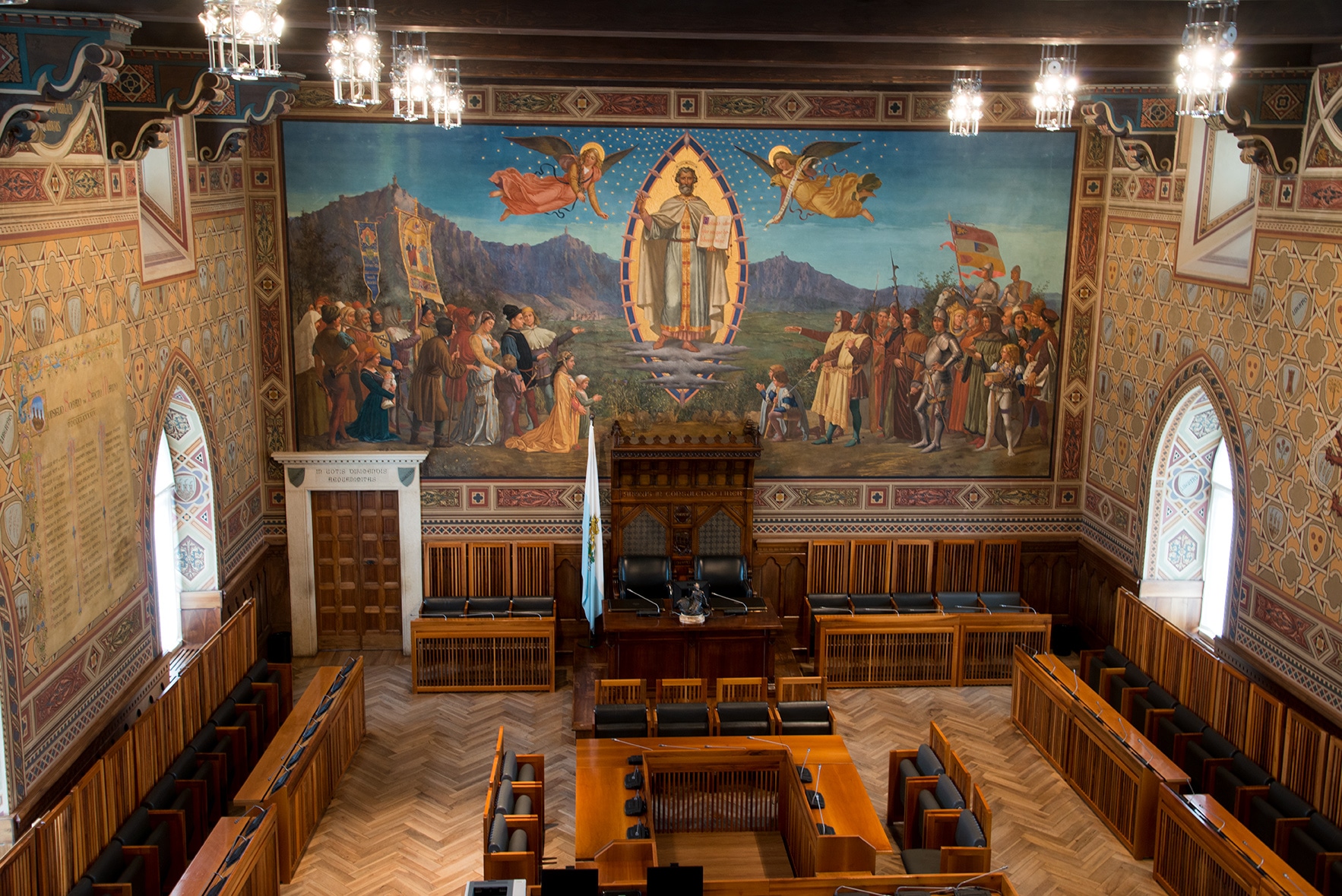
The text has changed shape, the majority has backed down on several points, and the debate has returned to a calmer tone. But full agreement is still out of reach. The sticking point remains the so-called “guillotine” — the mechanism that, after 25 hours of examining the articles, would allow debate to be cut off and force a single vote on all remaining amendments. For the majority, it is a tool against endless delays. For the opposition, it risks becoming a way to shut down discussion whenever things get uncomfortable.
This is the issue around which the political clash continues to revolve in the second reading of the bill amending the rules of procedure of the Grand and General Council (Consiglio Grande e Generale). Friday morning’s session nonetheless marked a shift in tone compared with the first reading, when the text had been met with a wave of criticism and branded by the minority parties a kind of “gag law.”
Opening the session, Manuel Ciavatta (PDCS) explained that the majority wants to find “as much common ground as possible.” Two main issues remain on the table: the introduction of committees acting in a “drafting” capacity (sede redigente) and, indeed, the guillotine. After the first round of speeches, proceedings were suspended to allow the majority and opposition to negotiate directly over the final amendments.
When the Council reconvened, Ciavatta described the meeting as having taken place in a “very constructive and positive” atmosphere. The face-to-face talks produced several new adjustments and a commitment to keep refining the text as the debate continued, with the aim of reaching, if possible, a more broadly shared version.
The most significant U-turn concerns speaking times. The majority has scrapped the reductions originally planned: councillors will therefore continue speaking within the same time limits set out in the current rules. Also dropped was the proposal for a preventive check by the Secretariat’s Office on the admissibility of amendments — another point that had infuriated the opposition.
“Speaking times will remain exactly the same for everyone,” Ciavatta clarified, adding that, following these changes, it is no longer fair to speak of a “gag law.” The majority’s stated goal, however, remains to make the Council faster and more efficient, avoiding the repetition of the same procedural steps.
This is the reasoning behind the proposal for committees acting in a drafting capacity. In practical terms, after the first reading and the committee’s examination of a bill, the full Council would no longer need to vote article by article on the entire text. Only the articles still carrying amendments would return to the floor before the final vote on the whole measure.
Ciavatta cited the example of the family law bill, made up of roughly forty articles. Under the new system, instead of voting on all of them again, the Council would have debated only the dozen or so articles still accompanied by proposed amendments. According to the majority, this would eliminate duplication without stripping the Council of its final vote.
The opposition, while acknowledging the potential time savings, fears that a significant part of the debate would end up shifting away from the full Council chamber, and that groups not represented on a given committee would have fewer chances to speak. For this reason, the plan is moving toward a trial period, after which it will be assessed whether the new system has actually worked or has simply increased the committees’ workload.
Among the shared changes is also the introduction of substitute committee members, a point of particular importance for smaller groups. The rules on the publicity of sessions are also changing: to request radio broadcast of a public committee hearing, three councillors will now suffice, rather than a third of the committee’s members.
The real obstacle, however, remains the guillotine. The first version allowed it to be triggered after two days of debate. That limit was later changed to 20 hours. Following talks with the minority, the majority said it was willing to extend it to 25 hours, while the opposition had asked for it to be raised to 30.
To prevent only majority-selected amendments from being discussed before time runs out, the principle of alternation has also been accepted: one proposal from the majority, one from the opposition. An additional safeguard, but not enough to remove all resistance.
Repubblica Futura acknowledges the improvements but maintains a negative assessment. Nicola Renzi admitted that, compared with the first draft — which he called “appalling” — significant progress has been made. RF, however, remains opposed to the guillotine and rejects the idea that the Council’s delays are the opposition’s fault.
Antonella Mularoni reiterated that “in democratic countries, the rules of the game are decided together,” while Matteo Casali described the new text as merely the “lesser evil.” According to Casali, parliament cannot be judged solely on the number of laws passed and the speed at which they are approved: beyond quantity, what matters above all is the quality of the work.
The position of Rete is equally firm. Emanuele Santi acknowledged that the new text represents progress compared with the original draft, which he called “shameful.” On the guillotine, though, he holds firm: “The guillotine puts a limit on democracy, and we absolutely cannot accept that.”
For Santi, prolonged debate over amendments is not always simple obstructionism. In the past, he argues, it has allowed the opposition to secure amendments, correct legislation and halt decisions considered mistaken. His main concern relates above all to the budget law, the moment when confrontation between majority and minority is typically at its sharpest.
Domani – Motus Liberi also acknowledges that the text has improved, but is calling for further guarantees. Gaetano Troina rejected the accusation that it is always the opposition slowing down the Council. Fabio Righi, meanwhile, proposed a more gradual mechanism, one that would leave a final window for negotiation before amendments are put to a single, block vote.
For the majority, Matteo Rossi (PSD) defended the compromise reached: 25 hours of debate, alternation between amendments from both sides, and the preservation of current speaking times. A solution that, in Rossi’s view, guarantees debate without leaving the Council chamber deadlocked indefinitely.
Independent councillor Giovanna Cecchetti also judged the text more balanced compared with the initial version. She acknowledged, however, that some of the opposition’s fears — particularly regarding the budget law — are understandable. “Debate is not an obstacle to the Council functioning — it is one of the reasons the Council exists,” she observed, summing up the issue: “We must not have to choose between efficiency and democracy.”
The debate has thus produced real, if still incomplete, mediation. The cuts to speaking times have been dropped, the preventive check on amendments has been shelved, and new safeguards have been introduced for the opposition. On the guillotine, however, the gap remains.
Proceedings were suspended at 1:30 p.m. and will resume on Monday at 2 p.m. The majority is aiming to wrap up the reform and speed up the Council’s work. The opposition, for its part, insists that the pursuit of efficiency must not become a shortcut for shutting down debate. The talks have brought the two sides closer together, but the final stretch remains the hardest part of the road.