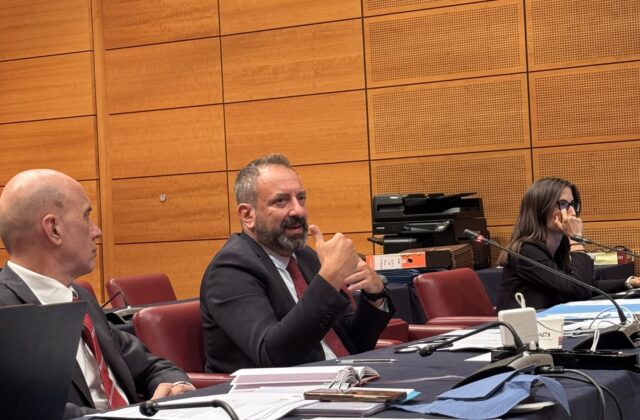
Nicola Renzi rejects the reconstruction according to which, during last week’s Foreign Affairs Committee session, he presented the majority with a political bill in exchange for Repubblica Futura’s support for the Association Agreement with the European Union.
Contacted directly by our newsroom, the RF leader calls that interpretation baseless and asks that the full passage be read, the one from which the seven words that made the headlines were extracted: “now it’s up to you to decide how you want to pay us back.”
The point, Renzi argues, is that the sentence does not end there.
The minutes continue as follows: “Now it’s up to you to decide how you want to pay us back, though nothing is owed. We did what we did because we believed in it. So, if we want to get down to serious work, let’s get to work. If not — and this is another legitimate path for a majority and a government — tell us: we’ll go it alone. And carry on as you are.”
The payback, in other words, is named by the speaker in the very next line, and it is not a government post: it is parliamentary work on transposing the agreement.
“I asked for nothing for myself or for my party, and I said so in the same sentence,” Renzi states.
“I asked that we get down to serious work. I asked for the schedule of laws to be transposed, as they did in Andorra.
I asked that the rules on the labour market be discussed before they are drafted, not once the text is already finalised. I asked that the Committee for Institutional Reforms not remain stalled for four months.
That is the payback I put on the table, and I said it out loud precisely because it has nothing to hide.
Whoever cuts seven words out of a twenty-minute speech knows perfectly well what they left out.”
And the rest of the speech, indeed, is all there.
Renzi describes the parliamentary committee’s visit to Andorra, where officials projected on the wall the seventy laws needed to transpose the EU acquis, indicating how many were already ready. “I would have expected something similar,” he says in the minutes: a schedule with deadlines — three months, six months, nine months.
On the labour market, he asks that the country be told openly that something will change — “it may not change for the worse, it may increase competition, it may give us many opportunities” — and criticises those who at a public event allegedly argued the opposite, though he specifies twice that he was not referring to the Secretary present at the committee session.
As for his defence of Secretary Beccari, which in the contested reconstruction would become the main item on the bill, Renzi places it in the same context: having personally defended the Secretary “against ridiculous accusations, if not insults,” received “from the usual troublemakers who occasionally wander around the Republic” does not, in his view, generate any credit to be collected.
One detail is worth noting.
In the accounts circulating in recent days, the same passage has been told in two opposite ways: in one version Renzi stood up in the chamber to defend the Secretary; in the other, he claimed credit for not having stood up, keeping — as the phrase goes — a tally of his own silences. Both versions cannot be true. The minutes record the first.
Setting the controversy aside, what remains on the table is the question Renzi actually raised and which no one has yet disputed on the merits: just days before the signing and ahead of the agreement’s provisional entry into force, the Grand and General Council (Consiglio Grande e Generale) still has neither the list of laws to be approved nor a timetable for approving them.
It is a question that concerns everyone, majority and opposition alike, and one that will not be settled by deciding who owes whom, and for what.