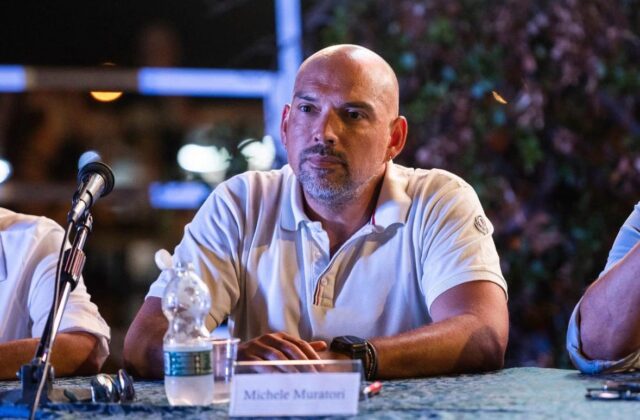
We continue our series of in-depth columns curated by Michele Muratori, group leader of Libera, dedicated to the analysis of current political affairs, the main institutional challenges, and the topics of greatest interest to the Republic of San Marino.
*****
Today’s ballot box verdict, on Tuesday, November 3rd, goes well beyond simple parliamentary arithmetic and lays bare the spectre of what American politics calls a lame duck.
The expression, born in the eighteenth century on the London Stock Exchange to describe insolvent financiers unable to keep pace with the market, has become in the United States the perfect metaphor for a president stripped of his congressional majority and condemned to advance only with great difficulty.
Under the spotlight is the full renewal of the House and 35 Senate seats, but among the ballots American citizens are also casting a weighty judgment on the administration’s record, testing the resilience and functioning of the constitutional checks and balances.
Polls and demographic trends point to a road that is decidedly uphill for the Republicans in power.
Approval of the president’s performance continues to hover at historically low levels, around 32% according to the latest figures from Reuters and Ipsos, with heavy losses especially among moderates and in urban suburbs.
The picture is further complicated by sentiment toward Congress, where surveys from YouGov and Pew Research give the Democrats a lead of between 8 and 12 points.
With such razor-thin margins shaping the numerical balance of the chambers, the battle for control of power becomes the true fulcrum of this election.
Aware of the stakes, in the final stretch of the campaign Donald Trump himself tried to raise the pressure to the maximum.
From the campaign trail he conjured scenarios of financial collapse should the opposition win, going so far as to invoke the ghosts of the 1929 crash, while reiterating just how decisive this vote is for the future of the party itself.
Statements that betray a clear awareness of just how much this day could shape the second half of his term.
American institutional history, after all, teaches just how ruthless midterms can be for whoever occupies the White House.
Bill Clinton knows this well: in 1994 he lost 54 House seats and handed the majority to the Republicans led by Newt Gingrich after four decades of Democratic dominance, ushering in a season of bitter budget battles and relentless congressional oversight.
So does Barack Obama, who in 2010 shed 63 seats in the same chamber, forcing his administration to pivot toward executive orders and other administrative tools.
In both cases, the parliamentary downsizing turned relations with the legislature into a deeply polarized trench war.
On the other side, the Democrats head into the vote buoyed by strong grassroots mobilization, but facing the challenge of keeping their different factions united.
While the progressive wing pushes for a frontal, institutional clash, the moderate leadership is aiming to shore up support in the center.
Channeling this energy into coherent legislative action will be the real test for the opposition over the next two years.
For the White House, losing control of Capitol Hill would mean entering a phase of serious governing turbulence.
The president’s agenda would effectively be paralyzed amid exhausting negotiations, while congressional committees would ramp back up with sweeping hearings, investigations into federal agencies, and the ever-present shadow of new impeachment proceedings ready to resurface.
Adding further complexity to the day is a particularly striking diplomatic precedent.
For the first time since 2002, American authorities have not invited observers from the OSCE, the Organization for Security and Co-operation in Europe.
This removes the historic external guarantee precisely for a vote marked by extremely high tension (OSCE Official Statement).
Without independent, third-party monitoring, confidence in the vote-counting procedures is weakened right when the debate over voting-access rules is at its most heated.
Not to mention that, by forgoing multilateral oversight, Washington risks losing part of its credibility when it comes to demanding electoral transparency standards from other countries.
As voting continues across the entire country, the real question is whether this shock will be enough to change course, or whether the international situation has already been compromised beyond repair.
Against a global backdrop marked by deep fractures, the outcome of the ballot box will reverberate well beyond America’s borders, even as there remains a high risk that an unfavorable verdict could be contested or openly rejected by the White House.
A possible realignment of Congress may try to set the democratic checks and balances back in motion, but the fate of the presidency and America’s international posture remains suspended between the hope of an institutional brake and the very real spectre of a lame duck.