For three weeks Italy has been gripped by a protest movement that keeps growing. First came the farmers, who set out from Calabria on 28 September with their tractors to block highways and fuel depots, then the truckers joined in, halting lorries across Sicily, Calabria, Puglia and Basilicata. Since Thursday students have joined too, with marches in around forty cities. Today it all converges on Rome, where in the afternoon the CGIL‘s national march winds its way from Piazza della Repubblica to Piazza del Popolo, followed by more than a hundred associations.
Those protesting have different grievances but a common root: costs that no longer add up. Diesel prices for those who work with a vehicle, missing resources for schools for those who study in them. In the South the blockades have not let up, and Sicilian truckers are set to remain on strike until 20 October.
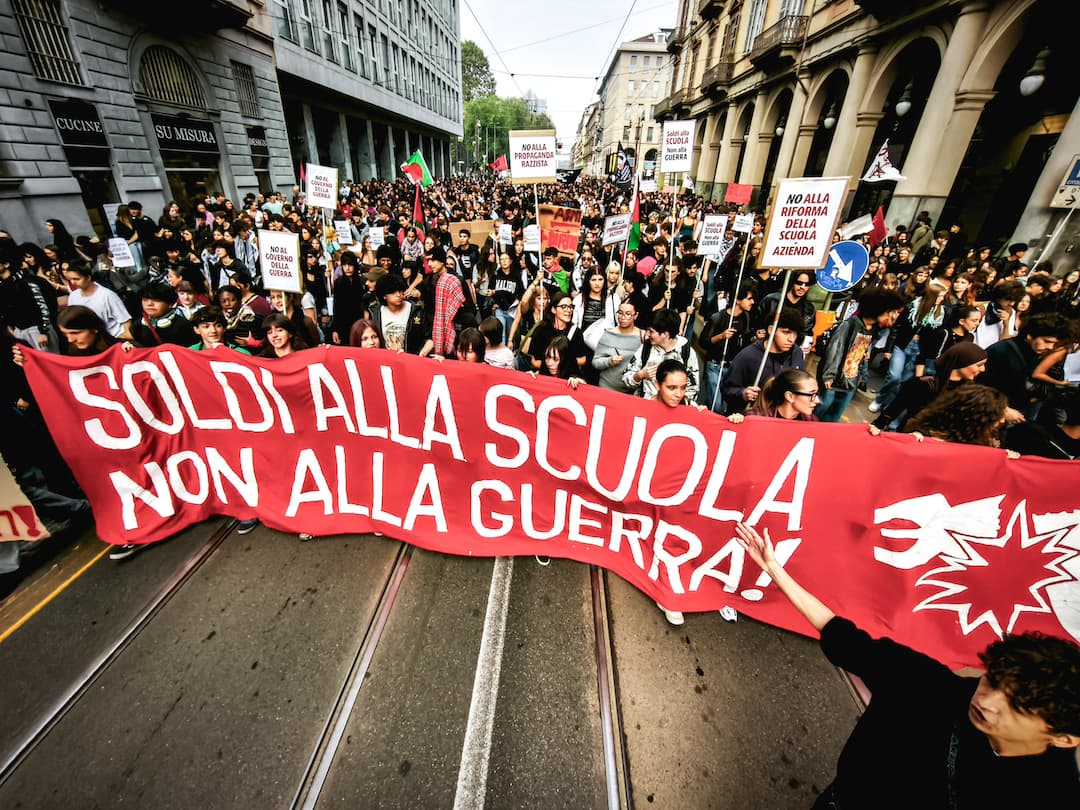
Yesterday student rallies swept across the country from Turin to Cagliari, passing through Milan, Genoa, Bologna, Padua, Florence, Rome and Naples. Organisers claim more than 400,000 participants. The chant echoing through the marches was “We want more classrooms and fewer bombs.”
There were also tense moments. In Bologna police repeatedly charged the march heading towards the station with batons, in Turin there were baton charges and thrown objects, with three minors arrested, and in Verona nineteen people were reported to authorities, almost all of them underage students. Each side blames the other for sparking the clashes.
The reasons that brought young people onto the streets are concrete: crumbling school buildings, teacher shortages, the decree capping the number of migrant-origin pupils allowed per classroom, funds funnelled into the defence industry, and the rising cost of living weighing on families. The figures on school funding are disputed: the Ministry claims an increase of 959.8 million euros, the Five Star Movement denounces nearly a billion euros in cuts over three years, and the association Libera calculates 620 million euros less for education over three years. Analyses of the budget documents agree on one point: from 2027 spending on schools is set to decline. The CGIL, too, is bringing to today’s march a demand to cut military spending, starting with the additional 14 billion euros announced by the government.
The other front has been open for much longer and receives far less attention. The protest by farmers and truckers began in Calabria on 28 September, nearly three weeks ago now. Tractors occupied the roundabout at Lamezia Terme airport, blocking state roads 18 and 280, and on 5 October they blocked access to the Eni and Meridionale Petroli depots, which supply more than 60% of the region’s fuel network. From there the protest spread to Sicily, Basilicata, Lazio, Puglia, Tuscany and Sardinia. In Calabria the strike has reached the port of Gioia Tauro, the Lamezia area and the A2 motorway junctions in the Cosenza area.
The reason has one name: diesel. According to data from the Ministry of Enterprises, self-service diesel is hovering around 2.25 euros per litre, while petrol stands at 2.03: those who work with a tractor or a lorry pay more for fuel than those who drive a car. And the gap has widened in recent weeks, with diesel rising by 6.2% between 3 August and 10 October, compared with 1.8% for petrol.
There is also a date that explains the timing. On 6 October the discount on diesel excise duty expired: the rate, which had been lowered to 622.90 euros per thousand litres on 26 September, returned to the standard 672.90, roughly six cents more per litre including VAT. The discount could have continued under the “mobile excise duty” mechanism, which lowers excise taxes using the extra VAT revenue generated when oil prices rise, but the necessary inter-ministerial decree was not published in time. By then the tractors had already been on the roads for eight days.
What they are asking for is modest and specific: a cap on diesel prices and production costs, immediate non-repayable compensation, amendments to decree-law 198, and measures against damage caused by wildlife. The protests are mainly organised by the Movimento Territorio e Agricoltura (Territory and Agriculture Movement), led by Matteo Talarico, together with local committees formed on the ground.
To understand what lies behind these demands, one figure from the Foggia area says it all: some olive growers have stopped harvesting, because the price of oil no longer covers the cost of picking the olives and taking them to the press. The crop is left on the trees, worth less than the effort of gathering it.
The point where the two stories met came on Thursday in Corato, near Bari, where students came out to support the farmers’ sit-ins. A tractor and a classroom have nothing in common, but for weeks both have been doing the same sums and reaching the same conclusion: what is needed costs more than what is available.