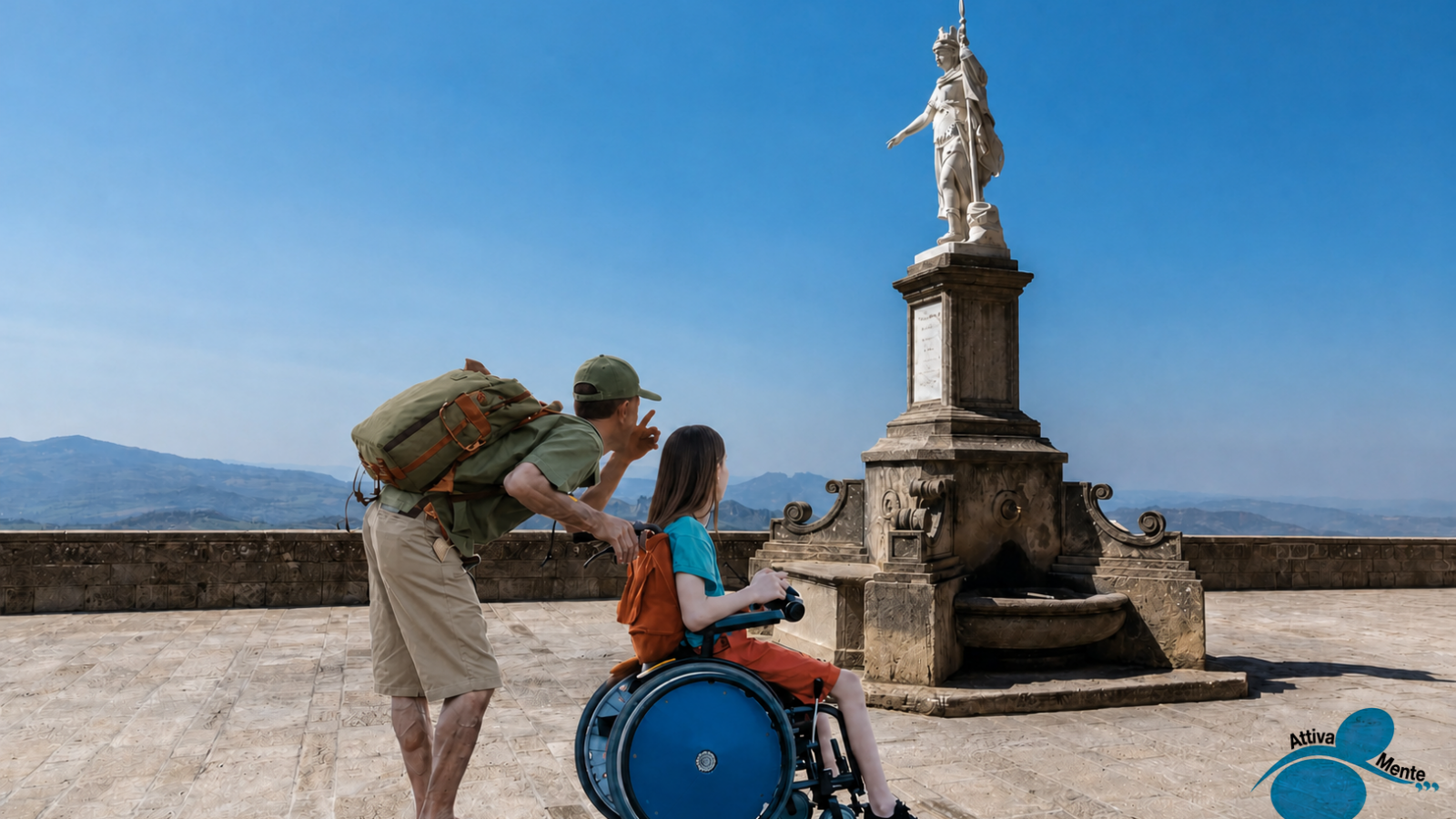
Recovering and updating “San Marino per tutti” (“San Marino for All”), adapting it to new technologies and turning it once again into a reliable tool for people with disabilities who wish to visit the Republic. This is the request put forward by Attiva-Mente, which has promoted a formal petition (Istanza) calling for the relaunch and enhancement of the project dedicated to accessible tourism.
The association starts from the role San Marino has taken on over the years in the field of tourism accessibility, recalling the two international conferences organised in 2014 and 2023 with the World Tourism Organization. These events contributed to shaping the San Marino Declaration on Accessible Tourism and the San Marino Action Agenda to Advance Accessible Tourism 2030.
“In light of this legacy and the commitments made by the Republic, we believe it is important not to let the experience built with ‘San Marino per tutti’ go to waste, especially since it is still listed by the official Visit San Marino portal as a reference point for accessible tourism” – reads the statement from Attiva-Mente.
According to the association, the project now needs updating, both in terms of content and technology. “Today the project contains information that in many cases dates back several years, and it remains a digital tool inevitably tied to the era in which it was created. The petition therefore proposes recovering it, updating it and adapting it to the possibilities offered by current technology, so that it can once again become a reliable, accessible and useful tool both before and during a visit”.
The central issue, Attiva-Mente stresses, is enabling people to find out about the actual accessibility conditions of facilities, routes and services before setting off. This is a particularly important aspect in a territory with the historical and urban characteristics of San Marino. “It’s not about claiming that everything is accessible, but about making it possible to find out what genuinely is”.
The association also cites the recent ASviS publication Guida al turismo accessibile – Strumenti e buone pratiche per un turismo aperto a tutte e tutti (Guide to Accessible Tourism – Tools and Good Practices for Tourism Open to All), published in May 2026, highlighting the need to move beyond a concept of accessibility limited solely to physical barriers. Reliable information, verified standards and monitoring of available services are identified as key elements enabling people to plan their trips.
For Attiva-Mente, accessible tourism in fact encompasses the entire experience: finding information, communicating, booking, getting around, staying overnight and enjoying places, services, culture and activities, taking into account different disabilities and needs.
A specific section of the request concerns digital accessibility. “Renewing ‘San Marino per tutti’ would be an opportunity to ensure it can be properly used via smartphones, tablets, assistive technologies and different browsing methods” – the association points out.
The request also extends to public online services. “We are simply asking for an extra effort, and more broadly, we hope that digital accessibility can progressively become a structural requirement for all public administration websites and online services, including the portal mentioned above, so that public information and services are genuinely usable by everyone, in line with the United Nations Convention on the Rights of Persons with Disabilities”.
Finally, Attiva-Mente is calling for any relaunch of the project to take place with the direct involvement of people with disabilities and the organisations representing them, invoking the principle “Nothing About Us Without Us”.
“We are not proposing to start from scratch, but to recover an existing initiative, update it and give it continuity, while at the same time enhancing the role San Marino has chosen to play internationally in the field of accessible tourism” – the statement concludes. The association has therefore launched a signature-collection campaign in support of the petition, summing up the spirit of the proposal: “Accessibility also begins with the chance to find out, before setting off, what a destination can truly offer”.