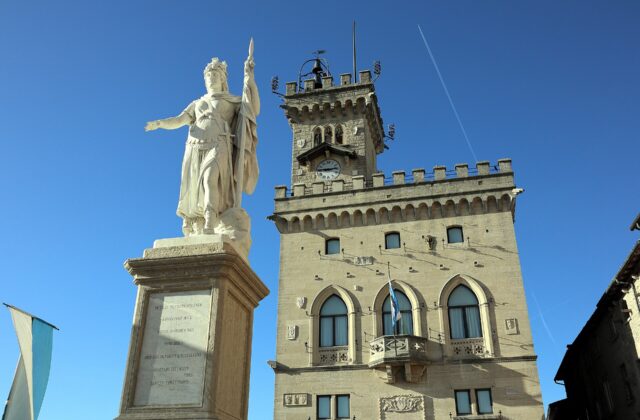
Carlotta Andruccioli (Domani – Motus Liberi) spoke during the debate on point 7 of the agenda of the Grand and General Council (Consiglio Grande e Generale), dedicated to the ratification of the Association Agreement between the Republic of San Marino and the European Union. Her remarks focused on the absence of a referendum, the lack of citizen engagement, and delays in training and in transposing the EU acquis.
Below is the full text of Carlotta Andruccioli’s speech.
I would like to start by saying that I too recognise the historic significance of the moment the Grand and General Council is reaching today, just as I have personally acknowledged, and as our political group has acknowledged, the importance of the moment in which the Association Agreement with the European Union was signed. We are fully aware, and we have always said so, of our country’s need to integrate ever more closely with the European single market, if only because, geographically speaking, we are located within the European continent.
I would like to reiterate that no one, at least in this Chamber, should feel nostalgic for a past in which the Republic of San Marino was regarded as a rogue state. If anyone still harbours nostalgia for that period, I believe they are to be found much closer to the government and majority benches than to the person speaking to you right now. This is a position we have always expressed, regardless of the political point-scoring that may be taking place in this Chamber today, or the arguments that some may use to justify certain choices.
There is, however, another point we have always made and that I would like to reiterate, given that the contents of various government programmes keep being invoked — namely, the question of the referendum. I am also responding to my colleague Matteo Casali, because we have been pushing for this for eight years now, both when we were in government and in the majority, and when we were in opposition. We have always done so without wanting to turn this issue into a political battle, and that is precisely why, over the years, we did not want to frame the referendum request as a confrontation between political forces. We did not want to turn this demand into a matter of political flag-waving or ideology.
Faced with the fact that this issue was completely ignored by this Chamber — to the point that there was not even a willingness to discuss it — we decided to table two bills, as my colleague Gaetano Troina has already explained. We did so, firstly, because we believe in the democratic principle, and secondly, because we believe that popular legitimacy could have given greater political strength to the path our country is being asked to pursue.
And what was the Chamber’s response to these two bills, one of which was tabled several months ago? Not only have these bills never reached a first reading, they have never even been placed on the agenda of the Grand and General Council. I think this speaks volumes about the unwillingness of much of the political establishment to address and discuss certain issues. We can spend all the words we like saying we support the referendum as a tool, but then we must confront the reality of the facts. There is also the issue of representative democracy, which is sometimes invoked to argue that, within a representative democracy, certain decisions should not be submitted directly to the judgment of citizens. I understand this argument, but I do not agree with it.
Given that, if we do not think it appropriate to involve citizens on an issue of this magnitude, then we really ought to question the meaning and purpose of the referendum institution within our legal system, I would like to add another consideration. If you truly believe in the principle of representation, and in the idea that those who sit in this Chamber act on the basis of a direct mandate received from citizens, then you should also have the courage to take a position on the issues brought to your attention, and to explain to your electorate the reasons behind the choices you make. That is what representative democracy means, colleagues. It means taking responsibility for your decisions and being accountable to the electorate that entrusted you with the mandate to represent it in this Chamber.
The problem is that, on certain issues, you don’t even want to reach a vote. I repeat: personally, I would have much preferred those bills to be brought before the Chamber and voted down, as would certainly have happened, because at least you would have taken political responsibility for that decision and put your name to it.
The 2013 referendum is cited again and again, with the argument that San Marino citizens have already expressed their views on this matter. I believe there are some inaccuracies in this reasoning, which has also been put forward by the Secretary of the Sammarinese Christian Democratic Party, Gian Carlo Venturini. First of all, the 2013 referendum concerned accession to the European Union, not the Association Agreement. Secondly, that referendum was held a full thirteen years ago, in a historical, political and economic context very different from the one we find ourselves in today.
I would like to add another point, because the first two considerations I made may seem fairly obvious, whereas there is an aspect that is systematically forgotten. Those voters who in 2013 voted in favour in the referendum voted to launch the procedures for accession to the European Union, making San Marino’s actual entry conditional on the outcome of a further confirmatory referendum. This detail is never mentioned by anyone. It is a fact that all of you keep forgetting when you invoke the result of the 2013 referendum to argue that it is not necessary to consult citizens again. I therefore believe there is little room left for further argument on this point.
We continue to maintain that popular legitimacy could have given greater strength to the action of San Marino’s entire political class with regard to the implementation of the Association Agreement with the European Union.
I would now like to turn to the issue of information and public awareness of the contents of the Agreement, because we have also spoken about this many times, in every forum, stressing the importance of providing all the information citizens need in order to understand what this process entails. I believe the concern expressed by many of our fellow citizens is entirely legitimate, not least because it often stems precisely from a lack of knowledge about the contents of the Agreement. I do not think this can simply be dismissed by saying it is just a hundred keyboard warriors.
Keyboard warriors may certainly exist, but perhaps, instead of limiting yourselves to watching what gets written on Facebook, you should engage directly with citizens, talk to them and try to understand what concerns they are expressing. You should try to understand how much of this concern actually stems from a lack of knowledge about the contents of the Agreement, and how much, instead, can be traced back to what is perceived as improvisation on your part in managing this process.
From 2018 to today, I have taken part in several public meetings organised by successive governments, and I have also attended various training sessions for public employees. I must say that the first — and only — genuinely serious session, free of slogans and grand philosophical speeches, that I was able to attend took place just last week. I want to acknowledge the work of the Department of Foreign Affairs, because that was truly an interesting and in-depth training session, which allowed us to examine the actual contents of the Agreement in detail.
I want to give credit for that, but it is a shame that a training session of this kind came just one week before the ratification of the Agreement and one month after it was signed. On this point, we continue to stress the delay with which action was taken, just as we continue to criticise the enormous delay regarding the work that will be needed to transpose the EU acquis. Some say that now is the time to start studying, but clearly this groundwork should have been done much earlier. It is like showing up for an exam and saying that from that moment on we will start studying. It is obvious that, with an approach like this, we risk failing.
This is exactly what we are criticising — not the need for a path of greater integration with the European Union, but the manner and timing with which this process has been managed.
I would like to conclude my remarks with real passion, setting aside all logic of party allegiance and political confrontation. There is no need to try to convince eurosceptics, because that is probably a very difficult task. But try not to let down those people who believe in this process, yet who are frightened by the way you are managing it.
I also speak from personal experience, because I belong to a generation accustomed to internationalisation, one that is not afraid of the Association Agreement with the European Union. But when I talk with my peers, I realise that many of them are worried about the improvisation and about the fact that our country is still lagging behind on many of the issues that will need to be addressed.
My appeal, given that you do not want citizens to be consulted directly through a referendum, is that you truly take seriously the responsibilities that come with this step. Try not to let down precisely those who believe in the Association Agreement and in the opportunities this process can offer the Republic of San Marino. That too is part of taking responsibility for the representative democracy that you yourselves keep invoking.