A close look at the United StatesAmerican politics, culture and society: Insider.sm hosts an in-depth column dedicated to the United States, curated by Carlotta Andruccioli, a San Marino councillor with a degree in International and Diplomatic Sciences and author of the blog UScarly.
Born from a passion for the US, this space tells the story of the country beyond the daily headlines, exploring its political dynamics, cultural shifts and contradictions. An opportunity to get a closer look at a reality that also shapes the European debate and our everyday lives.
_________________________________________________________
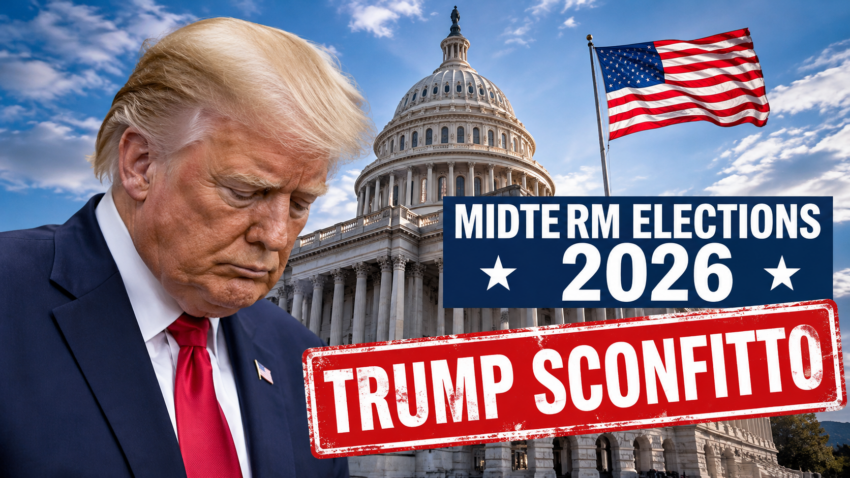
The midterm elections of November 3 delivered a result for the United States that far exceeds even the most optimistic forecasts of the Democratic Party. The Democrats won control of both chambers of Congress, while also posting significant gains in state-level races.
For Donald Trump, it is a heavy setback, one that could reshape the American political landscape ahead of the 2028 presidential election.
But what drove this result? And above all, are we looking at a genuine shift in the political tide, or simply a rejection of the president’s policies?
A Congress that changes colour
Let’s start with the numbers. In the House of Representatives, the Democrats gained roughly forty additional seats compared to their starting position, reaching 253 seats against the Republicans’ 157, with a few districts still to be called at the time of writing.
The picture has flipped in the Senate too: the Democrats reached 54 seats against the Republicans’ 44, while results in Alaska and Mississippi — two traditionally Republican states where Democratic candidates are currently ahead — remain to be finalised.
The shift was also visible at the state level. Of the 36 governorships up for election, 28 went to the Democrats and 20 to the Republicans, with Kansas and Alaska still undecided.
Economy and voter turnout: the reasons behind the defeat
The main factor that appears to have influenced the vote was the economy. Inflation, rising energy and fuel costs, and the struggle to make ends meet weighed heavily on the choices of many Americans.
Trump had built part of his 2024 presidential campaign on the promise of improving families’ economic conditions, sharply criticising the Biden administration.
Two years on, however, a significant portion of the electorate believes that their financial situation has actually worsened.
The composition of the electorate also played an important role. Women, young people and African Americans shifted further toward the Democrats compared to the 2024 presidential election.
Particularly notable was the change among Hispanic voters: after increasingly backing Trump in 2024, part of this electoral group swung back to reward the Democrats.
Another decisive factor came from the suburbs and outlying areas, which had favoured Trump in 2024 but this time contributed to the Democratic recapture of Congress.
Some caution is nonetheless warranted: midterm elections tend to mobilise voters opposed to the sitting president in greater numbers.
The result, therefore, does not necessarily offer a definitive snapshot of American voters’ leanings, especially with the 2028 presidential race on the horizon.
Texas and Michigan: the states that surprised
Among the most striking results is certainly that of Texas, traditionally Republican and, until just a few months ago, considered hard for Democrats to contest.
The Democratic Party won the Senate seat with James Talarico, the governorship with Gina Hinojosa, and a majority in the state House.
It is a historic shift, driven by several factors: support from Hispanic voters, discontent over border immigration policy, demographic changes, and the ability of Democratic candidates to reach moderate and religious voters as well.
Another state worth watching is Michigan, where Abdul El-Sayed won the Senate seat with 53% of the vote.
Here, the fallout from Trump’s trade tariffs against Canada played a role, as did support from Muslim communities.
His victory is especially interesting because it represents a win for the Democratic Party’s progressive wing in a state that is pivotal to the national balance of power.
Surprising results also emerged elsewhere: South Carolina, Iowa and Kansas, historically Republican-leaning, swung to the Democrats.
Even in Mississippi, Democratic candidate Scott Colom is currently ahead, although the count is still ongoing.
A weakened Trump and a Republican Party searching for its future
Following this defeat, many commentators have begun describing Trump as a lame duck — a president still in office, but with his political weight and ability to influence events significantly diminished.
Control of Congress will allow the Democrats to slow down or block the White House’s legislative agenda, launch investigations, and influence presidential appointments through the Senate.
The defeat could also open a period of tension within the Republican Party.
Among the names to watch ahead of 2028 are Vice President J.D. Vance, Secretary of State Marco Rubio, and Ron DeSantis.
To build an independent political future, some of these figures may increasingly seek to distance themselves from the president.
The new Democratic generation looks to 2028
On the Democratic side too, figures are emerging who could become protagonists of the next phase of American politics.
Among them is James Talarico, a young progressive Christian from Texas, able to craft a message built around faith, dialogue and social justice.
In Michigan, Abdul El-Sayed, a representative of the progressive wing, has made his mark, while in Georgia Jon Ossoff, re-elected to the Senate, is strengthening his national profile.
Another notable result is that of Annie Andrews in South Carolina, who centred her campaign on healthcare costs and the economic struggles facing families.
These candidates seem to have grasped that winning back part of the electorate requires more than speaking to one’s own ideological base.
It means putting concrete issues back at the centre of the conversation: healthcare, jobs, the cost of living and protection of the middle class.
A Democratic victory, but not yet a decisive turning point
The 2026 midterm elections send a clear message: Donald Trump is not politically invincible, and a significant portion of the American electorate wanted to send him a strong signal.
It would, however, be a mistake to interpret this result as an unconditional return of trust in the Democrats.
Instead, what emerges is an electorate increasingly attuned to everyday concerns, willing to change allegiance when it fails to find concrete answers to its problems.
For the Republicans, a complex phase lies ahead, in which they will have to reckon with Trump’s political future and his legacy.
For the Democrats, on the other hand, this victory represents an important opportunity — but also a responsibility: to prove they have a credible political agenda, rather than simply riding a wave of protest votes against the president.
And then there is 2028. The first alliances, candidacies and internal balances within both parties could begin taking shape well before the next presidential campaign gets under way.
The real question, then, is not simply who won these midterms, but which direction American politics will take over the next two years.