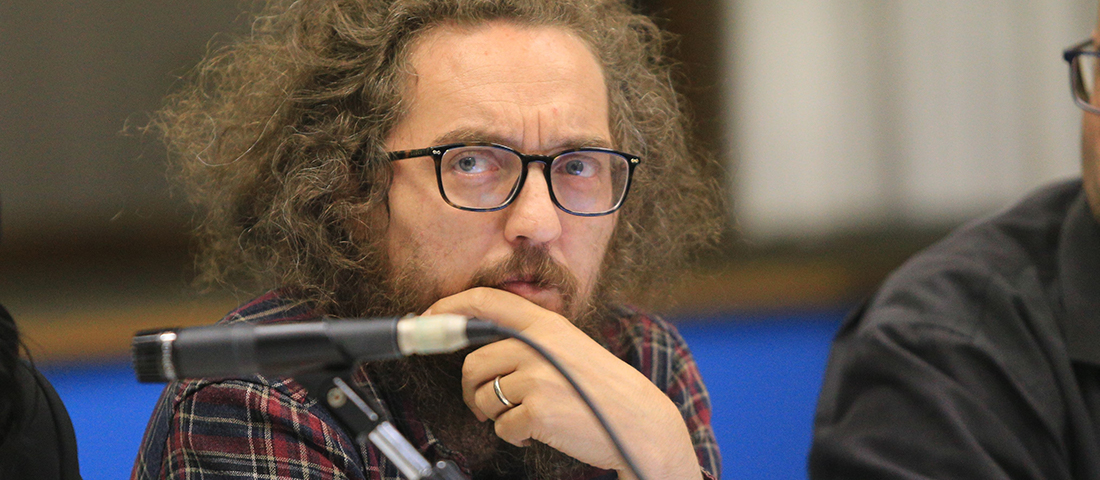
Gian Matteo Zeppa (Rete) spoke during the debate on item 7 of the agenda of the Grand and General Council (Consiglio Grande e Generale), dedicated to the ratification of the Association Agreement between the Republic of San Marino and the European Union.
The councillor reviewed the work carried out by various political forces over the past ten years, dwelling on the theme of sovereignty, the opportunities linked to European integration, the Bulgarian affair, and the resistance encountered along the negotiating path.
He also addressed the referendum question and criticised certain members of the government.
Below is the full text of Gian Matteo Zeppa’s speech.
I have heard many words of shared support for a path that, in some respects, has come to an end, but which, from my point of view, has only just begun. I would like, however, to take a somewhat different approach from those who have spoken before me, not least because this is yet another speech I am making on the subject of the negotiations with the European Union, having represented Rete, among other things, on the Foreign Affairs Committee.
These are therefore considerations I have made and remade on many occasions, as have many other colleagues who sit on the Foreign Affairs Committee, but which I nevertheless feel it is worth restating.
I was reflecting, partly in light of what happened yesterday during the Communications item — which was, in a manner of speaking, a rather quarrelsome session, at least in terms of words — on the fact that over all these years we have clashed sharply on so many issues.
We have clashed over the financial system, over the justice system, and over countless assessments of the conduct of the governments that have succeeded one another, roughly from 2016 onwards.
Yet all these governments have always had one thing in common, namely the opening and conclusion of negotiations with the European Union, regardless of the role the various political forces have played over the years, whether they were then in the majority and are now in opposition, or vice versa.
This is something that, in my view, we have not dwelt on sufficiently.
In a period of history marked by deep political divisions, perhaps the only point on which we have managed to find real common ground has been precisely the negotiation with the European Union. Why did this happen?
Probably because the entire political class — which is certainly representative, being made up of those who, at every election, put themselves forward as candidates and are chosen by the citizens — showed what might be described as an almost unusual degree of foresight compared with so many other issues.
It had the ability to keep open a path that could prove virtuous and constructive for the Republic of San Marino.
Otherwise, as I have often said within the Foreign Affairs Committee, San Marino would have died, or would risk dying, of inertia. It would be like those small communities that, in some stories or films, are depicted as entirely closed realities, self-sustaining and self-regenerating, building their own internal structures.
San Marino has always lived with this strong dichotomy around the concept of sovereignty, a word that has been repeated many times again today. We have often understood sovereignty as something to be exercised exclusively within our own reality, without developing a genuine European dimension — at least until these last few years.
When I speak of a European dimension, I am not referring generically to multilateral relations. The Republic of San Marino, by the very nature of its history and internal dynamics, has always been a rather closed community.
Communities, however, evolve, and this evolution inevitably brings changes also in terms of public sentiment and the personal feelings of each of us.
There is something I have already had occasion to say in Committee, and which, I must admit, rather irritates me. I have heard it repeated many times today, and many times yesterday too, namely that this Agreement, this negotiation, its conclusion and its ratification represent something we are doing for young people.
I keep saying that this Agreement is not only for young people, because San Marino society is not made up exclusively of young people. It is clear that it represents a great opportunity for them, for obvious reasons of age, since they have a longer life ahead of them. But this Agreement is also an opportunity for someone like me, who is, shall we say, differently young, and approaching fifty.
I therefore believe that certifying the merits of this Agreement solely on the basis of the opportunities it may offer future generations is, in some respects, limiting. It confines the reasoning within a vision that is not mine.
This Agreement is an opportunity for everyone, truly everyone, including the chance to break free from that old narrative according to which our sovereignty was only good for allowing us to act like crooks.
We must also have the courage to remember what we have lived through, because part of our history has indeed been marked by such dynamics. I am thinking of the cash-and-carry affair, of all those issues related to the meat trade, which I believe many of you still remember very well.
We are also this; we are the children of that society, and we know how difficult it often is for children to disown certain episodes that have marked their fathers’ history. All the better, then, when a different path can be taken, like the one we have tried to build over these past ten years.
I say this because I still hear, even outside this Chamber and in the corridors, people expressing concern that, through this Agreement, we would lose our sovereignty. Personally, I do not want San Marino to die of inertia, nor do I want the society in which I live to be condemned to a condition of progressive isolation.
I am familiar with the arguments of those who oppose this path, and I am well aware that some claim that this is not the best moment to draw closer to Europe.
I have always said that I am not a convinced europeanist, in the ideological sense of the term, but I have had the good fortune of representing my movement, from 2012 onwards, on the Foreign Affairs Committee, engaging with all the Secretaries of State who have held office over the years.
This has given me the opportunity to form my own views, to build a critical position, and to delve deeper into what has also been Rete’s political journey, as my colleague Emanuele Santi recalled in his speech.
A journey that initially also concerned the prospect of the European Economic Area, and which broadly falls within that same framework.
I have lived through this process first-hand, I have had to question some of my own personal convictions, and I have tried to build an independent assessment on this issue.
Of course, I may well be the biggest fool on the face of the Earth, and my view is worth no more than anyone else’s, but I believe that if one truly intends to make positive use of this Agreement, one cannot limit oneself to viewing it solely as something that restricts our options.
Especially because we have unfortunately seen what has been happening recently on the international stage.
I am referring to recent events in political, or rather geopolitical, news, when we witness meetings involving Donald Trump, whom I consider a madman, Vladimir Putin, whom I consider equally mad, and the President of China, deciding among themselves what the balance of power in the world will be, apparently leaving Europe out of the picture.
Just these past few days, someone told me that this proves it is not in our interest to draw closer to Europe.
I believe exactly the opposite.
Precisely in light of what is happening, we have all the more reason to draw closer to Europe and to secure an agreement of an economic, financial and systemic nature with the European Union, because our very existence is also tied to Europe’s ability to continue playing a role on the international stage.
The Republic of San Marino, despite the serious shortcomings that marked our system in previous years, is a reality for which the development of multilateralism is essential.
It is not simple to take a clear position, as San Marino’s political class has chosen to do with respect to this path. There is, however, another aspect that, from what I have been able to hear, has been addressed by very few colleagues.
I am referring to the fact that, recently, this path has once again been affected by what I consider an age-old lack of transparency on the part of the Republic of San Marino, even towards itself. I am talking about the Bulgarian affair.
Ratification of the Agreement could have come much sooner, but at a certain point someone opened the door to Bulgarian parties so that they could gain control of a San Marino bank. Subsequently, it was clearly suggested that a veto could be imposed, through Bulgaria’s vote, on the Agreement with the Republic of San Marino.
I believe this represents a significant problem, because it demonstrates once again how little transparency we have shown in certain circumstances, and how much, instead, we need to become part of a more structured context.
I am convinced, and I will keep saying it until I am exhausted, that certain episodes that affected our financial system in the past would not have occurred, or at the very least would have had a far more limited scope, had we found ourselves within a context in which we were not completely alone.
I must say that, in some respects, it even makes me smile to see certain turncoats — people who signed an electoral programme and a coalition agreement with the political forces that today make up the majority, including the socialist area — only to find them later championing the cause of isolationism.
Every effort is being made to claim that there was inadequate information provided about the Agreement. On this point, as colleague Emanuele Santi has already recalled, I believe there was indeed a problem, one that affected both the current Government and those that preceded it.
It is clear that, during the negotiating phase, certain information could not be made public.
Once the negotiations were concluded, however, a much more extensive and widespread information campaign should have been launched, not least to counter those political positions that today are being pursued by instrumentally wielding the weapon of the referendum.
I have already said this during a broadcast, and I repeat it today in this Chamber. A referendum is a serious matter, and Rete has used the referendum tool throughout its history, fighting countless battles through referendums. This, however, cannot be a referendum born of someone’s upset stomach, and I say this as an opposition councillor.
Whoever is proposing this referendum today is, in my view, proposing a political referendum, forgetting that representatives of every political force had included the conclusion of the Agreement with the European Union in their election manifestos, in some cases almost as the very first point.
We must therefore understand what is actually being sought, and whether the intention is to use the referendum tool to pursue a political battle.
It also seems to me that there have been rulings by the Collegio Garante (Guarantor Panel) rejecting certain referendum initiatives. Despite this, it continues to be claimed that there is always something hidden behind this process.
I believe matters are sufficiently clear, and that, if only for the sake of intellectual honesty, it should be acknowledged that what is being promoted is a political referendum on the work carried out by the various governments — in particular the current one, but also all those that preceded it, since we have all been in government and we have all worked to try to bring the Association Agreement to its conclusion.
What particularly bothers me is seeing how this issue is being continually exploited by certain people.
One can be entirely in favour of, or entirely opposed to, the Agreement, but when it reaches the point of writing on social media that someone has sold out, perhaps it is time to start reflecting on the responsibility — including legal responsibility — attached to what is written on social media.
Evidently, behind certain statements lies an underlying mindset that prevents some people from grasping the broader significance of this opportunity, perhaps because they do not want to grasp it. They do not want to understand that this process does not belong to a single political party, but belongs to the whole of San Marino’s system.
Clearly the conclusion of this process bothers someone, and I believe that among those it bothers are precisely those who miss the old San Marino, who miss that system which produced the scandals linked to the long drink, to meat, and to fraud against the European Community.
The problem is not only that some still long for that reality, but that, as I said earlier, the Bulgarian affair also contributed significantly to slowing down this process.
I also believe there has been resistance within the Palazzo itself, and no one will ever talk me out of the conviction that someone, even within the majority itself, has opposed this process for precisely the reasons I mentioned earlier.
In short, as colleague Emanuele Santi has already said, we are absolutely convinced of the merits of the Association Agreement. As for the referendum tool, we have never ruled out in principle the possibility of a referendum evaluation at a later stage, but we must also ask ourselves what exactly a referendum should be held on at this precise moment.
Should we hold it over someone’s upset stomach?
I believe a referendum makes sense when there are concrete effects to be assessed — whether positive, and personally I am absolutely convinced they will be positive, or negative.
A referendum consultation can be held on something tangible, on the concrete implementation of certain provisions and on the results they will have produced, as also emerged within the joint working group that the Secretary of State has convened on several occasions.
I believe it was also noted by some Secretaries of State during the debate that this process has made it possible for all the components of our country — politics, intermediary bodies, employers’ organisations and all the other parties involved — to interact constructively and positively.
This should give some people pause and should make clear that we are not all scoundrels intent on selling off the sovereignty of the Republic of San Marino, unless one continues to reason on the basis of that age-old underlying mindset and the fact that someone will miss that old model of isolation.
We are therefore convinced that, should a referendum consultation be promoted in the future, it should be held on something tangible — on the concrete results that will have been produced by the implementation of the Agreement.
As for the rest, I would also like to raise an issue concerning certain Secretaries of State who are not present in the Chamber today, but which I have already had occasion to raise during the joint committee meetings.
We cannot continue to have situations in which certain Secretaries of State come to Committee presenting reports that, as a colleague noted just a moment ago, date back as far as a year, showing themselves to be unprepared on certain aspects of the process we are dealing with.
This lack of preparation must be remedied — it absolutely must be remedied — because it is also the responsibility of governments and Secretaries of State to ensure that the information reaching the committees is adequate, complete and up to date with respect to the work we are called upon to carry out.