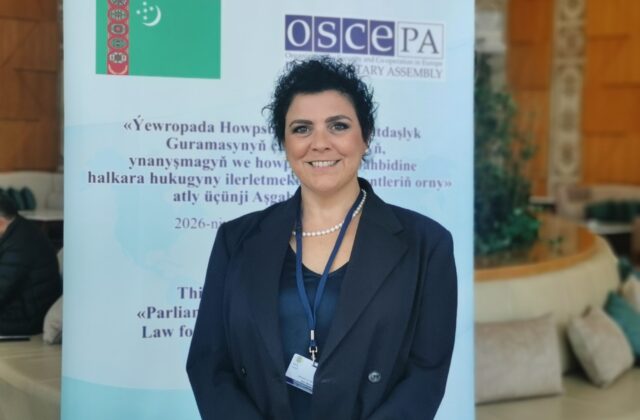
Sara Conti (Repubblica Futura) spoke during the debate on item 7 of the Grand and General Council (Consiglio Grande e Generale) agenda, dedicated to the ratification of the Association Agreement between the Republic of San Marino and the European Union.
The councillor retraced the main stages of the negotiation, acknowledging the contribution of the governments that have succeeded one another over the years, and dwelt on the opportunities that European integration could offer the country, without giving up its own identity and specific characteristics.
Below is the full text of Sara Conti’s speech.
I speak in this debate with a certain degree of emotion.
I must say that this is certainly not the first time this Chamber has discussed the Association Agreement with the European Union, but we can surely say that today’s session represents a unique occasion, also in light of our political journey, because we are finally called upon to express ourselves through a vote on the ratification of the Association Agreement.
In this brief speech, I will try to retrace some of the stages that have brought us to this moment — not to repeat what so many colleagues before me have already said, but because I believe it is important to remember how we got here.
I would like to recall that our country, our small state, has shown throughout its history a very strong attachment to its traditions, its peculiarities and its specific characteristics.
We find this every year, on the first of October and the first of April, during the installation ceremonies of the Captains Regent, as well as during the celebration of the Arengo. These are traditions that belong to our thousand-year-old history and that we continue to carry forward to this day.
Despite all the changes that our small state has inevitably had to face throughout its history, we have never given up our specificity or the elements that most distinguish us.
Naturally, as I said, we have also shown that we know how to confront, overcome and interpret the changes taking place beyond our borders, because it is inevitable that, whenever something happens outside that produces significant consequences within our state, we too are called upon to adapt and to find answers.
We well remember the watershed moment from which this whole journey began.
It is important to recall it, because it was precisely from that moment that the preparatory work began which, within a few years, led to the drafting of that European Commission document identifying the most appropriate path to allow San Marino, Andorra and Monaco to achieve a greater level of integration with the European Union.
The path identified was that of defining and negotiating an association agreement.
Naturally, an association agreement with these characteristics had never before been concluded with any other state, and I believe this is also one of the reasons why such a long negotiating period — which lasted more than ten years — was necessary.
I would like to recall these stages also through the people who, over the years, contributed to building this path. The first person I would like to mention is sitting right next to me: my colleague Antonella Mularoni, who at the time held the role of Secretary of State for Foreign Affairs and who worked on launching the process related to the Association Agreement.
Nor will I ever forget the image of former councillor and former Secretary of State Pasquale Valentini, standing next to the then EU High Representative for Foreign Affairs, Federica Mogherini, on the occasion of the official opening of negotiations in 2015.
Although at the time I was not yet a member of this Parliament, nor was I directly and actively involved in that historic moment, I remember it very well, and I still recall it today with a certain emotion.
From that moment on, every successive government continued to carry this process forward, even as the people called upon, in various capacities, to work on the dossier changed from time to time.
From this point of view, I believe credit must be given to everyone who contributed to this result — not only to the various Secretaries of State and the State Secretariats involved, but also to the officials and representatives of our diplomatic corps, who ensured that this complex and intricate work could continue over the years.
Of course, I cannot fail to mention my colleague and former Secretary of State for Foreign Affairs Nicola Renzi and, last but certainly not least, the current Secretary of State Luca Beccari, who had the opportunity to sign the Association Agreement, bringing this long negotiating process to its conclusion.
I do not wish to recall all these steps merely to be redundant with respect to the considerations already made in this Chamber, but because I believe it is useful to retrace them in order to fully understand the significance of the act we are carrying out today.
We now have before us the opportunity to open up more to the outside world, and I believe we must be able to do so without fear, so as to allow our economy to grow further and to let new opportunities develop and flourish, especially for our younger generations.
Once again, our state will be called upon to measure itself against its own capacity to face change — a major change, which we can certainly describe as epoch-making. I am convinced that we will manage to navigate this transition while keeping our institutions, our identity and our characteristics firmly intact, exactly as we have tried to do throughout the entire negotiating process.
The Association Agreement will allow us to build a stable and structured relationship with European institutions. It will allow us to take part in a system of shared rules, within which we will also have the opportunity to assert our specificities and to represent the interests of the Republic of San Marino.
We will be able to do so by sitting at the tables where the rules are discussed, rather than simply being subject to decisions made elsewhere, as would inevitably have happened had we not decided to draw closer to the European Union.
Time is running out, and I would like to conclude my speech by stressing that, in my view, being Sammarinese and being European are not two incompatible or opposing conditions.
On the contrary, I believe that the broader condition — that of feeling part of a Europe that is not merely a continent in geographical terms, but also a cultural reality in which I believe we can all recognise ourselves — also contains within it the possibility of feeling proudly Sammarinese, of defending our sovereignty, about which so much is said and so many fears are expressed, and of safeguarding our specific characteristics.
I believe these two conditions can coexist, and that, in certain respects, one can be encompassed within the other.
It is precisely today, at this moment so important for the history of our Republic, that we inaugurate a new path and open a new chapter in our history, in which San Marino will draw closer to the European Union and will have the opportunity to take part in the processes through which the shared rules that will shape our future are defined.
I am not usually one to speak of personal situations or feelings during my speeches in this Chamber, but I would like to use these last few seconds available to me to say that today I am truly very proud to be a member of this Parliament and to have the opportunity to cast my vote in favour of the ratification of an Association Agreement in which I deeply believe.