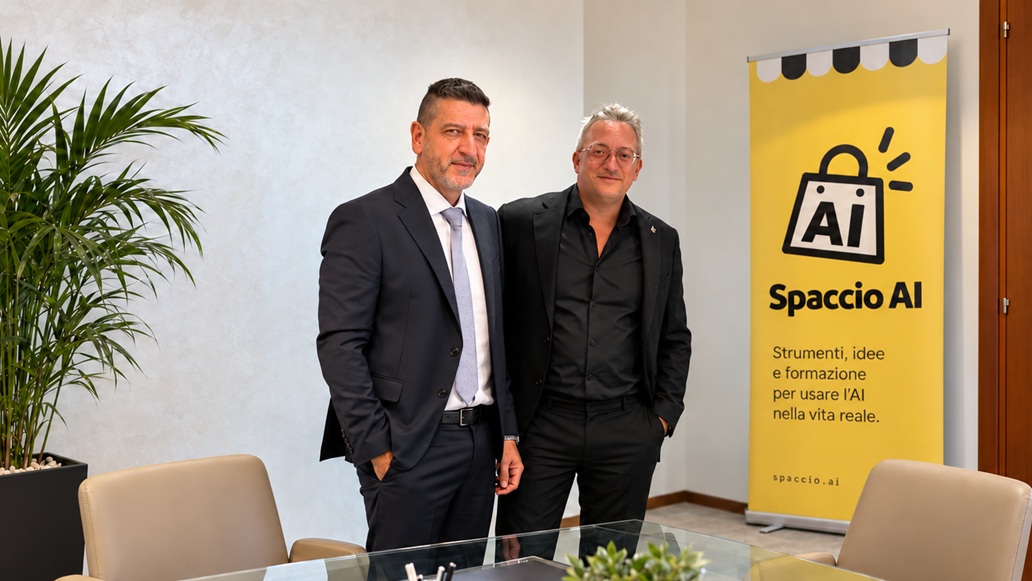
It’s called Spaccio.AI, and it aims to teach people how to use artificial intelligence in their everyday work. The project envisions training centres in Rome, Turin and San Marino, with a fourth already in the works in Luxembourg, which will also double as stores stocked with AI tools.
Behind the venture is Strategic, a San Marino-based company specialising in artificial intelligence and cybersecurity, which is promoting it together with international partners through an investment of roughly 900,000 euros over three years.
The name is provocative. The substance is not.
The project is entirely driven from San Marino.
It starts in San Marino, looks to Italy and already has its sights set beyond the border. At the helm are Luca Bartolini, general manager of Strategic, and Roberto Osler, a partner and expert in databases and IT systems for large companies.
AI has already made its way into offices, shops and professional practices, often through the back door. Some use it on the sly, some fear it, some pretend it doesn’t exist. Few have truly learned how to use it. The real risk isn’t artificial intelligence itself — it’s not knowing how to use it.
Spaccio.AI starts from this premise, with a simple idea: AI doesn’t take jobs away from those who know how to use and control it. On the contrary, it makes them more valuable.
“AI is an amplifier: if you’re foolish, it lets you do even more foolish things; if you’re smart and skilled, it makes you a thousand times more so,” explains Bartolini. “We want it to truly serve people and their work, not the other way around.”
The centres won’t be simple classrooms.
They will be vertical stores: people come in to learn, and they’ll also find the tools, from devices to software.
Training and products will share the same space, because a tool without the know-how to use it stays locked in a drawer, and know-how without tools remains mere theory.
Training will be delivered in person, in small groups, from beginner to advanced levels, covering ChatGPT, Claude, Gemini and the other tools reshaping the way we work.
Osler, who works with these tools every day, puts it this way: “I see people who have artificial intelligence right at their fingertips and use it like a search engine. You don’t need to know how to code. You need to know what to ask it, how to check what it tells you, and when not to trust it. That’s what we teach in our centres, hands-on, keyboard in front of you.”
Alongside the centres, the plan also includes events and intensive courses throughout Italy.
Some will call it an AI course. In reality, it’s a long-term bet built on a precise idea: the tools are within everyone’s reach — the skills are not.
The first event is already scheduled: Friday, 6 November, in San Marino, a session on the basics of AI aimed at small businesses.
Spots are limited, and most are already taken.