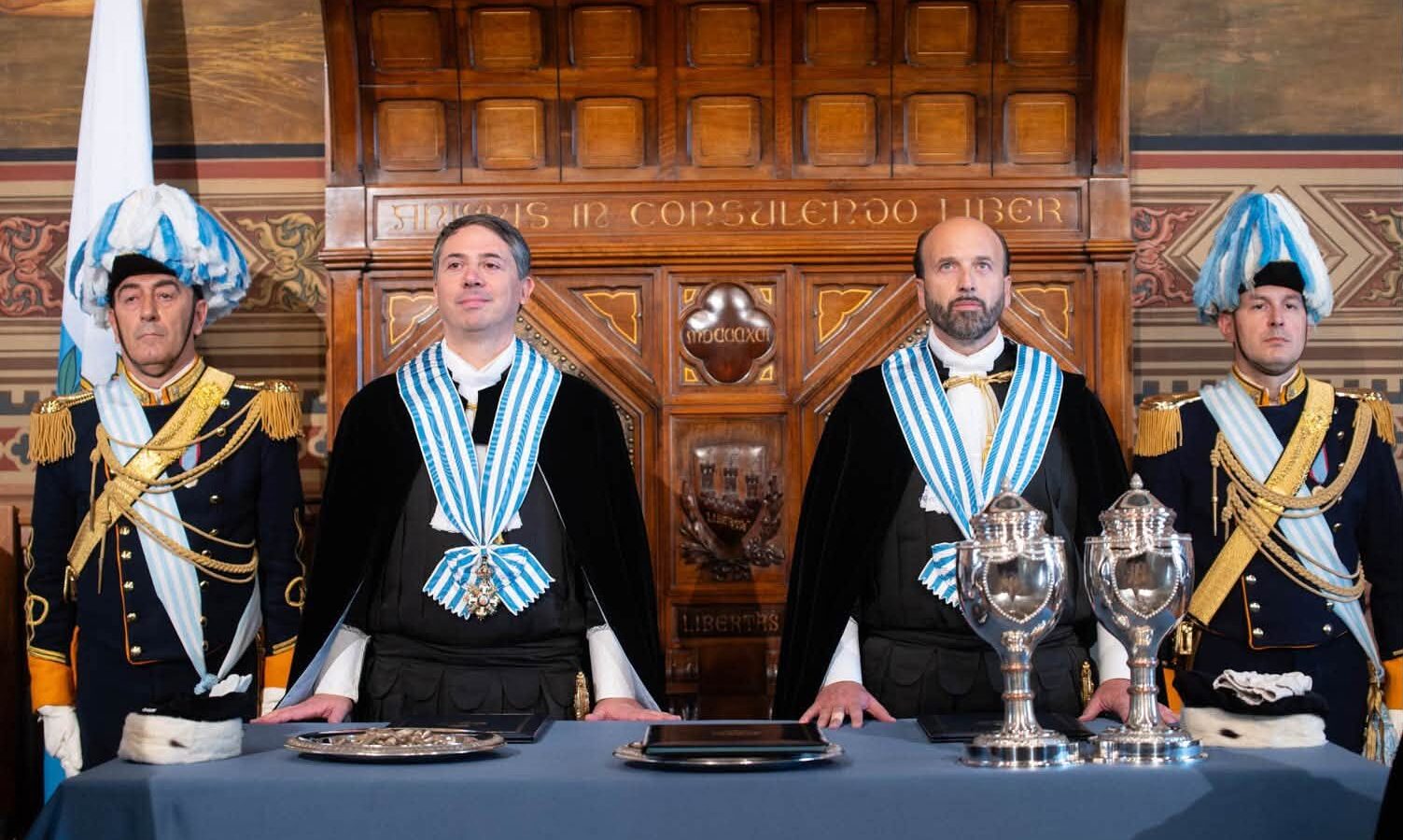
Opening address by the Captains Regent Gerardo Giovagnoli and William Casali on the occasion of the first sitting of the Grand and General Council (Consiglio Grande e Generale) for the new term
Ladies and Gentlemen, Members of the Council,
Mr. Secretaries of State,
There are images which, though belonging to the simplicity of everyday life, hold profound meanings and help us understand the responsibilities we are called upon to assume.
It is the image of a child who, one evening, beside his grandfather, lifts his gaze to the sky in search of the moon.
He watches it with wonder, points to it, and imagines he could reach it. He does not yet know the distance separating him from that light, nor the difficulties such an undertaking might involve. He knows only the beauty of what he sees and the desire to draw closer to something that appears so far away.
The grandfather listens. He knows that distance, but he also knows that mankind has managed to reach the moon: an undertaking that for generations had seemed impossible, made real through knowledge, determination and the work of countless people.
He does not diminish his grandson’s wonder, nor does he claim to tell him how far he will be able to go.
He passes on what he has learned from his own experience, while leaving him free to imagine his own future.
In that simple scene we find the meaning of responsibility towards future generations: to safeguard and hand down a legacy of values, knowledge and tools, so that those who come after us may find their own path and fulfil their own aspirations.
It is with this awareness that we have accepted the great honour of assuming the Supreme Magistracy of the State.
With a feeling of deep gratitude, but above all with full awareness of the responsibility it entails: that of safeguarding a heritage of freedom, values and institutions spanning the centuries, while keeping intact its capacity to speak to the present and look towards the future.
Taking on the Regency means, in fact, becoming part of a history that did not begin with us and will not end with our mandate.
A history made up of women and men who were able to preserve the independence of the Republic, face the difficulties of their respective times, and hand down to the generations that followed not only an institutional order, but an idea of community founded on freedom, human dignity and collective responsibility.
A legacy that cannot be considered permanently secured, because every generation is called upon to renew its meaning through its own choices.
Freedom, after all, is not preserved merely by celebrating what we have been, but by showing, through our everyday decisions, that we remain worthy of the values we have been given.
And it is precisely in the relationship between faithfulness to our roots and the courage to look beyond the known horizon that one of the most significant passages in the Republic’s contemporary history takes its place.
Only two days ago, on 19 October, the signing of the Association Agreement with the European Union marked a milestone of extraordinary importance in the Republic’s history.
It is an achievement that matured over years of negotiations, in-depth analysis and institutional choices, thanks to the contribution of those — trade union representatives, social partners and the entire administration — who, with perseverance and expertise, worked to offer San Marino new prospects without sacrificing the distinctive features of its history.
We cannot regard this moment merely as the completion of a diplomatic procedure or the conclusion of a long negotiation.
It represents, first and foremost, the concrete demonstration of a small Republic’s ability to look far ahead, to identify new opportunities, and to build, with determination, the tools needed to achieve them.
Like that child gazing at the moon, our Republic too has managed to turn its gaze towards a horizon that, given the complexity of the challenges and the size of our State, might have seemed distant.
The signing of the Agreement is therefore not the end point of a journey, but the beginning of a new season.
The necessary steps for its implementation will have to be taken and, above all, the commitments undertaken must be translated into concrete opportunities.
Along this path, openness and identity must not be seen as opposites: the ability to reach a goal must be matched by the ability to make the most of it responsibly.
We are convinced, in fact, that the European association process should not be experienced as a gradual weakening of our identity.
On the contrary, it is precisely the awareness of who we are that must allow us to face with confidence what we are called to become.
The identity of a people is not defended by shielding it from change, but by preserving its core principles while finding the courage to interpret one’s own time.
Our Republic has survived to this day not because it remained motionless, but because, over the centuries, it has managed to adapt to the transformations of history without giving up its essence.
Our freedom, our sovereignty, the value of neutrality and our vocation for dialogue do not belong solely to the memory of the past. They are the reference points guiding our future choices.
Reference points that take on an even deeper meaning in light of the international context we are living through.
We are living in a time marked by conflicts, geopolitical tensions and growing confrontation, in which the use of force increasingly prevails over the search for dialogue, and in which principles we considered firmly established are once again being called into question.
It is a time that challenges us on the international community’s ability to defend peace, human dignity and respect for the sovereignty of States.
In this scenario, the Republic of San Marino, drawing on its tradition of freedom and neutrality, must continue to regard international law as one of the essential foundations of coexistence among peoples.
International law cannot be invoked only when it protects one’s own interests and set aside when it limits their exercise.
The value of its rules lies in their consistent application, regardless of the size and political or military weight of States.
For a reality such as ours, respect for international law is not merely a guideline of foreign policy, but an essential guarantee of independence, freedom and security.
San Marino must therefore continue to recognise law, dialogue and cooperation as the fundamental instruments of coexistence among peoples, helping to spread awareness of them within its own community as well.
But the credibility with which a State defends its principles in international relations is also measured by the consistency with which it is able to apply them domestically.
The European path ahead of us will not only bring new relations with the outside world, but will require a gradual evolution of our institutional, legislative and administrative system.
The signing of the Agreement has opened a phase in which the ability to make commitments must be matched by the ability to put them into practice.
The gradual adaptation of our legal order to the provisions set out in the Agreement will require expertise, planning and an organisation of the work capable of ensuring continuity and quality.
This must not become a race against deadlines, nor a mere formal adjustment.
Clearly defined procedures, coordination tools and clearly assigned responsibilities will be needed, so that obligations can be addressed well in advance.
In this respect, the Grand and General Council will be called upon to play a particularly important role: the need for timeliness must always go hand in hand with respect for parliamentary prerogatives, the quality of debate and transparency in decision-making.
Alongside these major institutional milestones, we must not lose sight of people’s everyday concerns.
For many families, purchasing power, the cost of housing, and timely access to healthcare and services remain priority issues.
It is not for the Regency to indicate the economic or social policy choices to be made, which fall within the competence of the bodies vested with the relevant functions.
We nonetheless consider it our duty to draw attention to the purpose of public action: to respond to the needs of the community, within the limits of available resources and in the general interest.
This goal, which requires a courage we urge be found, matters more than adherence to abstract principles.
Laws and decisions acquire their full value when they produce results that are understandable and verifiable in people’s lives.
It is also through this capacity that citizens’ trust in institutions is nourished and strengthened.
The Regency also wishes to draw the Assembly’s attention to the quality of legislative output.
The constant introduction or amendment of provisions, sometimes shortly after their approval, can generate uncertainty, add to administrative burdens and make the application of rules more difficult.
A law, even when necessary and well conceived, risks failing to achieve its purpose if it is not clear, stable and practically enforceable.
Its effectiveness depends on citizens and professionals being able to understand it, and on the bodies responsible being able to apply it consistently.
For this reason it is important that legislative production be accompanied by an assessment of its effects: understanding what results have been achieved, what difficulties have emerged, and whether corrective measures are needed.
The law must not be regarded as an end in itself, but as a tool serving the public interest.
The quality of civic life, moreover, does not depend solely on the existence of rules and sanctions, however necessary they may be to protect rights and ensure people’s safety.
It also requires shared commitment to the principles underpinning our legal order and the spread of a solid culture of mutual respect.
Alongside effective rules, it is therefore essential to strengthen the role of schools, families and associations in civic education and in preventing harmful behaviour.
It is through the combined effort of different parties, each bearing their own responsibility, that conscious behaviour can be promoted and respect for the rules consolidated.
Ladies and Gentlemen, Members of the Council,
Mr. Secretaries of State,
differences of thought, different allegiances and the plurality of political sensitivities are an invaluable asset of our democracy.
But above every disagreement must remain the awareness of a shared responsibility: that of safeguarding the credibility of institutions and strengthening the bond of trust that unites them with the community.
May an authentic pact with citizens therefore be renewed, starting precisely from this Chamber.
A pact in which authority does not derive from the position held, but from consistency of conduct; in which debate does not become confrontation for its own sake; in which respect for the rules always goes hand in hand with respect for people.
A pact that recognises the citizen not merely as the recipient of public action, but as an essential partner, whose participation is a resource for the proper functioning of the State.
A truly virtuous institutional system must be able to recognise its own shortcomings and remedy them.
It must welcome observations and treat remarks made in good faith as opportunities for improvement, not as threats to its authority.
Citizens must be guaranteed not only the formal possibility of being heard, but also the certainty that their requests — when directed towards the common good — will be considered with seriousness, impartiality and respect, through effective means of protection and response.
The strength of institutions is not measured by their ability to avoid criticism, but by their ability to listen to it without losing their authority.
The quality of public action, indeed, cannot be reduced to mere formal compliance with procedures: it must find expression in the effectiveness of services, the certainty of timelines, transparency of decisions, and the capacity to respond to people’s needs.
We must foster a culture of evaluation and continuous improvement, in which mistakes are acknowledged and corrected and responsibilities are clearly assigned.
Citizens’ trust is not built on the promise that institutions are infallible, but on the certainty of their accountability.
This responsibility also obliges us not to stop at the needs of the present, but to look with foresight at the transformations that are redefining our era.
The quality of institutions is also measured by their ability to understand change and to put in place the tools needed to address it.
Technological progress and, in particular, the development of artificial intelligence are profoundly changing the way we live, work and make decisions.
These are transformations that affect not only the technical dimension, but also the protection of rights and the relationship between citizens and public authorities.
The Republic must know how to seize these opportunities through a model of governing innovation based on expertise, transparency, data protection and human oversight of decisions.
Technology can improve the efficiency of the administration, simplify procedures and make services more accessible, but it cannot become a tool for opacity or for evading accountability.
Not everything that is technically achievable is necessarily right or appropriate.
Every citizen must be able to understand how decisions that affect them are made and to know what means of protection are available to them.
Innovation must remain at the service of the person and of human dignity, never the other way round.
From this perspective, the small scale of our Republic can be a precious resource: the closeness between institutions, citizens, and economic and educational bodies can foster innovative solutions attentive to the specific characteristics of our territory, and allow their effects to be verified more directly.
It will, however, be necessary to invest in people’s skills and preparation, so that the benefits of digital transformation are accessible to all generations.
Sovereignty, too, takes on a new dimension today: retaining the ability to understand and govern the technologies and information on which essential functions of the State depend means continuing to exercise one’s autonomy responsibly.
And it is precisely this awareness that, at the start of our mandate, we wish to place at the heart of our commitment.
We cannot know all the challenges the Republic will be called upon to face in the coming months, nor fully foresee the changes that will affect our legal order and our society.
We can, however, choose the spirit with which to face them: with dialogue, responsibility, respect for the rules, and attention to the common good.
We wish to preserve a Republic capable of engaging with the world without losing its own identity, of embracing progress without giving up its values, and of guaranteeing freedom as a concrete condition of everyone’s life.
This is a commitment that requires authoritative institutions, attentive to people’s needs and aware of the limits and responsibilities of their own functions.
Let us return, then, to the image of the grandfather and grandson gazing at the moon.
That grandfather does not know which paths the child will choose, which difficulties he will encounter, or which goals he will manage to reach.
He knows, however, that he can leave him something precious: the memory of what has been, confidence in his own abilities, and the courage to look beyond what today seems impossible.
This, too, is the meaning of the responsibility we have taken on.
Our mandate will last only six months, but the Republic we are called to serve belongs to a much longer history, destined to continue beyond our time.
It is not for us to decide what future the coming generations should choose.
It is our task to safeguard the values and institutions that will allow them to make those choices freely, with awareness and confidence.
Because being faithful to San Marino’s history does not mean holding the Republic back in the past, but handing on to those who come after us a freedom that is still solid, and the possibility of building the future they are able to imagine.
San Marino, 21 October 2026/1726 d.F.R.