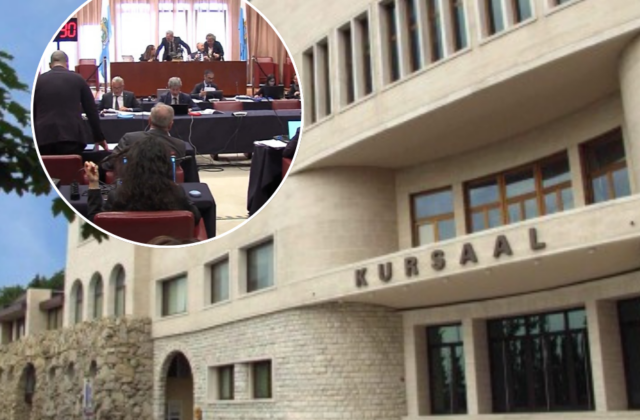
Paolo Pascucci will be the new Magnificent Rector of the University of the Republic of San Marino. The Grand and General Council (Consiglio Grande e Generale) unanimously approved the appointment made by the Academic Senate on 23 July. Pascucci will lead the university for the 2026-2029 term, taking over from Corrado Petrocelli after a long period of growth and development for the San Marino institution.
The handover received broad, cross-party support in the chamber. Even before offering congratulations to the incoming Rector, nearly every speaker focused on thanking Petrocelli, who was widely credited with playing a central role in the process that led the university to full accreditation and a stronger presence on the international academic stage.
The item was initially presented by Secretary of State Andrea Belluzzi, who stepped in while awaiting the arrival of his colleague Teodoro Lonfernini. Belluzzi recalled that, under Petrocelli’s leadership, San Marino’s university system completed the process that secured its full standing within the European Higher Education Area. For Pascucci, he said, the challenge now will be to consolidate this achievement, strengthen accreditation, and continue expanding the university’s academic offerings.
Speaking for the Pdcs, Manuel Ciavatta described the incoming Rector as a professor of “great experience and high scientific standing,” while also praising the work carried out by the outgoing Rector. Psd, Libera, Repubblica Futura, Alleanza Riformista and D-ML likewise voiced appreciation for the university’s progress and extended their congratulations to the new Rector.
The debate also touched on the issue of university autonomy. Nicola Renzi of Repubblica Futura suggested opening a reflection on whether, going forward, it remains necessary for the Council to formally approve such appointments, arguing that this could pave the way toward “full recognition of university autonomy.” Giuseppe Maria Morganti of Libera took a different view, insisting that the Council’s endorsement must remain “a fundamental step,” given the significant institutional weight carried by the Rector as head of the Republic’s only state university.
Fabio Righi of D-ML focused instead on the relationship between the university, innovation and business, urging the new Rector not to settle for a traditional management approach but to turn the university into a driving force capable of anticipating changes in the productive sector. Matteo Rossi of the Psd called Petrocelli an “iconic figure,” recalling the international profile the university achieved during his tenure.
Closing the debate, Secretary of State for Education Teodoro Lonfernini acknowledged that the approval item had “initially been overlooked” when the agenda was prepared, and thanked all the parliamentary groups for allowing it to be included.
Lonfernini then looked ahead to the university’s next phase, announcing plans to launch a public competition to permanently fill the position of Director General, which is currently held on an interim basis following Laura Gobbi’s move to head the Public Administration Department (Funzione Pubblica).
The Secretary also identified the development of the university’s so-called “third mission” as one of the key priorities going forward: putting the institution’s scientific, educational and cultural expertise more directly at the service of the local area and the community, while strengthening ties between the university, public institutions, and the economic and social fabric. This strategy, he added, must go hand in hand with the development of new academic programs and greater competitiveness for San Marino’s university system.
At the end of the debate there were no divisions: the approval of Paolo Pascucci’s appointment as Magnificent Rector for the 2026-2029 term passed unanimously.