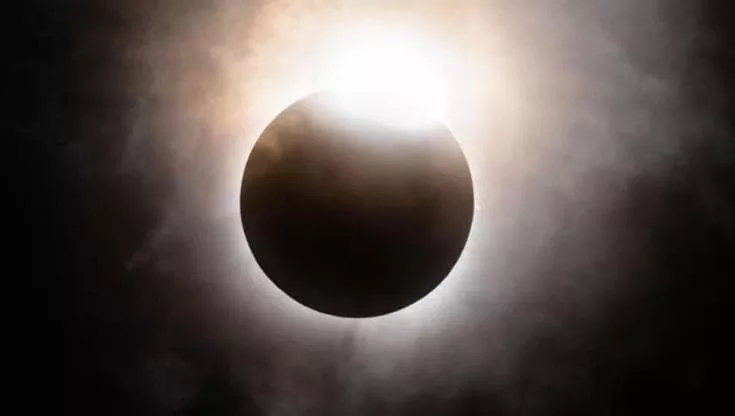
All eyes will be on the sky this evening for the solar eclipse of August 12, one of the year’s most eagerly awaited astronomical events. In parts of Europe the Sun will be completely blocked out by the Moon, while in Italy the phenomenon will only be visible as a partial eclipse, with particularly high coverage percentages in the north.
Among the cities most affected is Bologna, where the Moon will cover around 92.7% of the solar disk. Maximum coverage is expected at around 8:21 pm, by which time the Sun will already be very low on the horizon. It will therefore be important to choose an observation point facing west and free of obstacles such as buildings, trees or hills.
High percentages are also expected in Genoa, with around 93.6%, Turin with 93.3%, Milan with 92.3% and Venice with 91.3%. The spectacle will be less pronounced further south: in Rome coverage should reach around 69%, while in Naples it will be about 46%.
The main recommendation, however, concerns safety. Never look directly at the Sun with ordinary sunglasses, even particularly dark ones. To follow the eclipse safely, special viewers or glasses fitted with filters compliant with the ISO 12312-2 standard and in perfect condition are required.
Particular care should also be taken with binoculars, telescopes and cameras, which require specific solar filters mounted in front of the lens. Even when photographing the phenomenon with a smartphone, it is advisable to use adequate protection in front of the camera lens.
Those without special glasses can resort to indirect projection using a small hole punched in a piece of cardboard, observing the image of the Sun projected onto a surface and never looking directly through the hole.
In Italy it will never be safe to remove eye protection during the eclipse, since the Sun will not be completely obscured. The only exception applies to locations within the path of totality.