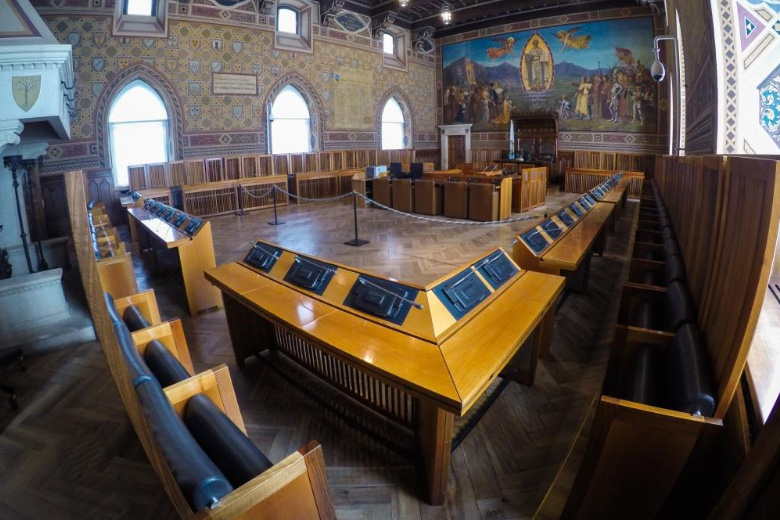
The Burgagni-Cherubini report will be discussed during the session of the Grand and General Council (Consiglio Grande e Generale) convened from 7 to 23 September. At the centre of the debate is the case of a San Marino citizen convicted in Italy, shortcomings in oversight, and a series of proposals: preventive measures, checks on self-certifications, extraterritorial jurisdiction, and a ban on public office for those convicted of sexual offences against minors.
A 55-page report that begins with a particularly serious judicial case ends up scrutinising rules, controls, communications between San Marino and Italy, and public administration procedures. The document, drawn up by the Technical-Administrative Commission composed of lawyers Gianna Burgagni and Daniele Cherubini, will now reach the Council floor: it has been included among the agenda items for the next session of the Grand and General Council, convened for 7, 8, 9, 15, 16, 17, 18, 21, 22 and 23 September 2026. The topic appears at item 17, listed as “Reports of the Technical/Administrative Commission on the child sexual abuse case, in implementation of the resolution approved by the Grand and General Council in its sitting of 18 September 2025, and subsequent debate.”
The examination had already been included on the agenda of previous Council sessions but was postponed in both June and July. The Council’s official website indicates that the reports, submitted on 10 June 2026, were still “awaiting examination” following the earlier postponements. The dossier now formally returns to the councillors’ table.
The work stems from the resolution approved by the Council on 18 September 2025 and addresses the institutional consequences of the case involving a San Marino citizen given a final conviction in Italy for sexual offences against minors, who was subsequently arrested. But the goal goes beyond the individual case: understanding where the system showed weaknesses and how to prevent similar situations from recurring.
The mandate given to the Commission was broad: to examine the possibility of introducing administrative preventive measures to protect the public during extradition proceedings; to assess penalties for those who make false statements or omit information relevant to access positions in public administration; to study extending San Marino’s jurisdiction to sexual offences committed abroad by San Marino citizens; to reconstruct the entire administrative and information trail of the case; and to consider banning individuals convicted of sexual offences against minors from working in public administration.
The most delicate point of the case concerns what happened while the Italian proceedings were still under way. According to the Commission’s reconstruction, the conviction relates to events that occurred during a football camp held in Carpegna between 27 June and 2 July 2021. The victims were four 14-year-old minors from Ancona. Twenty-two children from the Republic of San Marino also took part in the camp, but they stayed overnight in a separate accommodation facility, not in the rooms where the victims were housed.
The Italian ruling became final after the Court of Cassation’s decision. The sentence indicated in the report is 4 years and 4 months’ imprisonment, alongside a series of accessory penalties and security measures. These include a lifetime ban from holding positions in schools and facilities primarily attended by minors, a temporary ban from public office, and, after serving the sentence, a one-year prohibition on approaching places habitually frequented by minors and on carrying out work involving regular contact with them.
The extradition request and the arrest
The reconstruction of the exchanges between Italy and San Marino occupies a substantial part of the report. In June 2025, documentation regarding the conviction and Italy’s request to proceed with arrest for extradition purposes arrived through institutional channels.
This is where one of the central issues emerges. San Marino does not extradite its own citizens, based on declarations made at the time of ratifying the European Convention on Extradition. The individual concerned, moreover, expressed through his lawyer his intention to serve his sentence in San Marino.
The Commission nonetheless highlights an important point: before the extradition request arrived, no San Marino authority had been formally notified of the pending Italian criminal proceedings. Furthermore, the confidential nature of information exchanged through international cooperation prevented that data from being freely used for purposes other than those for which it had been communicated.
On 23 August 2025 the convicted man was finally arrested on Italian territory. The San Marino Gendarmerie, working with Italian authorities, had monitored his movements and assisted in the arrest. On 27 August, just days later, the Office for Labour and Active Policies (Ufficio per il Lavoro e le Politiche Attive) filed a complaint with the Investigating Judge over statements the man had made in administrative procedures.
The public employment issue
It is precisely here that the report addresses one of the most controversial aspects of the case.
On 12 July 2023 the man had applied to join the placement lists for public employment, declaring through self-certification that he had no criminal record and no pending charges.
The relevant office subsequently requested verification from the San Marino Court. The pending charges certificate at that time showed a proceeding for assault relating to events in Murata in April 2021. The documentation concerning the Italian proceedings for offences against minors, however, had not yet been recorded in the San Marino certificates.
The same situation repeated itself in September 2024, when the man again applied to the placement lists and submitted another self-certification.
In the meantime he held several positions. The report reconstructs periods of employment in 2023, including a stint as a kitchen assistant, followed by roles within the public administration.
The most sensitive development comes in 2025. From 24 April to 22 June, he worked mainly in the kitchen of the Cailungo nursery school, with some days covering shifts in the kitchens of the Dogana and Città nurseries. From 23 June to 6 August he worked at the Dogana school complex.
The Commission nonetheless clarifies an important point: during that period he reportedly worked exclusively in the kitchens, as a kitchen assistant, and there is no evidence that he had duties inside the nurseries themselves or any direct contact with the children.
Why the Italian conviction did not appear on the certificates
This is one of the passages that best explains the system’s breakdown.
When the San Marino pending charges certificate was requested again in August 2025, the document still read “nothing found,” despite a final conviction having already been handed down in Italy.
The report devotes numerous pages to explaining the difference between the Criminal Record (Casellario giudiziale) and the Pending Charges register (Carichi pendenti). The former essentially covers final convictions; the latter, proceedings still ongoing before the San Marino Court.
The Commission also highlights a structural weakness in the exchange of judicial information between Italy and San Marino. The two countries do not currently have, as described in the report, a shared centralised IT system allowing for immediate information sharing. Records of final convictions are transmitted periodically, while proceedings still pending abroad do not automatically flow into San Marino’s pending charges register.
It is precisely on this front that the report calls for a leap forward: intensifying and strengthening the exchange of information between the two states, particularly regarding criminal proceedings and final convictions.
Preventive measures before extradition is even completed
The Commission does not stop at reconstructing events. It puts forward concrete proposals.
The first concerns the possibility of intervening before an extradition procedure is concluded, especially when offences against minors are involved.
According to the report, consideration should be given to introducing, through legislation, administrative preventive measures that the judicial authority could apply when proceedings for offences against minors or an extradition procedure are pending.
Among the options mentioned are bans on approaching places habitually frequented by minors and suspension from specific work activities involving contact with children.
The underlying principle is that it should not be necessary to wait for the conclusion of the entire international judicial process before adopting administrative protective tools. The Commission nonetheless explicitly stresses that any such measure must be governed by law and accompanied by appropriate safeguards.
False self-certifications, stricter checks
A second front concerns the statements made to access public employment.
The Commission proposes strengthening the system of checks and consequences for those who make false statements or omit relevant facts in public administration procedures.
One of the suggested changes concerns official verification of self-certifications. According to the report, such checks should become mandatory not only for winners of public competitions but also at the moment of registration and access to public placement lists.
A tightening of administrative consequences is also proposed: those who submit false statements or documents could not only lose the benefit obtained but also be barred for a set period from accessing other benefits.
Sexual offences committed abroad: San Marino could prosecute
Another proposal touches directly on the Criminal Code.
The Commission addresses the issue of extraterritorial jurisdiction – that is, San Marino’s ability to prosecute its own citizens for certain offences committed outside the Republic’s borders.
The report proposes including Article 173 of the Criminal Code, concerning lewd acts against minors or consenting incapacitated persons, among the offences for which San Marino law could apply even when the act was committed abroad.
The Commission also suggests a broader reflection on extending this principle to other sexual offences committed against minors, recalling the obligations arising from the Lanzarote Convention.
Those convicted of sexual offences against minors barred from public administration
The final major chapter concerns access to public administration.
The Commission believes it possible to explicitly introduce a ban on holding public office or public employment for anyone convicted of sexual offences against minors.
To achieve this, it proposes amendments to the regulations on eligibility requirements for public competitions and public employment relationships, as well as possible changes to the job placement lists.
The aim would be to make explicit a barrier that, according to the Commission’s analysis, currently needs clearer legislative definition, coordinated with the rules on convictions, bans from office, and the requirements needed to work in public administration.
Now the debate moves to the Council floor
The picture emerging from the 55 pages, then, is not limited to the responsibility of a single individual. The case becomes a starting point for highlighting a series of grey areas: judicial information that does not automatically flow between two states, differences between the criminal record and the pending charges register, self-certifications that require stricter checks, limits stemming from the rules on extraditing San Marino citizens, and preventive tools deemed insufficient.
The Commission thus puts forward a package of measures: more checks, greater exchange of information with Italy, preventive measures to protect minors, a review of the rules on false statements, an expansion of San Marino’s jurisdiction, and clearer rules on access to public employment.
After being postponed in previous sessions, the debate is once again on the Council’s agenda. Item 17 of the September session provides not only for the examination of the reports but also for “subsequent debate.” It will therefore fall to the Grand and General Council to discuss the Commission’s conclusions and any legislative and administrative responses to be put in place.