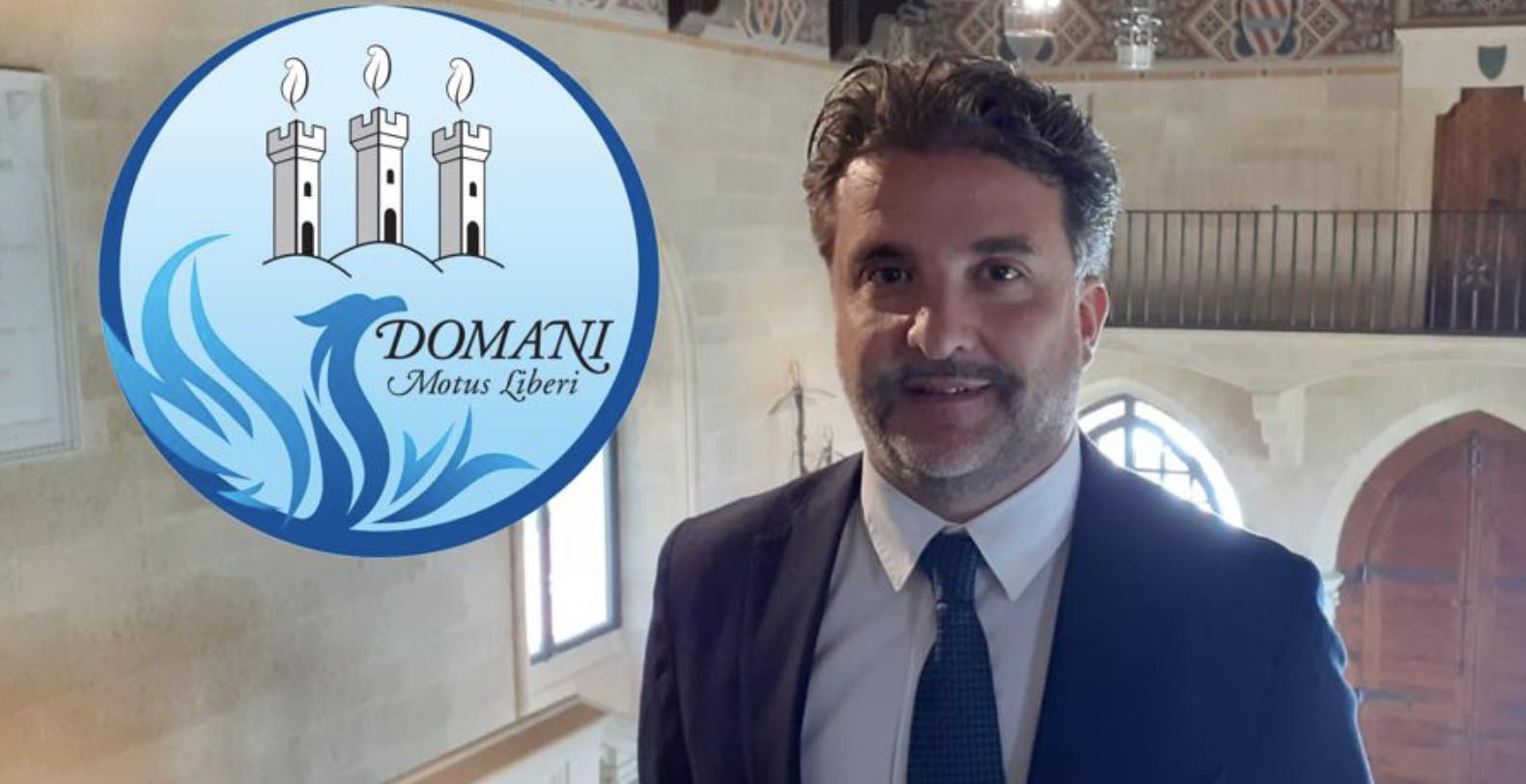
Fabio Righi (Domani-Motus Liberi) spoke during the debate on item 7 of the Grand and General Council (Consiglio Grande e Generale) agenda, dedicated to the ratification of the Association Agreement between the Republic of San Marino and the European Union.
The opposition councillor delivered a sharp speech, responding to criticism directed at his political party by tracing D-ML’s positions from 2019 to the present day.
His address focused on the call for a referendum, the political responsibilities of successive governments, the competitiveness of businesses, and the need to plan costs, investments and the reorganisation of the public administration.
Below is the full text of Fabio Righi’s speech.
«We believe it is necessary and urgent to immediately suspend, and consequently slow down, the process of association with the European Union, which should only resume once clear and necessary agreements have been reached with the Italian Republic — with which we urgently need to restore not merely a relationship of good neighbourliness, but one of a strategic nature».
This was Domani-Motus Liberi’s position in 2019, before it took on government responsibilities during the 2019-2024 legislature.
«In order to fully grasp the importance of the Association Agreement and be prepared for this milestone, there needs to be, within the country, a complete and transparent sharing of the Agreement’s contents, so that citizens are properly informed both of the opportunities it brings and of the changes and reforms it requires of us.
We also believe it is appropriate that, with regard to these opportunities and changes, citizens be properly involved and called upon to express their views».
This is the point in the manifesto with which Domani-Motus Liberi stood in the 2024 general election.
I want to stress this, as I already did in the Foreign Affairs Committee, so that the position my party has consistently maintained since its founding is not misrepresented or exploited, and so that it is not portrayed — as some here like to do through the microphones of this Chamber — as a position cobbled together in recent months in pursuit of some obscure agenda.
That said, in all honesty, I listened very carefully to the speeches given in this Chamber, and I believe the very least this Chamber — at least the majority and those who spoke before me — could do is stop telling tall tales and hiding behind easy slogans.
The first of these is the claim that this Agreement is wanted by the entire citizenry, purely and simply because citizens voted in four governments that supposedly placed the Association Agreement with the European Union among the top priorities of their political activity.
You can tell that story to people with short memories. It’s true that in San Marino we often have short memories, and that citizens too tend to forget certain events, but perhaps it is worth clarifying a few points to remind everyone of what our country’s situation actually was across the various legislatures.
Let’s start with the government of 2012-2016. I don’t recall the European Union being at the centre of that government’s political agenda. What I do recall at the centre of political activity were the blacklist issue, relations with Italy, the Delta case, and the consequences that affair had on San Marino’s entire economic and financial system.
I also recall how extremely difficult relations were with the Italian government of the time.
Then came the government of 2016-2019. I’ve heard you talk about the Adesso.sm government many times in this Chamber — made up of Sinistra Socialista Democratica, Repubblica Futura and Civico 10 — and it seems to me that whenever you spoke about it, you focused on very different issues than the European Union.
According to what you have continued to tell us through these very microphones, that was the Conforti government, the government of the banks, and of all those untold disasters that you still remind us of today.
Then there was the government of 2019-2024, which is particularly easy for us to discuss, since we were part of it. Even during that legislature, the European Union was not really at the centre of government activity.
We had to deal with the Covid pandemic, we carried forward a whole series of initiatives, and the European Union issue suddenly became something that had to be rushed through dramatically only towards the end of the legislature, when Rete left the government and someone, perhaps, realised that — besides having obstructed the country’s development — they had very little else left to tell citizens.
At that point, the offices began saying that matters needed to be closed, that all the files had to be brought to a conclusion exactly as presented, with no further scrutiny and no specific analysis whatsoever.
This is precisely where another great lie comes in, one we have heard repeated in recent days — the claim that we were in government, said nothing, and even approved the initialling of the Agreement.
No, that too is a falsehood that keeps being told. We were present at the State Congress and we voted against that initialling, which was put to the State Congress on the basis of a text drafted in French that, moreover, was not yet complete.
Proof of what I am saying lies in the fact that you had to put the final text of the Agreement to a vote again only recently, precisely because what had been initialled was not yet the final text.
And to think that, since then, the world has changed even further.
Let’s move on, then, to the 2024-2026 period, the one in which we are told that the current political class has managed to leave behind all the rot of old-style politics, all the rot of a certain way of doing politics, and that it now represents, at last, a new kind of politics.
Well, the new politics you represent, in our view, is the one that tried to sell the country to a Spanish businessman through the entire DES project.
The new politics you represent is the one behind the Bulgarian case, the affairs surrounding the sale of the banks, with friends, relatives, alleged kickbacks, ongoing proceedings, international arbitrations and open commissions of inquiry.
Then there are what we consider cases of state-sponsored money laundering, such as the Giochi del Titano affair, the outcome of which is still unclear, right up to the latest, pitiless episode involving the Bureau of the Council, in which, in our view, you broke the law, committed crimes and did whatever you deemed right and fitting to do.
This is the picture with which the Republic of San Marino presents itself to Europe today.
You come into this Chamber to further insult not only the intelligence, but also the dignity, of San Marino’s citizens. As for our own dignity, you have tried to attack it in every way possible, but that is not a problem for us.
We have broad shoulders and we are certainly not here to complain about what has been done to us. But when it comes to the citizens, the matter is different, because all of us took an oath in this Chamber, pledging to act in the interests of this country, this nation, and its people.
That is precisely why I want to revisit some of the mockery we have been forced to listen to through these microphones. We hear it said today that now we must start studying, that now we must begin to imagine the future of our Republic, that now we must become transparent politicians.
Indeed, those who dare to suggest that perhaps we are not yet fully ready, that perhaps something isn’t quite right, that perhaps we have overlooked some important aspect, and that maybe, before signing a contract, it would be wise to read what is actually written in it and understand the consequences of the commitments being made — such people are even mocked.
After all, according to this logic, that is apparently how it works everywhere else in the world: citizens first sign their contracts, and only afterwards do they go and read what’s written in them, assessing whether they can meet those commitments and whether they will actually be able to honour and carry them through.
And this is precisely where the great insult in what you are saying lies, but also the great truth you have long been trying to hide — namely, that you have turned this issue into a slogan, that you have turned the Association Agreement with the European Union into a political banner, without paying the necessary attention to what the competitiveness of the Republic of San Marino within the European context will actually have to be.
Why do we say this? Because the task of politics — at least as we understand political activity — is not that of a building caretaker, who merely has to manage what already exists.
The task of politics is to have a vision, to try to understand what will happen over the years, and to prepare one’s country so that it is able to seize the opportunities that will arise in the future.
We have never considered, and will never consider, this Agreement solely through the lens of normalising relations. Incidentally, when we talk about normalisation, we are mainly talking about the normalisation of your relations, your way of doing politics, and your relationship with the outside world.
We have no need to normalise our way of doing politics, because we have been crystal clear from day one that certain things cannot be done, that laws cannot be broken, that institutions cannot be bent to one’s will, and that we are not in this Chamber to form a business club, but to serve the interests of the Republic of San Marino.
That is probably why, for you, becoming normal represents a great achievement, while for us being normal is not an achievement at all — it is simply normality.
Today we find ourselves discussing whether we should be normal, and whether our businesses should be able to enjoy the same opportunities when operating outside national borders. But why, before signing this Agreement, should they not have had those opportunities in the first place?
Why, before today, should our foreign policy and our economic policies not have paid attention to the needs our businesses have been voicing for years?
This brings us to other claims I heard during today’s debate, according to which anyone expressing doubts about this Agreement is unaware of what our businesses need. Well, we have a very clear idea of what our businesses need. The issue of energy has been raised with us by the business community for years.
The issue of introducing VAT has been raised with us for years. The issue of TARGET2 has been raised with us for years. The need to set up proper training pathways has been voiced to us for years, as has the need to carry forward a genuine process of digitalisation for our country.
Now you need to explain to me what prevented us, over all these years, from actually tackling these issues, and what still prevents us from doing so today. What stood in our way? Certain political forces stood in our way — certainly not the absence of an association agreement with the European Union.
What was lacking was political will — the very same political will that does not automatically change simply because of signing a piece of paper.
The people who created certain scandals, the ones who right up to the last moment tried, or at any rate risked, jeopardising our European path, are always the same people — you, your followers, your associates, your officials. The people are always the same.
On this point I agree, at least in part, with the remarks of the speaker before me, who noted that, in the absence of a concrete plan and genuine political will to change the country, we can sign any agreement we like, but we will not achieve the results we are aiming for.
So what are you telling us? What are you telling the citizens of San Marino? We are tired of listening to this nonsense in this Chamber, and I believe that if citizens had even a shred of love for this country, they ought to be out in the streets over certain situations.
Someone, during the Communications item, said it was ridiculous to keep raising certain issues, because there would be nothing left to argue about.
Nothing to argue about? Do you consider it a minor matter to break the law, commit crimes and bend institutions to one’s personal will? Do you not consider the integrity of the rule of law and respect for democratic rules to be sufficiently important issues?
I believe these are absolutely fundamental questions.
Allow me, at this point, to address the issue of the referendum as well, on which, once again, we keep being told that this tool cannot be used. Look, it is not Domani-Motus Liberi claiming that a referendum is possible — the judges say so, the Guarantor Panel on the Constitutionality of Norms (Collegio Garante della Costituzionalità delle Norme) says so.
This concerns the confirmatory referendum of council initiative which, as set out in ruling no. 5 of 2025, legitimately allows the ratification of the Agreement to be put to the citizens for confirmation through a referendum vote.
On this point too, we keep hearing what I consider another great falsehood — namely, that because ours is a representative democracy, the moment general elections are held, citizens completely surrender their sovereignty to the representatives they have elected. This is entirely your own interpretation.
Sovereignty continues to reside with the people, and the moment the people ask to exercise it directly — as they have on several occasions, asking to reclaim direct exercise of that power — I believe it is the duty of the institutions to accommodate the legitimate holder of sovereignty.
Here again, it is not Domani-Motus Liberi arguing that it is possible to proceed in this direction, but the Guarantor Panel itself that has clarified this possibility.
Let’s not keep hiding behind the fact that there have been four governments that pursued this path, claiming that you were elected by citizens specifically and exclusively to sign the Association Agreement with the European Union.
Are you perhaps trying to tell me that career advancements tied to party membership cards, unlocked building plots, jobs within the public administration, and all the promises made both outside and inside this Chamber — promises that continue to be made even today — had nothing to do with the outcome of San Marino’s elections?
Do you think it’s all perfectly normal, and that citizens voted for you simply because you waved the European Union flag? Gentlemen, where exactly do you think you’re living? Do you really believe people don’t notice what is happening in our country?
People often say nothing because a situation has developed about which we harbour serious doubts regarding respect for democratic principles.
At this moment, in our view, there is a striking climate of silence (omertà) within the country. There are people who do not stand for political office because they fear repercussions at their workplace, and there are people who do not freely express their opinions because they are afraid of the retaliation that occurs, and that you carry out.
This is the truth, as we see it.
Finally, I would like to address the question of opportunities, using my remaining minutes to reiterate once more that I believe my party has demonstrated, through actions — including during its time in government — just how committed it is to building a transparent country, open to the outside world and able to keep pace with the times.
We have not shown this commitment through words alone. We drafted laws, we tabled measures, we voted for them, and we fought resolutely against the fake news spread by certain people who, in practice, escorted to the border multinational companies that could have represented a development opportunity for our country.
And then you come into this Chamber mouthing off about the younger generations and the opportunities we must offer our young people.
But those young people go to work abroad because they want the chance to operate within certain professional environments — the very same environments we could have created within the borders of the Republic of San Marino, and which you chose not to create.
You sent sovereign investment funds packing, you gave up countless opportunities, and you did so knowingly.
From our point of view, all this has caused clear damage to our country — damage for which you should be held accountable. Certainly, from today onwards, we will all need to roll up our sleeves, but we cannot overlook the responsibilities of those who brought us to the situation we find ourselves in today.
When we are told there is no alternative to the Association Agreement, the obvious response is that of course there are no alternatives left — because you destroyed every one we could have built.
Today, then, we find ourselves having to accept what is being proposed to us, merely negotiating the chance for an extra day, month or year to adapt, purely and simply, to European regulations.
You are the ones who brought us to this situation, and I believe the resulting political responsibility is enormous.
From this moment on, we will certainly need to roll up our sleeves, because we have no intention of abandoning our political commitment, as some would have us do when they tell us that if we disagree, we might as well resign.
No — we have a responsibility to remain in this Chamber and keep working for the good of our country, despite you and despite the situation we find ourselves in, because we continue to believe that a different Republic of San Marino is possible.
So we will have to roll up our sleeves, and once again we return to what we have been saying for months, indeed for years. Serious planning of expenditure is needed, as is planning of investments and planning of the reorganisation of our public administration, which cannot be carried out in a slapdash, improvised manner.
Adequate control systems must also be guaranteed, because surely you don’t intend to use the opportunity presented by the Association Agreement with the European Union to bring another four hundred people into the public administration — people from whom you then expect to receive votes in the next general election.
On this front too, we want precise controls to be guaranteed.
As things stand, none of this yet exists.
It doesn’t exist, and you yourselves admit as much in your own remarks, when asked whether the public administration is actually ready to face this change, and you reply that you hope so, that you wish it were so.
But that is the kind of answer I might get from an ordinary citizen I happen to run into at a bar, whom I ask whether, in his opinion, our country will be ready to face this process, and who replies that he hopes so.
That cannot be the answer given by those called upon to sign international commitments on behalf of the entire country, by those holding the pen and taking on the responsibility of signing an Agreement of this magnitude.
The time has come for seriousness and responsibility. The responsibility for this situation is yours, and belongs to no one else.
It’s always you. There was even a song that went: “It’s always you causing chaos.”
Jokes aside, this is the situation we find ourselves in, and today we still don’t even have a vague idea of what activities will actually make our country competitive within the European context.
You can say it loud and clear — this is not our politics, this is not the state that represents us, and these are not the institutions or the ways of exercising power in which we recognise ourselves. We will keep working to build a different Republic of San Marino.