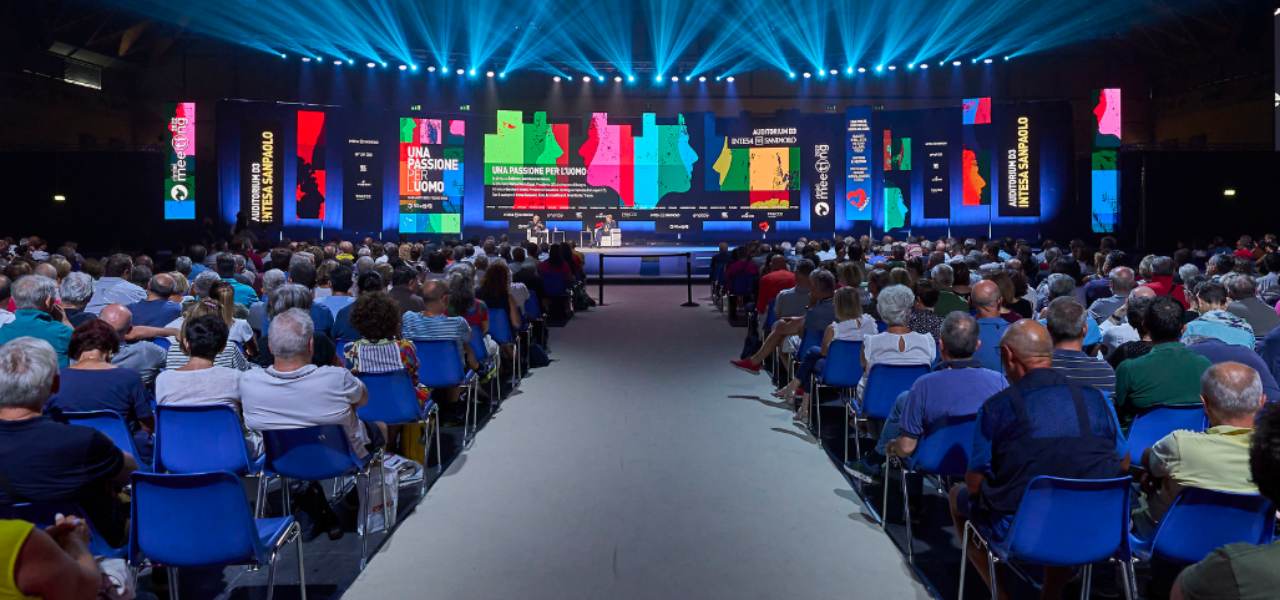
After a weekend marked by the visit of Pope Leo XIV, the Rimini Meeting enters its fourth day with a particularly packed Monday, August 24. From the Holy Land to geopolitics, by way of energy, economics, education, artificial intelligence and science, the day’s program brings together religious figures, journalists, institutional representatives, scholars and leading figures from the business world.
One of the day’s inevitable threads will be conflict and the future of the Middle East. It begins at noon in the Intesa Sanpaolo D3 Auditorium with “Loving the Holy Land.” Francesco Ielpo, Custos of the Holy Land, and Father Gabriel Romanelli, the Latin parish priest of Gaza, will take part in the discussion, introduced by Tv2000 correspondent Alessandra Buzzetti. The meeting will bring to the fairgrounds direct testimony from those who continue to lead Christian communities marked by war and suffering. Ielpo oversees the Franciscan communities present in Palestine, Israel, Syria and Lebanon, while Romanelli brings the daily experience of the Gaza City community.
The reflection on the new international balance of power continues at 1pm in Conai Hall A2 with “A furious world.” Alessandro Aresu and Giovanni Orsina, moderated by Domani deputy editor Nicola Imberti, will attempt to read a global picture in which the old equilibria have progressively crumbled while what comes next has yet to take precise shape. At the center: sovereignty, markets, democracies, diplomacy and the return of force as a tool of international relations.
Also at 1pm, there will be room for interfaith dialogue with the meeting “Continuing to meet,” bringing together, among others, Wael Farouq, Fausto Taiten Guareschi, Emilia Guarnieri, Yahya Sergio Yahe Pallavicini and Wakako Saito. The starting point will be the friendship between Father Luigi Giussani and the Buddhist monk Shodo Habukawa, prompting reflection on what space encounters between religions can still occupy today in an international context riven by fractures and conflicts.
At 3pm the Middle East returns directly to center stage, with an event dedicated to the prospects of the Israeli-Palestinian conflict and the two-state solution. The Meeting’s program starts from a stark question: has that prospect already been overtaken by events, or can it still be taken seriously as a basis for future coexistence?
At the same time, in the Neri Generali Cattolica Hall, there will instead be room for a biblical and cultural discussion dedicated to the Song of Songs. Among those taking part will be Cardinal José Tolentino de Mendonça, Prefect of the Dicastery for Culture and Education, alongside writer, poet and translator Davide Brullo.
Energy, the Mediterranean and business
One of the meetings most closely tied to current economic affairs is scheduled for 3pm in Conai Hall A2: “The role of the Mediterranean in the global energy context.” At the table will be Italy’s Minister of the Environment and Energy Security, Gilberto Pichetto Fratin, alongside representatives from some of the sector’s leading players, including Snam, Enel, Eni and Hitachi Energy.
The starting point is the oil supply crisis linked to the closure of the Strait of Hormuz, which has brought the strategic position of the Mediterranean and of Italy back into focus. The discussion will address infrastructure, supply chains and the country’s potential to strengthen its role as an energy hub.
Also at 3pm, discussion will turn to the relationship between competitiveness and sustainability among European businesses, with Istat president Francesco Maria Chelli, ECB executive board member Piero Cipollone, Elena Manzanera Díaz and Fondazione per la Sussidiarietà president Giorgio Vittadini taking part. Against this backdrop lie the economic, digital and energy transitions and Europe’s ability to remain competitive.
Gaza, told to young people
At 4pm at the Tracce A3 Arena, Francesco Ielpo returns to the spotlight, this time speaking directly with a group of university students for “Young people question the Holy Land.” It is the students themselves who will pose the questions — about the life of Christian communities, the wounds of war, peace, and the reasons that make it possible to keep hoping.
At 5pm, meanwhile, in the Intesa Sanpaolo Auditorium, attention will widen to other crisis scenarios with “A hope in a time of conflicts.” Among the guests will be Cardinal Claudio Gugerotti, Prefect of the Dicastery for the Eastern Churches, Apostolic Vicar of Southern Arabia Paolo Martinelli, and Adriano Dell’Asta, professor of Russian Literature and Culture at the Catholic University.
Also in the afternoon, the Meeting will take up the theme of work and enterprise. At 5pm, one session will be devoted to Léon Harmel and the idea of work as a place of human relationships, while the Cdo Arena will host a discussion on “generative businesses,” weighing economic performance, employment, wages, investment, social responsibility and ties to local communities.
At 7pm, Mentana and Vespa on Italy
One of the events likely to draw the most attention takes place at 7pm in Conai Hall A2, where Enrico Mentana and Bruno Vespa will meet. The title, “A history of present-day Italy,” sums up the ground for discussion: the two journalists, moderated by Mattia Ferraresi, will discuss the country’s changes and contradictions, and above all the peculiar phase of Italian stability within a far more uncertain international context.
In the same time slot, the program offers several other significant events. In Gruppo FS Hall C4, representatives of Forza Italia, Italia Viva, Fratelli d’Italia, Noi Moderati and the Democratic Party will debate school reform, addressing autonomy, teacher recruitment, inclusion and educational freedom. Guests include Valentina Aprea, Enrico Borghi, Grazia Di Maggio, Mariastella Gelmini and Simona Malpezzi.
Also at 7pm, discussion will turn to the increasingly close relationship between artificial intelligence and energy. AI can boost productivity and efficiency, but at the same time requires data centers, infrastructure, energy and vast amounts of resources. Speakers will include Emilia-Romagna’s regional vice-president Vincenzo Colla, RSE chief executive Franco Cotana, and representatives from the energy and industrial worlds.
Another event will be devoted to family and generativity, marking ten years since the apostolic exhortation Amoris Laetitia. In the Neri Generali Cattolica Hall, speakers will include Gigi and Anna Chiara De Palo, Gabriella Gambino, Fabrice Hadjadj and Mónica Santamarina.
From particles to black holes with Fabiola Gianotti
The day’s program will reach one of its most eagerly awaited conclusions at 9pm in the Intesa Sanpaolo D3 Auditorium. “From subatomic particles to massive black holes: the wonder of the universe” will bring together two leading figures of international scientific research: Fabiola Gianotti, physicist and former Director-General of CERN, and Heino Falcke, professor of Astroparticle Physics and Radio Astronomy at Radboud University and vice-chair of the Event Horizon Telescope collaboration. They will be introduced by astrophysicist Marco Bersanelli.
It will be a journey between the two extremes of contemporary physics, from the infinitely small of particles to the infinitely large of black holes, bringing together scientific research, knowledge and wonder before the universe.
The fourth day will not end with the talks, however. At 9:30pm the Teatro Galli will host “Moving through silences,” a concert by I Solisti Veneti built around the music of Arvo Pärt and Rachel Portman — the first woman to win the Academy Award for Best Original Score — featuring pieces drawn from Emma, Chocolat and The Cider House Rules. The program also includes Ennio Morricone’s Notturno Passacaglia.
Also at 9:30pm, the Piscine Ovest will host Rotattada & Friends, a more informal evening built around music and friendship, while the Villaggio Ragazzi will present “Marcellino che spettacolo!” at 9pm, inspired by the story of Marcellino Bread and Wine.
After the exceptional nature of the Pope’s visit, the day thus brings the Meeting back into its more traditional format: numerous simultaneous events and an agenda that holds together faith and current affairs, wars and diplomacy, Italian politics, economics, technology and science and culture. The full program and any updates are available on the official website of the Rimini Meeting.