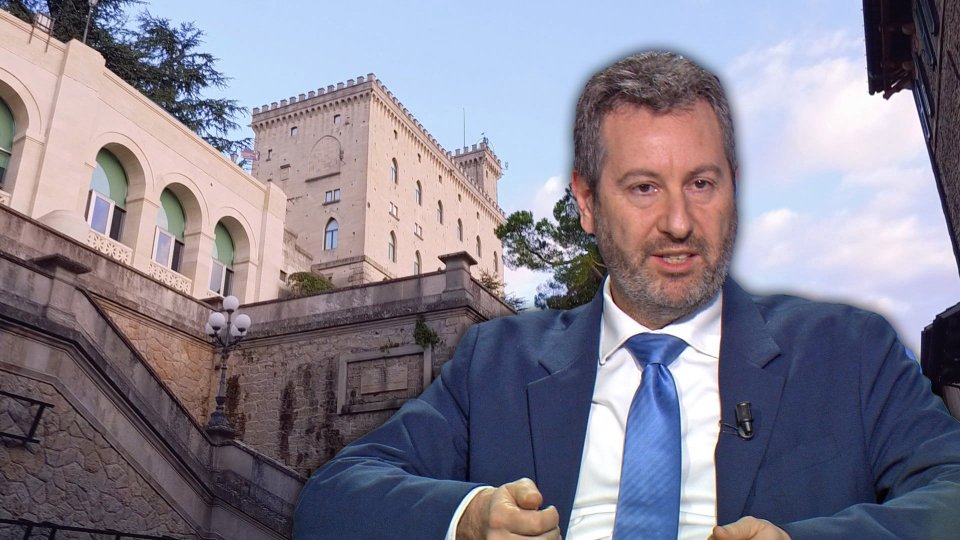
Finance Secretary Marco Gatti spoke during the debate on item 7 of the Grand and General Council (Consiglio Grande e Generale) agenda, dedicated to the ratification of the Association Agreement between the Republic of San Marino and the European Union.
His address focused on the growth prospects of San Marino’s economy, the competitiveness of local businesses, the need to avoid additional bureaucratic burdens when transposing European regulations, and the political responsibility of government and Parliament regarding the ratification of the Agreement.
Below is the full text of Marco Gatti’s speech.
First of all, I’m pleased to hear the debate unfolding in this Chamber, because it confirms that the vast majority of political forces are absolutely convinced that the Association Agreement with the European Union represents a significant step forward for our country’s prospects.
This is within a framework in which the Republic of San Marino is not an island in relation to the European Union, but rather an enclave within Italy — a founding member state of the EU that also sits at the very heart of the Union.
I believe anyone who has had the chance to handle portfolios related to economic sectors cannot fail to recognize that today it is impossible to imagine not intensifying and strengthening our agreements with the European Union.
This is a choice that can no longer be postponed, precisely because of the future of San Marino’s economy and of our businesses, which increasingly need to engage with a broader market.
Yesterday’s small businesses have become today’s medium-sized enterprises, and in order to continue existing and developing, they need to open up to new markets.
Even the Italian market has become too small for many of our companies, which need a wider market in order to have further growth prospects.
Clearly, the European market becomes the main point of reference for our businesses.
This is also one of the reasons why the International Monetary Fund, as well as all the rating agencies, keep asking us when the Association Agreement will enter into force — because its entry into force represents an extremely important boost to our country’s growth and economic development prospects.
I therefore believe we should not get caught up in drawing up endless small balance sheets, trying to calculate every single cost and benefit, because essentially we have two options here: seize the opportunity to grow, or risk dying within our small reality.
I believe the fact that Parliament, with such a wide majority, is convinced that this Agreement represents a positive factor for the country is an extremely important element, because it means that, regardless of which governments follow in the future, there is a widespread conviction that this is an essential path if we want to ensure continuity in the economic growth of the Republic of San Marino.
Arguing otherwise, in my view, means not having a clear understanding of the current needs of our industry, our economy, and our manufacturing businesses.
Every day we work to find solutions and arrangements, based on our agreements with Italy, to allow our businesses to continue operating in the market — but this comes at a higher cost compared to what European businesses can benefit from.
Being outside the single market and not being recognized as equivalent to European companies entails additional production costs, which risk becoming unsustainable for San Marino businesses and for the continuity of their activities, because they end up pricing them out of the market.
I therefore believe that the Association Agreement, from an economic standpoint, absolutely represents a major boost to growth, one that we must be able to work on.
It is clear that, from this point forward, we will need to be skilled in tackling what has also been highlighted in many of the speeches I’ve heard, namely all the work related to the transposition of European regulations.
There are regulations with such technical content that they are automatically transposed in all European countries.
Then there are directives, which must be incorporated into our legal system and which necessarily require careful thought and in-depth study.
They require reflection, but they also require identifying the most streamlined possible methods — not only for the transposition itself, but above all for the integration of those provisions into our legal framework, so as not to end up generating unjustified bureaucracy.
States’ ability — and I believe our state can do a great deal in this regard — must be to manage to transpose European directives in the least bureaucratic way possible.
This too, in fact, can become a factor of competitiveness for our economic system.
Our ability to transpose these directives as effectively as possible, avoiding the introduction of unnecessary additional bureaucratic burdens, can represent a competitive advantage for our businesses within the European market.
Not forgetting, of course, all the benefits this could bring to San Marino citizens. Today we face countless small problems every time we leave Italian territory and, in some circumstances, even when dealing with Italian territory itself.
This is because many matters are no longer left to the discretion of individual states to decide autonomously, but are instead addressed and regulated at the Community level.
Many issues that directly affect private citizens could therefore also be addressed and resolved through the Association Agreement.
Allow me one final consideration regarding the debate that has developed around the topic of the referendum.
We live in a representative democracy, and it is clear that a government and a parliament must decide whether to have the courage of their convictions and take responsibility for them, or whether to hide behind the referendum tool.
We must also ask ourselves whether, in some cases, the referendum is being used in an instrumental way, for reasons of political opportunism — perhaps in an attempt to gather a few votes from those opposed to the Agreement, by claiming that we would have wanted to put it to a referendum.
I believe that whoever governs a country must take on the responsibility of fully weighing the advantages and disadvantages of the international agreements the country intends to pursue.
I am not referring solely to the Association Agreement with the European Union, but also to the many other agreements that the Republic of San Marino enters into with other states.
Governments and parliaments must take on this responsibility, which is a political responsibility, and one that will subsequently be judged based on the results those agreements are able to produce.
It will then be up to the electorate, through the democratic tools at its disposal, to judge the performance of that government and that parliament. We are here to govern — we are not here to hide behind an electorate called upon to vote without yet having had the chance to concretely see and verify what results an agreement will actually produce.
If today all businesses are asking us to move in this direction, if all trade union organizations are asking us to move in this direction, and if the vast majority of political forces represented in this Chamber share this choice, then I believe we are not dealing with an Agreement that should be thrown in the bin or subjected to a referendum without even having had the chance to concretely assess what its advantages — and any potential disadvantages — might be.