San Marino’s public debt has fallen below 60% of GDP, the state accounts have posted a primary surplus for the fourth consecutive year, and the new €350 million Eurobond has significantly reduced refinancing risks.
These are among the key findings highlighted by the International Monetary Fund (IMF) at the conclusion of its mission to the Republic, which acknowledged the progress made in restoring public finances and strengthening the Sammarinese economy.
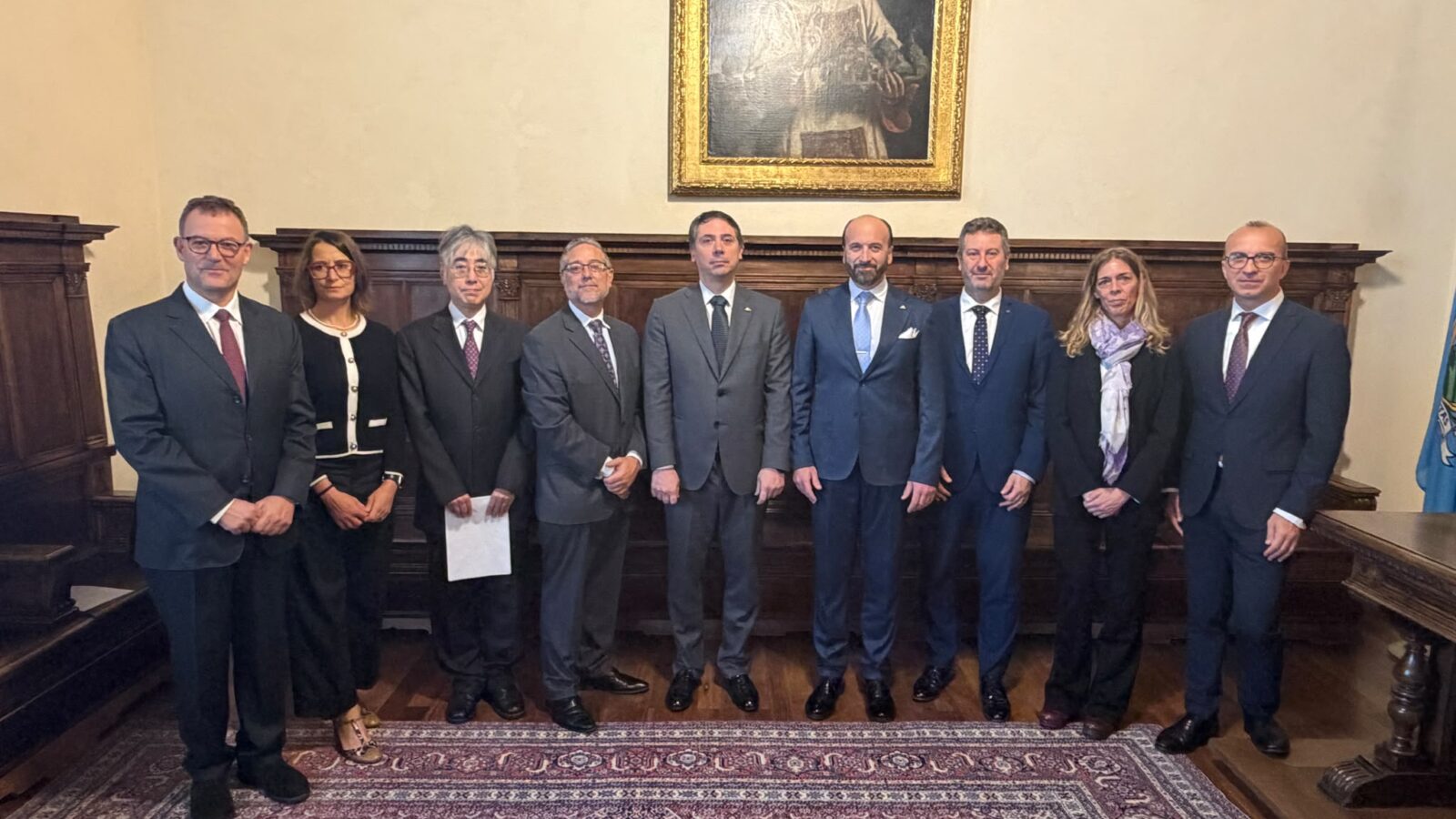
The delegation, led by Trevor Lessard, IMF mission chief for San Marino, stayed on Mount Titano from 26 October to 5 November as part of the periodic consultations provided for under Article IV of the Fund’s Articles of Agreement.
During the visit, meetings were held with Sammarinese authorities, the Central Bank, private sector representatives and social partners to review economic performance, growth prospects and the main risk factors.
In the statement released by the Congress of State, the Fund staff’s assessment is described as particularly positive regarding the path taken by the Republic, although it is accompanied by indications of further measures needed to consolidate these results.
One of the key figures concerns the reduction in public debt, which has fallen back below 60% of Gross Domestic Product.
In 2025, for the fourth consecutive year, San Marino recorded a primary surplus which, excluding support to the banking sector, reached 3.8% of GDP.
This result, according to the IMF’s analysis as reported by the Government, confirms the effects of the prudent fiscal policy adopted in recent years.
Particular attention is also given to the €350 million Eurobond placed in April 2026.
The five-year issuance, characterised by demand exceeding supply and a coupon rate of around 3.6%, made it possible to pre-finance the bond maturity due in January 2027.
According to the Fund, the operation improved conditions for access to financial markets, extended debt maturities to 2031, and reduced reliance on the domestic banking system.
Commenting on the mission’s findings, the Secretary of State for Finance and Budget, Transport and Energy, Marco Gatti, stressed the need to continue the path of financial consolidation.
“The IMF’s assessment presents a picture in which the results achieved and the responsibilities still outstanding must be read together.
The reduction of public debt below 60% of GDP and the improved conditions for access to financial markets attest to the credibility of the prudent course we have followed in recent years.
However, we do not regard these achievements as a finishing line, but rather as a sturdier base from which to tackle the challenges ahead of us.
Our priority is to turn greater financial stability into capacity for investment, productivity and development, while supporting the implementation of the Association Agreement with the European Union and keeping budgetary balances firmly in place.
The sustainability of public finances is not an end in itself: it is the condition that allows the country to plan for its future, support the productive system and safeguard opportunities for future generations,” Gatti stated.
On the economic growth front, the IMF forecasts real GDP growth of 1.5% in 2025 and 1.3% in 2026, supported by domestic demand, manufacturing exports and tourism.
For 2027, the forecast drops to 1%, before a gradual return towards medium-term potential.
The Fund acknowledges the resilience of the Sammarinese economy, bolstered by the diversification process, but also points to risks linked to international uncertainty.
Another section addresses the Association Agreement between San Marino and the European Union, signed on 19 October.
The Fund considers it a historic opportunity to strengthen integration into the European market, improve productivity and foster economic development.
Its implementation, however, will need to be accompanied by gradual planning, clearly defined institutional responsibilities, and resources suited to the Republic’s administrative capacity.
The Fund also urges San Marino to continue with structural reforms, improving the efficiency of public spending and allocating greater resources to investments with economic and social returns.
Among the measures assessed positively is the 2026 reform of the general income tax, which is credited with broadening the tax base, strengthening tax compliance, and increasing the progressivity of the tax system.
The sustainability of the pension system also remains a central issue, with the IMF recommending that reform efforts continue, taking into account demographic trends and the need to ensure long-term financial balance.
Among the investment priorities identified are healthcare infrastructure, the modernisation of public administration, the digitalisation of services, and the strengthening of energy self-sufficiency. On this last point, the Fund highlights the opportunities offered by the development of solar power production and the potential deployment of storage systems.
The banking system, meanwhile, continues to show some weaknesses, despite improvements in liquidity and a reduction in non-performing loans. The IMF acknowledges the results achieved by the Asset Management Company’s recovery activities, which enabled the full repayment of the state-guaranteed senior tranche.
Vulnerabilities remain, however, linked to asset quality, legacy exposures, and the need to strengthen the profitability and capital bases of certain institutions. For this reason, the Fund recommends continuing the consolidation of the sector, also in view of aligning with European standards for banking supervision and regulation.
The Congress of State welcomed the IMF staff’s assessments, describing them, according to the statement, as “an important recognition of the work carried out and, at the same time, an incentive to continue implementing reforms.”
The concluding statement published on 5 November constitutes a preliminary assessment by the International Monetary Fund staff. A report will follow which, after approval by the Fund’s management, will be submitted for review by the IMF’s Executive Board.