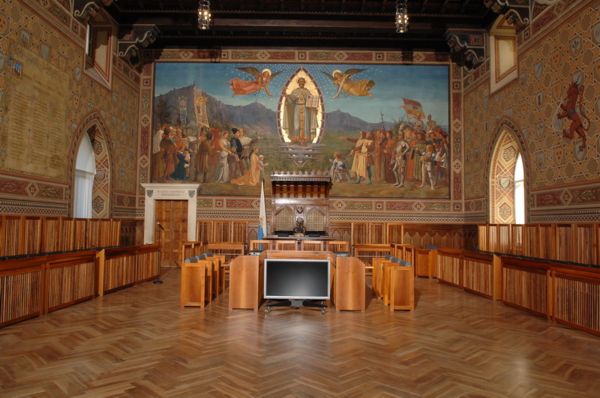
The six months spent serving as Captain Regent will now count toward pension entitlements even for self-employed workers and professionals. The Grand and General Council (Consiglio Grande e Generale) approved the measure with 30 votes in favor, none against and no abstentions.
The coverage also applies retroactively to terms served between 2005 and the date of ratification. Yet the debate brought another disparity to the forefront: the gap between councillors who continue to receive their salary during sessions and those who must give up working hours and income in order to attend.
Secretary of State Stefano Canti explained the rationale behind the measure: “With this law we wanted to put everyone on equal footing — self-employed workers, professionals and employees alike — when it comes to holding the office of Captain Regent.
The new provisions ensure continuity of pension standing in cases where self-employed or professional activity is interrupted due to the fulfillment of institutional duties, such as the regency mandate.”
In practical terms, the period spent leading the State will now be covered from a contributions standpoint even for those who must pause their professional activity. “The State will pay the notional contributions, allowing them to count those six months spent serving as Captain Regent toward their pension.”
There was broad consensus on this correction. However, disparities remain for those who take part in Council sessions: public employees keep their salary, private-sector employees rely on unpaid leave, and self-employed workers must set aside their own business.
Maria Luisa Berti (AR) asked to speak on the matter: “We still have a situation in which not everyone engaged in politics is treated equally.”
Michela Pelliccioni, an independent, stressed that these disparities make it harder to bring people and expertise from all professional backgrounds into the chamber.
Matteo Zeppa (Rete) framed the issue in terms of representation: “So let’s decide once and for all: either unpaid leave for everyone, paid leave for everyone, or the same allowance for everyone, if we’re talking about compensation. We can’t have some councillors treated better than others, because all sorts of situations can exist within the Council, but the real problem is that this undermines the representativeness of the 60 councillors.”
Maria Katia Savoretti (RF) also pointed to the difficulties faced by those who have no one to cover for them at work while absent. Her request was clear: “Either leave is paid for everyone or it isn’t paid for anyone, and the allowance must be the same for all. There must be absolutely no discrimination of this kind.”
What truly divided the chamber, however, was the lack of prior consultation before the government’s intervention. Nicola Renzi (RF), while acknowledging the merits of the measure, criticized the process: “What happens is that these decrees arrive without any prior discussion whatsoever, because this was an initiative taken unilaterally by the majority, if not by the Government itself.”
Emanuele Santi (Rete) pointed out that the status of councillors is already under discussion within the committee on institutional reforms. “Given that this committee met only a few weeks ago, we would have appreciated at least being informed that the Government intended to act on this matter, and in what direction. That was not done.”
The call to address the issue as a whole also came from within the majority. Guerrino Zanotti (Libera) offered his willingness to engage: “I am fully available to discuss this issue, which certainly cannot be resolved through a delegated decree, just as other matters cannot be settled that way.”
Fabio Righi (D-ML) instead urged attention to the work that precedes each session: “The issue is that there is an entire body of preparatory work needed to arrive at debates well-prepared, punctual and serious, grounded in real study — work that goes far beyond the hours spent in this chamber or in committee.”
According to Righi, investment is needed in the institutions themselves, to ensure that elected officials are placed in the right conditions to carry out their mandate.
Discussion also touched on the possibility of allowing public executives and department directors to remain in service until the age of 70. Marino Albani (PDCS) voiced support both for this change and for the pension coverage granted to Captains Regent.
Renzi called instead for general rules rather than exceptions carved out for specific categories. Antonella Mularoni (RF) raised the perspective of those who have yet to enter the workforce: “We must not forget our young people and the fact that they too have the right to enter the labor market and public administration, often with qualifications far more advanced than those once required.”
Canti clarified that the extension from 69 to 70 years applies to a specific group: “It is not available to individual public employees — only to public executives and department directors.”
On the matter of leave and the treatment of councillors, the Secretary of State expressed openness to further discussion: “I am also open to dialogue aimed at finding a definitive solution that ensures equal treatment for councillors, whether they are employees, professionals or self-employed workers — a solution that can find the support of the entire chamber.”