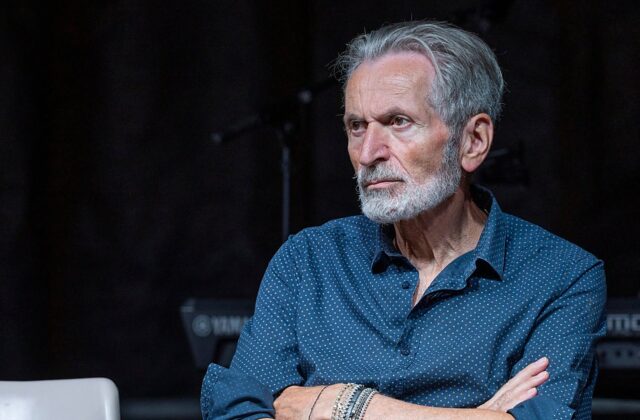
Oscar Mina (PDCS) spoke during item 21 of the Grand and General Council (Consiglio Grande e Generale) agenda, dedicated to the variation of the state and public entities’ budget forecast for the 2026 financial year. Below is his full address.
Oscar Mina (PDCS): I too would like to offer some thoughts on this budget variation, now in its second reading, taking what I believe is a balanced approach — not limiting ourselves to the individual figures, but trying to understand what they tell us about the state of public finances and the country’s priorities. I’d like to highlight a few points.
The first concerns the trend in tax revenue. The data show an overall increase of around 20.6 million euros, with the main items being general income tax, up by an expected 5.5 million, and the tax on imported goods, up by 9.5 million. These are certainly significant figures, but they deserve careful consideration.
On one hand, they represent a positive update to revenue forecasts; on the other, they remind us how important it is to keep constant watch over the economy, consumer spending and business activity, so that the balance of public accounts doesn’t end up depending solely on higher tax collection.
The second point concerns public debt and the management of financial resources. As colleagues have already noted, the figures show a 50-million-euro reduction in projected financing through public debt securities. There also appears to be a reshuffling of entries related to the repayment of public bonds, if I read correctly.
Within the overall framework of state finances, this helps to reduce financing needs. When conditions allow, I believe this is certainly an important goal to pursue.
However, we must bear in mind that debt sustainability cannot be measured through a single annual variation alone: it requires a medium-term strategy, rigorous planning, and the ability to maintain credibility with markets and international partners.
A third point concerns how resources are allocated and the country’s concrete needs. This variation touches on several areas of public life: support for economic activities, interventions across the territory, maintenance works, housing policy, the University, tourism and sport.
In particular, I believe that resources earmarked for the economic system and investment must be accompanied by clear, verifiable objectives. Allocating funds is not enough — we must be able to assess their actual impact, their capacity to generate development, and the benefits they bring to the whole community.
The same applies to interventions on public infrastructure and property. Maintenance, security and enhancement of state assets should not be viewed merely as expenses, but as tools to preserve the value of our shared heritage and prevent higher costs down the line.
There is another figure that I believe must be addressed with full transparency: the deficit. As some colleagues have already pointed out, the data show that the result of the first 2026 budget adjustment is a deficit of roughly 5.68 million euros — an improvement on the 7.87 million indicated at the first reading.
That is an improvement of just over 2 million, but we must not confuse a reduction in the deficit with the achievement of balanced accounts.
This result should encourage us to continue along the path of prudence, spending control and, above all, careful verification of forecasts. Every budgetary decision must be weighed not only against immediate necessity, but also against the consequences it may have in future financial years.
Financial policy must be serious, but it cannot be reduced to a mere accounting exercise: it must put the State in a position to respond to the community’s needs and to plan for the future.
I don’t wish to get into the merits of the figures themselves, since I’ve heard several different interpretations, but I do think it’s worth reiterating, in closing, one further point: our task is not simply to approve numbers, but to ensure that public resources are used in the general interest of the State, with transparency and a vision that looks beyond the present moment.
With that in mind, I consider this variation a useful step in updating the State’s financial management, and I confirm a favourable stance, convinced that the responsibility borne by this government demands seriousness in its choices, a focus on citizens, and above all the ability to look to the Republic’s future.