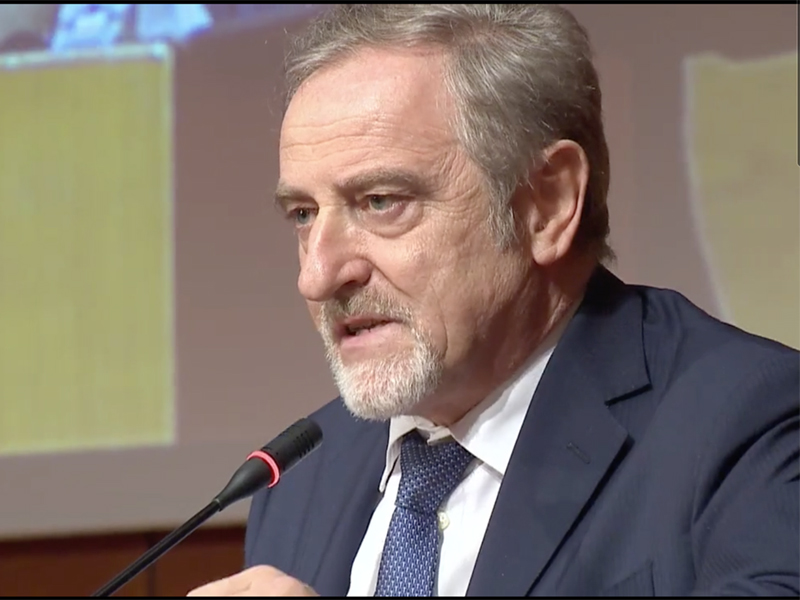
“All the rules can be perfect, but then you need the right people in the right place, and a total absence of conflicts of interest.” This was the appeal made by Michela Pelliccioni (Mixed Group) during the communications session of the Grand and General Council (Consiglio Grande e Generale). The councillor addressed the Giochi del Titano affair, calling for more effective controls and stricter requirements for appointments in the gaming sector, and urged the government to act on the banking system and public administration in order to seize the opportunities offered by the Association Agreement with the European Union.
The full remarks of Michela Pelliccioni (Mixed Group)
I’ll take thirty seconds to make a simple appeal regarding the scheduling times of the Grand and General Council, just to recall that the role of councillor is still not a professionalised activity. My request is therefore to set times that allow us to coordinate our professional work with our council duties, without having to constantly rush, because this coordination becomes particularly complicated otherwise.
Having closed that parenthesis and that request, I too will start by speaking about the signing — the historic signing of the Association Agreement. This is a goal I have personally always believed in. During this legislature I made a precise choice, becoming an independent councillor specifically to give full support to this path, and so today I can say I feel enormous pride at having reached this goal, the result of a collective effort.
A collective effort that tells us Europe is an opportunity for us, but also a cost. And allow me a joke: who better than me can say that betting on Europe has also been a personal cost?
But joking aside, I believe this moment is undoubtedly a crucial turning point. There is a need for collective action, once again, because politics must now more than ever prove itself capable of actually doing politics.
Signing was important, but knowing how to implement what we have signed will matter even more. The opportunity is undoubtedly enormous for businesses and citizens, but opportunities must be seized through targeted action and with an administrative machine that is up to the task. Otherwise we risk making the worst mistake of all: winning Europe on paper and then crashing into the wall of bureaucracy.
Unfortunately, I still see actions by some aimed at undermining this path, but I also believe that the timing of these actions is the litmus test that clearly reveals their intent. I also think that citizens do not only observe individual actions, but also the process through which a political action takes shape, and sooner or later it will be they who judge us once again.
Seizing the opportunities — this is the point on which I still do not see a clear course of action from this government. The time for choices can no longer be postponed, because failing to choose means choosing to harm this country.
There is a banking system that needs strengthening. I believe this is the issue of all issues, and I still don’t see clear actions or decisions. And mind you, this is not a secondary matter, because without oxygen the country dies. The patient is certainly not the banks — the patient is our country.
We therefore need choices that do not leave us closed off on ourselves, because we must carry forward coordinated actions with neighbouring territories as well — but not only with them. I must mention, for example, that I believe the European Grouping of Territorial Cooperation with the Province of Rimini goes in this direction and is one of the many opportunities we must certainly seize and develop.
I hope this chamber will be the place where coordinated, concrete actions are carried out, and not the place where, time and again, we simply have to acknowledge what we could have done but did not do.
We bear an enormous responsibility, not only to ourselves but also to future generations. We need politics that looks ahead, with capability and courage.
The courage to rise to the level of a bigger, more competitive and more integrated reality, because it is not enough to change the rules — we must change our mindset, especially within the public administration.
An efficient public administration is not one that simply carries out formal requirements, but one that supports citizens and businesses, engages with new technologies, values expertise, and measures results.
We need everyone’s commitment, and we also need clear communication to the public, free from useless populism.
I would like to use my remaining time to also speak about another issue that I believe carries great importance — not just for the news, but for politics as well — and that is certainly the Giochi del Titano affair.
What happened was a shock, a deep shock, and at an extremely delicate moment, because unfortunately this affair broke out right as the Association Agreement was about to be signed, and it has certainly created fear and concern.
I do not want to guess at outcomes, because passing judgment at this stage would be exactly that — guesswork. There is a judiciary, including abroad, following its own process. We await, with respect and also with confidence, the clarification of all positions.
But we, as politicians, can certainly already begin working on what has happened. Because first of all we must ask ourselves a precise question: what can we do to strengthen the oversight mechanisms in an activity on which — let’s not hide from it — the country has staked a great deal?
This matters because there is an image that accompanies substance, and image is a fundamental aspect in being able to continue preserving the substance of these activities.
I cannot say it is easy, but I believe Giochi del Titano has followed a serious path with regard to the responsibilities and obligations that apply to it. One need only look at the fact that it has obtained anti-corruption certification in line with European regulations.
This is clear, it is public, and so I don’t believe it’s a certification one earns through mere points. It is a certification that results from a precise process, compliant with certain standards, and this is certainly something we must consider. It is undoubtedly a point in its favour.
But we must also consider that all the rules can be perfect, yet what is then needed are the right people in the right place, and a total absence of conflicts of interest.
This is certainly one of the points on which politics has a duty to reflect, to see whether there are gaps or vulnerabilities that need addressing.
We have done so, and continue to do so, in the banking system, which is an equally sensitive sector and one in which politics has also worked hard to transpose European regulations.
Just consider the enormous progress made in setting increasingly qualified requirements for governance roles, increasingly strict requirements regarding the absence of conflicts of interest.
Just think of the Fit and Proper regulation, which is updated periodically and sets increasingly rigorous requirements.
I believe this is the path we must also follow for activities in the gaming sector, because the gaming system cannot be held to a lower standard.
On this point we must also ask ourselves whether our AIF — the Financial Intelligence Agency (Agenzia di Informazione Finanziaria) — has adequate staffing, expertise and tools to carry out specific activities that are markedly different from financial ones.
These are activities with different characteristics, requiring specific knowledge and oversight capabilities.
I do not wish to pass judgment or assign blame — I am simply raising questions.
The issue of the supervisory body is absolutely fundamental, because the AIF clearly has the authority to carry out checks and impose sanctions, but it does not necessarily have the authority to remove individuals or intervene directly in corporate bodies when they lack certain requirements or when certain violations occur.
On this we obviously have the State Gaming Authority (Ente di Stato dei Giochi), but I believe the State Gaming Authority, in terms of requirements and expertise, must move in step with the supervisory standards of the Central Bank, particularly with regard to specific competencies and requirements of integrity, professionalism and all the other elements necessary to hold certain positions.
And on these strict requirements, I believe politics must act not tomorrow, but starting today. We don’t need to wait for the results of the investigations to begin considering what can be improved.
Let us assess and verify what needs to be done, and let’s do it — to be a country that is up to the task, a country that looks to Europe without shortcuts, but which cares about having a clear image and an equally clear position.
Having adequate rules on sensitive matters is certainly the first step towards earning and consolidating the credibility this country absolutely needs, and which must be strengthened ever further.