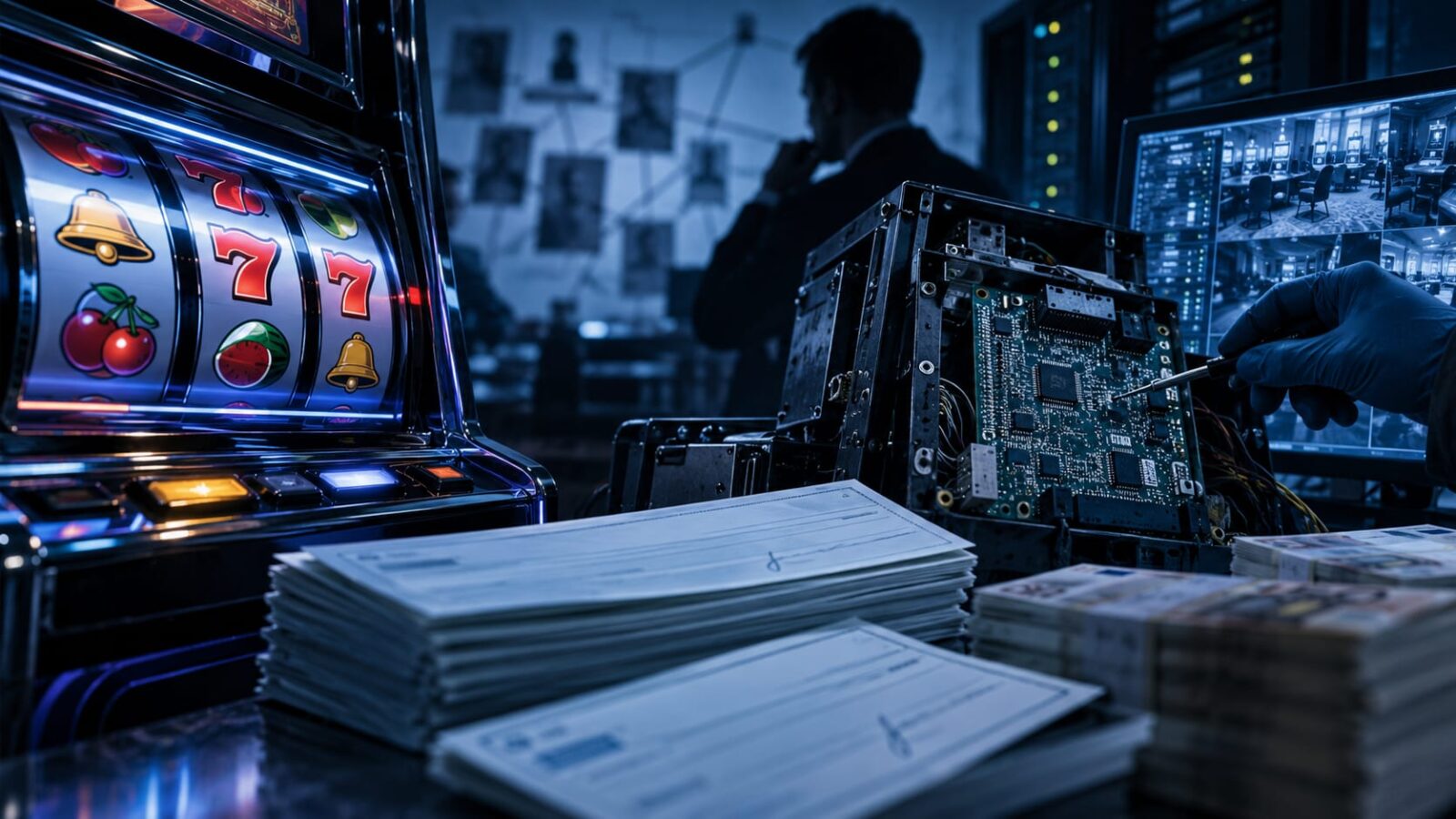
Seven years, nearly 7.5 million euros, more than a thousand checks: these are the numbers behind the prosecution’s case against Giochi del Titano.
And among the theories already circulating is a culprit that would suit many people just fine: a piece of software.
Investigators will examine the motherboards and servers of ten seized slot machines to determine whether someone rigged the payouts.
That’s a legitimate line of inquiry — but it would be far too convenient to stop there. Checks are issued in offices, not inside slot machines.
According to the prosecution’s as-yet-unproven case, some machines were reportedly kept free for a particular customer, and pressure was allegedly put on a bank not to request his tax return.
None of that is something a motherboard can do. That’s why the digital-tampering theory — a legitimate question for investigators, and one that would add a charge of fraud if confirmed — cannot become the whole explanation. A story in which the blame falls on a machine is, in the end, a story in which no one is to blame at all.
Better to line up the questions before the technical report arrives.
The first is almost obvious.
The mechanism described by the prosecution would work even with flawlessly functioning machines: slots typically return between 92 and 95 percent of what is wagered, and anyone looking to launder cash doesn’t need to win — they just need to lose a little and walk out with a slip of paper reading “winnings.”
According to reporting by L’Informazione, those slips of paper amounted to more than a thousand checks, plus top-ups onto prepaid cards: over seven years, that’s roughly one every two or three days.
Who filled them out? Who authorized them? And what did the due-diligence checks — which the law requires even of casinos — say about a customer whose declared income ranged between 5,000 and 38,000 euros?
The second question concerns the software, assuming it was functioning correctly.
A slot machine doesn’t operate in isolation: in a gaming hall, each machine typically communicates with a central system that tracks how much money comes in, how much goes out, and when.
It’s no coincidence that gaming data was also seized, along with the video surveillance systems. If the software was untouched, it recorded everything for seven years. Who was reviewing those numbers?
And whoever read them — what did they do with that information?
The third question applies if the technical report finds the opposite.
A slot machine can’t be reprogrammed just by walking past it: it requires physical access or credentials — keys, maintenance work, passwords, suppliers.
And a machine that pays out more than it should leaves a trail in the accounts: actual returns diverge from theoretical ones, and the loser is the house — meaning the State.
Who had access to open those machines, and is there a log of who actually did?
When did the State Gaming Authority, which authorizes and oversees these operations, last check in?
And if those winnings were so improbable as to suggest foul play, why did investigators notice before the people actually paying them out did?
A compromised piece of software doesn’t exonerate anyone — it simply raises another question: who held the keys?
Then there’s the timeline.
In late July, the company announced it had obtained ISO 27001 certification, the international standard for information security covering confidentiality, integrity, and availability of data.
Two months later, ten slot machines were seized to verify whether that very data was intact.
A certification attests to a method — it doesn’t vouch for the people involved, and it doesn’t look back seven years.
But one question seems fair: what was the scope of that certification? Were the gaming systems and cash operations included, or left out?
The last question is the most uncomfortable, and it isn’t about technology at all.
The transactions reconstructed by the Financial Intelligence Agency (Agenzia di Informazione Finanziaria) span from 2019 to 2026. The judicial request from Ravenna dates to January 2026.
The Agency’s reports that have come to light are from July and September, flagging irregularities that two banks had noticed. The decree requiring casinos to identify customers from the moment they walk in dates to August 31, and opposition parties have asked the government whether the two are connected.
In between lie seven years. Did the casino — which, by law, carries its own anti-money-laundering obligations — ever flag anything about that customer?
And if the alarm came from Italy, what failed to go off in San Marino?
None of these questions amounts to a verdict.
The Congress of State (Congresso di Stato) has called for balance in the public debate: precise questions are the most balanced approach we know.
We are still at the preliminary investigation stage. The presumption of innocence applies to everyone, and the company — which, according to L’Informazione, is itself under investigation as a legal entity — maintains it had nothing to do with any wrongdoing.
Precisely for that reason, it’s worth establishing one point before the technical report arrives: it will say whether the software was tampered with. It will not say who signed what.
The motherboards will speak. It would be good if, in the meantime, those with a role, a name, and a signature spoke too.