There is a thread running through nearly eighty years of relations between Italy and San Marino. Within it lie a border just a few dozen kilometres long, money, gambling and, across different eras, Rovereta. These are profoundly different stories, with no judicial connection between them, yet they end up crossing paths in the very same small patch of territory.
Today the name Rovereta is back on the front pages because of an investigation into the alleged laundering of nearly €7.5 million through the slot machines of Giochi del Titano. But the relationship between San Marino, Italy and gambling has much older roots. One has to go back to the immediate post-war period, when a coalition of communists and socialists governed Monte Titano and Europe was sliding into the Cold War.
In 1949, San Marino opened the Kursaal Casino. The idea was also an economic one: to attract visitors, particularly from neighbouring Italy, and generate new revenue for a small Republic emerging from the extremely difficult war years.
The project, however, quickly became a source of serious friction with Rome.
The issue was straightforward: many potential customers came from Italy. One only had to cross the border to find, on Monte Titano, a gambling house that was viewed with disfavour on the other side of the frontier. The Italian government responded by tightening controls and pressuring the Republic to put an end to the experiment.
The economic question was inevitably entangled with the political one. San Marino was governed by communists and socialists, while Italy was firmly anchored in the Western bloc. These were the early years of the Cold War, and the mere existence of a Republic partly led by communists, embedded within Italian territory, was already a source of tension.
The casino thus became much more than a room for trying one’s luck. Gambling ended up caught up in the political and diplomatic rivalry between the two states.
Italian pressure was felt most acutely at the border, making it increasingly difficult for gamblers to reach San Marino. Without customers coming from Italy, the casino’s economic model inevitably became fragile.
The experiment did not last long. In 1951 the casino closed, just 17 months after opening. The Kursaal building would remain, but with a different purpose, eventually becoming one of the Republic’s most recognisable public buildings.
The tension between Italy and San Marino, however, was not destined to disappear.
A few years later, the crisis of 1957 erupted — the episode that went down in history as the Rovereta affair. This time gambling was not at the centre of the dispute. The ground was openly political and institutional.
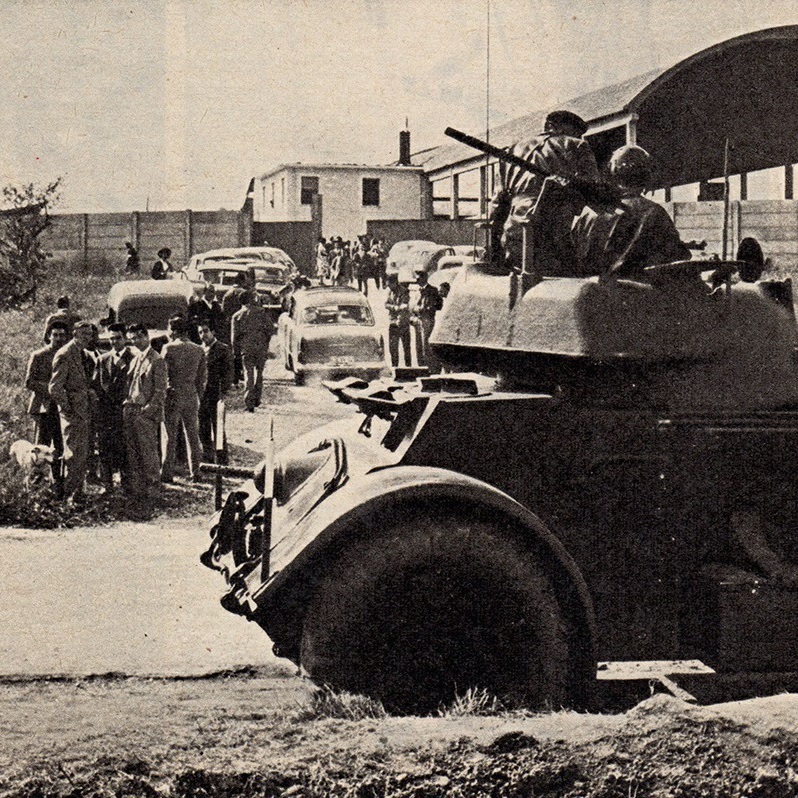
The balance of power within the Grand and General Council (Consiglio Grande e Generale) had collapsed, and the country found itself split between the ruling socialist-communist coalition and a new majority. Between 30 September and 1 October, some members of this new majority settled in an industrial building still under construction in Rovereta and proclaimed a provisional government.
In that episode too, the Italian border proved decisive. Rovereta was a strategic location precisely because it lay right up against Italy. Rome recognised the provisional government, and Italian carabinieri took up positions on the Italian side of the frontier.
Almost seventy years after those events, Rovereta is back in the news. And so is gambling.
Naturally, the context could not be more different. There is no diplomatic crisis today between Italy and San Marino, nor any political clash comparable to that of the post-war period. This time, in fact, the judicial authorities of both countries are working together to investigate a case that appears to span both territories.
At the centre of the investigation is the alleged scheme used by Sicilian businessman Elio Marino and his partner Aizada Chokoeva to turn large quantities of cash of suspected illicit origin into money apparently traceable to winnings from Giochi del Titano slot machines.
The mechanism outlined by investigators is said to have been fairly straightforward. Cash was fed into machines that, according to figures cited in the investigation, theoretically pay out between 92 and 95% of the sums wagered. A limited loss would therefore have been the price paid in exchange for winnings that could then be cashed out, including via cheques, and subsequently deposited in a bank.
This story too, according to the prosecution, runs back and forth across the border. The money is alleged to have originated from a system of wire transfers for invoices relating to non-existent transactions. Marino is said to have recovered the corresponding amount in cash in Italy through an Albanian intermediary. The cash would then have been brought to San Marino to be played at the slot machines.
Between 2019 and 2026, transactions worth €7,493,421.67 are said to have come under scrutiny.
Investigators are now trying to determine how extensive the alleged scheme may have been. Ten slot machines have been seized, along with gaming data, mobile phones, computers, servers and material from video surveillance systems. Seven people are currently under investigation, including five employees of Giochi del Titano. General manager Salvatore Caronia is under house arrest.
It is important to stop the parallel here: there is no connection whatsoever between the 2026 investigation, the post-war casino and the 1957 Rovereta affair.
Yet there is an intriguing historical thread.
In 1949, San Marino tried to use gambling as a tool to attract visitors and money from Italy. Rome reacted, and the casino question became one of the sources of tension between the two countries, until its closure in 1951. In 1957, in Rovereta, the border once again took centre stage, this time amid the most delicate political crisis in San Marino’s post-war history.
Today the picture is reversed. There are no opposing governments, nor borders to tighten. Italy and San Marino are cooperating on the judicial front to trace the path of millions of euros that, according to the prosecution, crossed that very same border.
And in the middle of it all, once again, is gambling.
From the Kursaal to the slot machines of Giochi del Titano, by way of Rovereta: completely different eras, protagonists and stories. Yet always with Italy and San Marino just metres apart, and the border as the ever-present backdrop.