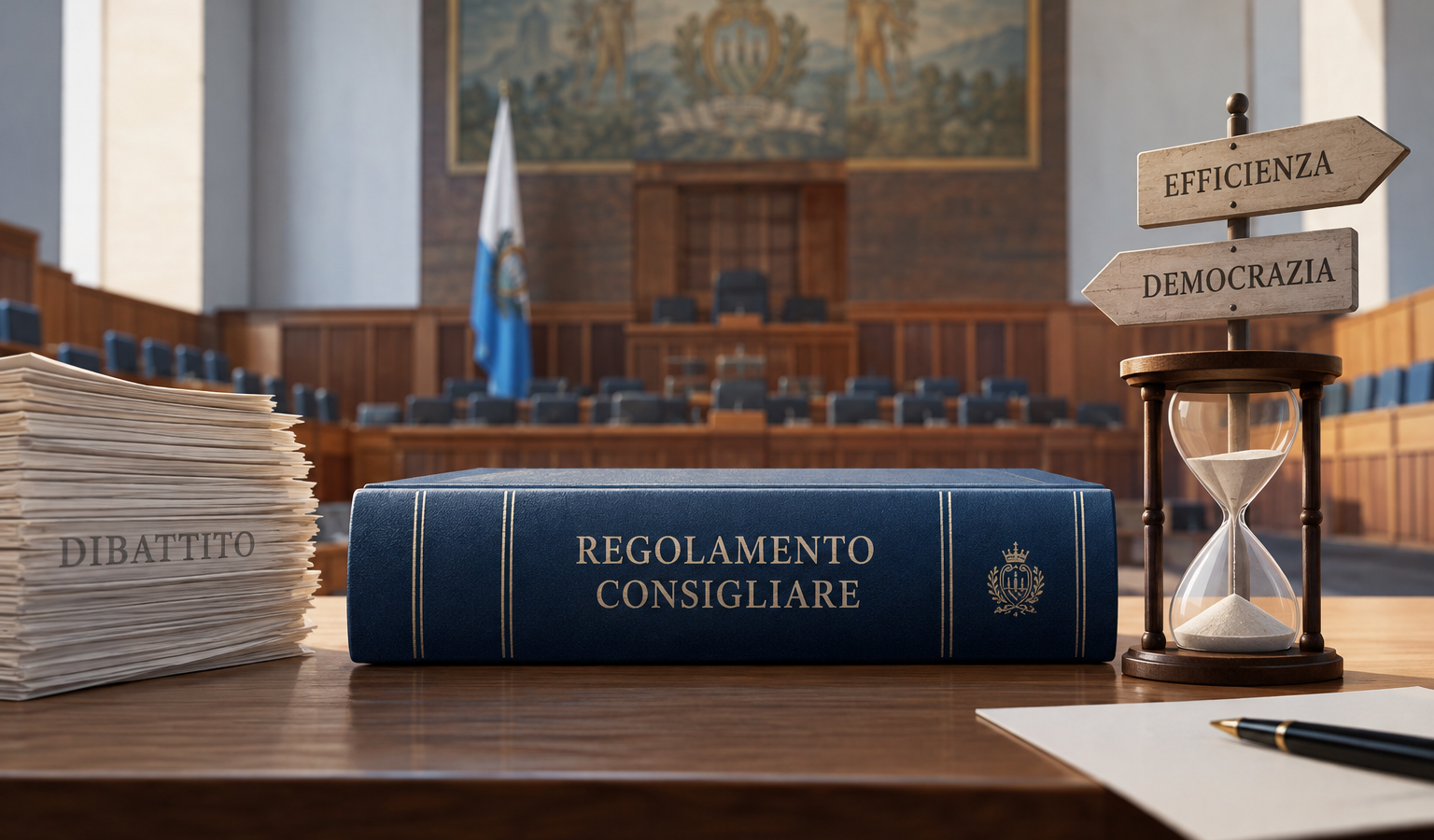
Is twenty-five hours too much, or not enough? Does the so-called “guillotine” clause really prevent a bill from getting bogged down, or does it risk weakening one of the few tools available to the opposition? And again: does it make sense for the Council to go back and debate and vote article by article on something already settled in Committee?
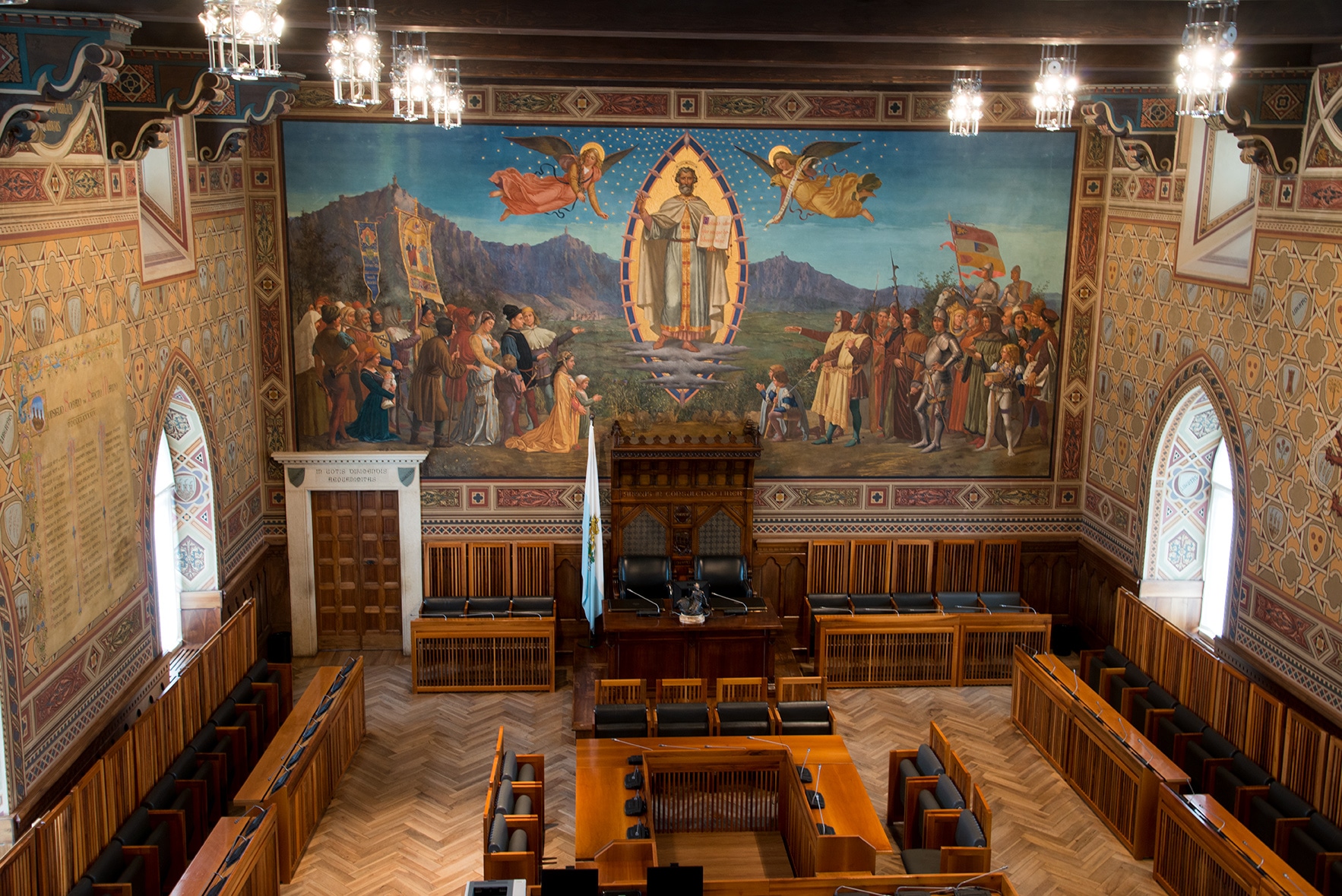
These are the questions that emerged from the lengthy debate on amendments to the Rules of Procedure of the Grand and General Council (Consiglio Grande e Generale). It is a discussion that has shifted considerably since its first reading. The majority has dropped the proposed changes to speaking times, other contested points have been removed, and yesterday’s exchange between majority and opposition produced further amendments. The main sticking point remains the so-called “guillotine” clause, while the idea of a “sede redigente” — a drafting procedure that would limit further debate on text already approved in Committee — is increasingly being framed as a trial run.
Perhaps this is the real political starting point. When the rules of Parliament are being rewritten, how much does method matter? The norms governing the relationship between majority and opposition are not written for this legislature alone. Those in government today could be in opposition tomorrow, and vice versa. This is precisely why the attempt to build broader consensus around the “rules of the game” carries weight that goes well beyond this single piece of legislation.
The majority’s position
The Christian Democratic Party (PDCS) argued for the need to make the Council more efficient while keeping the door open to dialogue with the opposition. Manuel Ciavatta identified the drafting procedure (“sede redigente”) and the mechanism for limiting debate on the articles of a bill as the central issues, stressing that the proposed changes to speaking times had been dropped. Lorenzo Bugli focused mainly on process, arguing that the rules should be as widely shared as possible and that individual councillors also bear responsibility for avoiding repetitive interventions. Oscar Mina and Giovanni Francesco Ugolini emphasised the need to strike a balance between the right to debate and the efficiency of the Chamber.
Libera, represented by Michele Muratori, argued for the need to streamline a process in which the same debate is often repeated across multiple stages. This was the basis for its support of a trial period for the drafting procedure, given that Committees are, after all, made up of councillors themselves.
The Sammarinese Socialist Party (PSD) highlighted above all how far the proposal has moved from its original version. Matteo Rossi described it as a compromise reached through dialogue, pointing to the preservation of current general debate times and the safeguards introduced in the handling of amendments. Paolo Crescentini, who had been critical at first reading, called instead for common sense and for rules that are as widely shared as possible.
For Alleanza Riformista, Maria Luisa Berti described the reform as a useful step towards making the Council more efficient, while noting that other areas still need attention, from the Arengo Petitions (Istanze d’Arengo) to the “comma comunicazioni” [communications item]. Denise Bronzetti placed particular emphasis on councillors’ own responsibility: in her view, no set of rules can ever be sufficient without a responsible use of parliamentary tools.
Secretary of State Andrea Belluzzi, for his part, pointed to the changing nature of politics itself and the relationship between communication and the productivity of institutional work, clarifying that when it comes to the future incorporation of the EU acquis communautaire, it will be up to Parliament to decide the tools, methods and pace.
The opposition’s position
On the opposition benches, assessments of the new text were not uniform, but one point recurred across several speeches: recognition that the proposal has changed significantly since its first reading, even if this has not removed all objections.
Repubblica Futura acknowledged the progress made — in particular the preservation of previous speaking times and the abandonment of some initial proposals — but remains opposed to the “guillotine” clause. Nicola Renzi rejected the idea that delays in advancing legislation stem from how much time the Council spends debating. Antonella Mularoni stressed the need for rules to be shared between majority and opposition, while Matteo Casali and Andrea Menicucci raised a further point: a Parliament’s efficiency cannot be measured solely by the number of laws it passes, but must also be judged on the quality of the legislation it produces. Enrico Carattoni criticised the chosen process altogether, arguing that the matter should have first been examined by the Committee for Institutional Reforms.
Domani-Motus Liberi likewise acknowledged the changes made to the original version. Gaetano Troina rejected the suggestion that delays could be blamed on the opposition. Carlotta Andruccioli credited the majority for the corrections made, while maintaining reservations about the “guillotine” clause and stressing that greater efficiency also requires more political dialogue before bills reach the Chamber floor. Fabio Righi called instead for a more gradual mechanism, in which closing debate would be a last resort after attempts at mediation had failed.
Rete, represented by Emanuele Santi, acknowledged that the amended text marks an improvement on the original draft, but maintains firm opposition to the “guillotine” clause. For the movement, the ability to extend debate on amendments is one of the key tools through which the opposition can influence the majority’s decisions.
Independent councillor Giovanna Cecchetti also judged the text more balanced than at the outset, while sharing some of the concerns raised by the minority parties. Her summary is perhaps one of the formulations that best captures the issue at stake: not choosing between efficiency and democracy, but trying to make the two coexist.
The real issue: what does efficiency actually mean?
Setting aside party lines, the debate brought to the surface a question that remains unresolved: when can a Parliament truly be called efficient?
Is it when it passes more laws in less time? When it avoids the same issues being debated repeatedly between Committee and Chamber? Or when it manages to produce better legislation through sufficiently thorough discussion?
The drafting procedure (“sede redigente”) attempts to answer the first part of the problem: what has already been settled in Committee should not necessarily need to be re-examined article by article by the full Council. The “guillotine” clause addresses the opposite scenario — a debate that risks never reaching a conclusion.
And this is precisely where the two readings inevitably collide. When does a lengthy debate become obstruction, and when does it simply represent the ordinary exercise of a minority’s prerogatives? And who decides the point at which debate has served its purpose?
These are not theoretical questions. They will become even less so once San Marino has to tackle the workload connected to the Association Agreement with the European Union. The issue of the acquis communautaire ran through almost the entire debate: majority and opposition agree on the need to organise for the work ahead, while disagreeing on how and by what process to do so.
A Parliament of sixty councillors will need to be able to handle a substantial volume of legislation without turning into a legislative assembly line — but also without risking gridlock every time a complex bill comes up for discussion.
Perhaps this is exactly what elevates the reform of the Rules of Procedure beyond a merely technical discussion. Behind terms like drafting procedure, guillotine clause, amendments and speaking times lies a much bigger question: what role should the Grand and General Council play in the years ahead?
Should it be a place where decisions already shaped elsewhere are simply ratified, or the place where those decisions are still genuinely formed? And if it is to be the latter, how can genuine debate be preserved without it becoming mere repetition or paralysis?
Yesterday’s debate has not yet provided a definitive answer. But it did demonstrate something: dialogue has concretely reshaped the text and brought positions closer together that, at first reading, appeared far more distant.
Perhaps, then, the final question is even simpler than the rules currently under discussion: to make the Council function better, is what’s really needed a new set of rules — or a different way of using the rules we already have?