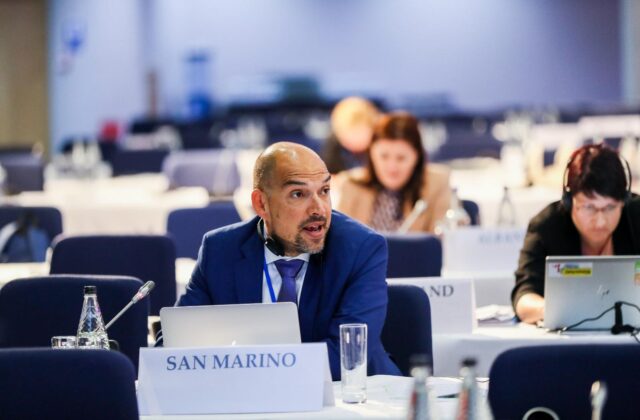
The “I Capifamiglia” committee has responded to Michele Muratori’s editorial with a piece titled “Just political propaganda” (“Solo propaganda politica”), accusing the Libera group leader of turning mere possibilities regarding the Association Agreement with the European Union into certainties. The reply demands documents, clauses, studies, figures and guarantees from Muratori. It offers none of these itself. In four thousand words, not a single article of the Agreement appears, nor an annex, a figure, or a transposition deadline: it is an indictment of an absence, built entirely out of another absence.
Let’s start with what deserves acknowledgement, because this newspaper hosts opinions but is nobody’s megaphone — and that applies to the bylines it publishes too.
The Capifamiglia are not an anonymous group, and anyone who dismisses them as such is aiming at the wrong target.
They are a civic committee with a public spokesperson, Massimiliano Carlini, who has submitted referendum questions to the Collegio Garante (the constitutional guarantee panel), absorbed the rejections, filed an appeal with the European Court of Human Rights, and built a joint front with the Socialist Party (Partito Socialista) and Pro San Marino. Demanding that citizens have their say before ratification is a legitimate political position, pursued openly and through institutional channels. We published their statement in full, as we publish their views every time they send them to us. The right of reply has never been in question here.
What follows is not about their right to speak, but about the quality of what they have written.
And a second point must be acknowledged before we move on. When the reply notes that Liechtenstein, Malta and San Marino are not comparable cases, it is simply right: the European Economic Area, full membership and association are three different legal regimes, and attributing a country’s entire growth to a single integration process is a logical leap no economist would sign off on.
Malta’s GDP tripling in twenty years is not entirely down to Brussels, and we say so even though we published the editorial that argued the opposite. Likewise, Muratori’s call to “sweep away every last trace of scepticism” remains the weakest line in his piece: in a Republic, scepticism is not swept away, it is answered. On this point the Capifamiglia hit the mark, and it would be dishonest not to say so.
The problem is everything else, and it starts with the very passage they themselves identify as the heart of their argument: what will happen when San Marino has to transpose a piece of European legislation it disagrees with. They present it as the most uncomfortable question, the one nobody wants to tackle.
It is a serious question. And it is a question the text of the Agreement has long answered, in writing. The institutional section entrusts the functioning of the arrangement to a Joint Committee in which both the Union and the Republic are represented, which decides by common accord and is the body responsible for setting the deadline by which San Marino must align its domestic law with developments in the acquis. Alongside it operates a tripartite Association Committee, together with Andorra, which has no decision-making powers.
Transposition does not cover the entire body of European law but only the sectors negotiated bilaterally, with exemptions negotiated on the basis of the characteristics of San Marino’s economy. All of this is set out in the information document produced by the Foreign Ministry (Segreteria di Stato per gli Affari Esteri), downloadable by anyone with an internet connection.
One may consider that mechanism insufficient. One may argue that “common accord” between a market of hundreds of millions of consumers and a Republic of thirty-four thousand inhabitants is an elegant formula for describing an asymmetry. One may challenge the composition of the Joint Committee, the timeframes for adjustment, the absence of any substantive veto power. These would be technical, verifiable objections, hard to brush aside, and this newspaper would give them the same space it has given to everything else. What cannot be done is presenting the question as though nobody had ever written an answer. Because at that point the problem is no longer the reticence of the Agreement’s supporters: it is that its critics have not read the document they are criticising, or have read it and preferred not to discuss its content.
It’s worth remembering that the Capifamiglia know perfectly well how it’s done. Back in April they produced an analysis citing the Preamble, the 1991 customs union, the 2012 monetary agreement, and the directive on administrative cooperation in tax matters, and it advanced a precise thesis: that integration with Europe already exists and that the Agreement would turn it from flexible into automatic. One may agree with that or not, but it was reasoning built on references. This time they chose rhetoric instead. It’s a step backwards, and they are the ones who chose it.
Then there is the criterion on which the entire reply rests: the distinction between “could” and “will”. No international agreement, they say, can guarantee investment, employment and innovation. True. And irrelevant, because it applies to any public act ever carried out by any government in the world: no budget law guarantees growth, no trade treaty guarantees exports, no healthcare reform guarantees health. If “might not be a guarantee” becomes the yardstick for decision-making, nothing will ever be decided again. It is not a standard of proof, it is a permanent veto dressed up as prudence.
And above all, that yardstick is never turned on their own proposal. Elsewhere, the Capifamiglia have set out their alternative: carrying on with bilateral agreements, as has been done up to now. Fine. That path, too, is one that could work. It could guarantee market access for the next twenty years.
Or it might not guarantee it at all, if the Union decided to stop granting individual deals to a country that had turned down the comprehensive one. Demanding certainty from only one side is not a demand for rigour: it is a choice about where to place the ruler.
A minor passage also deserves attention, because it is where the method gives itself away. After criticising Muratori for using foreign examples, the text adds: “It is a deliberate omission (?)”. Quotation marks and a question mark.
Bad faith is insinuated while simultaneously retreating from the accusation, so that if challenged one can say it was just a question. It is precisely the device the text spends four thousand words reproaching others for using. Those who demand clauses, studies and figures should not be handing over allusions in parentheses.
But the most significant point comes at the end, and it has nothing to do with Europe: it is about consistency. The reply devotes an entire section to explaining that the choice is not “a contest between the modern and the backward”, that false alternatives are an unfair device, and that one can be European without giving up the right to choose. It is the best-written, best-argued passage in the whole text.
Then it closes like this: do Sammarinese people really want to be “normal”, or do they simply want to go on being Sammarinese?
A perfect false alternative, built just a few lines after condemning false alternatives. Normal or Sammarinese. One or the other. Exactly the scheme they had just finished denouncing as unacceptable when someone else used it. This is not a stylistic slip: it is proof that the text is not objecting to a method, but to who uses it. When Muratori builds the binary scheme, it’s propaganda; when the Capifamiglia build it, in the very last line, it becomes identity.
It remains true that on one point they are entirely right, and it is the point this newspaper starts from: San Marino does not need to be reassured, it needs to be informed. Precisely. The debate over a treaty due to enter provisional application on the first of January should be conducted on the text, not on name-calling the opponent.
So the request is the same for both sides. To those who support the Agreement: stop measuring it against Liechtenstein’s GDP and explain which San Marino sectors will bear the costs of adjustment, on what timeline, with what resources and what public support.
To those who oppose it: set aside, for a moment, the terrain of “could” and tell us which article is unacceptable, which annex is unbalanced, which transposition deadline is unsustainable for businesses on the Titano.
The right question is not whether Sammarinese people want to be normal or Sammarinese. It is what weight, concretely, the Republic will carry within that Joint Committee which will decide “by common accord” how much time we will have to rewrite our laws.
We are waiting for that answer. From both sides.