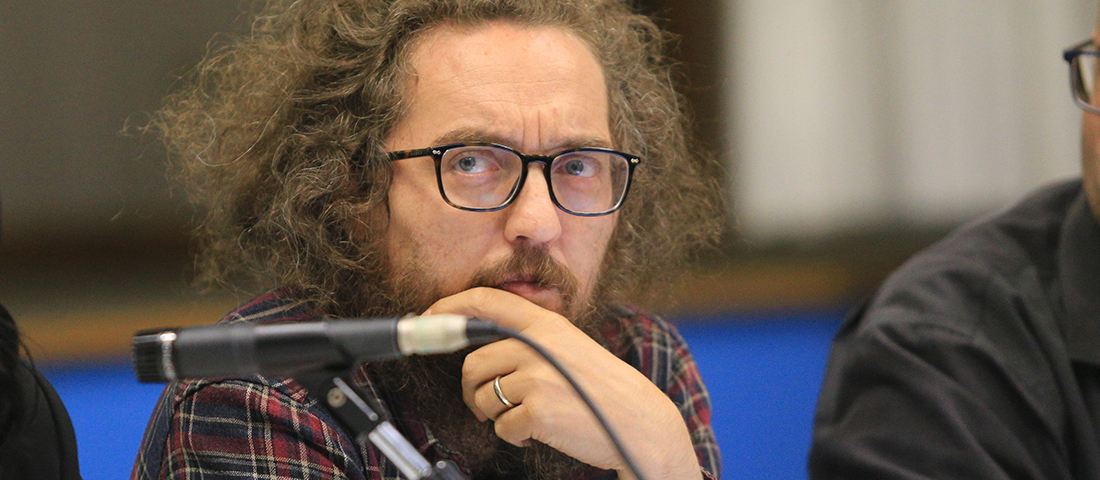
Matteo Zeppa (Rete) pressed for information on staffing, public administration reorganisation and the timeline of measures needed for the association agreement with the European Union. During the joint committee session on October 12, the commissioner criticised remarks made by Secretary of State Andrea Belluzzi and raised doubts about the role of parliamentary committees in examining the implementing decrees. His full remarks follow below.
“Let me start by endorsing something Secretary Beccari said: we shouldn’t be frightened by the sheer volume of legislative acts. That doesn’t worry me. What worries me is the political approach – in particular, what I consider a shallow and superficial remark from Secretary Belluzzi. This isn’t meant as an attack. I sit on the Foreign Affairs Committee, and we’ve discussed these matters with Secretary Beccari on every occasion. Still, given that two committees were convened jointly today, so close to the signing, I expected much more: figures, dates, information on the impact on public administration. Instead, nothing was said. It’s all ‘we will do this, we will do that.’ What concerns me isn’t the volume of work or the number of acts to be transposed, but an underlying superficiality that I can’t tell stems from incompetence, lack of preparation, or a deliberate attempt to obscure matters now that we’re at the finish line. This leaves me quite perplexed.
I agree with Belluzzi that the statistics office will become an independent authority, as he had already announced. In his remarks he also spoke of cutting costs and professionalising staff. Belluzzi, you’re hitting one point and then another without connecting them: surely you must have an estimate, your Secretariat must have some idea of how many people will need to be redeployed or retrained, and what new roles will be required because of the impact of the EU agreement. You cannot come here and say nothing. It’s disheartening, Belluzzi, truly disheartening. You might as well have convened only Committee 2 and discussed it there, because we have always been proactive with the Secretary and with all parliamentary groups, both majority and opposition. Here, there are no figures.
You mentioned a central chancery. If I understood correctly, this is a project for an authorities’ chancery that would distribute various tasks among the different authorities and offices. If I misunderstood, please clarify. Fine – but how many people will be needed, where will it be based, and on what timeline will it be set up? We sign on the 19th, today is the 12th, and we still know nothing. Or perhaps you simply don’t want us to know. I don’t understand this persistent tendency not to share information.
You mentioned a third requirement: what is the timeline for that? Everyone needs timelines. This isn’t a matter of majority versus opposition politics. We need information, because otherwise, dear Belluzzi, misinformation thrives on this kind of silence and exploits it. Even a party that was once in coalition with you, and is no longer in this Council, does exactly that. Information can always be updated – you can say there’s been a setback or a development. But you cannot come to a joint committee session and say nothing: ‘we will do it,’ ‘let’s wait,’ ‘let’s professionalise.’
In my view, there’s also a missing element tied to the process we’ve gone through so far: the contribution of professional expertise and the opportunity represented by the joint commission. During the negotiations, that commission served to bring together politicians, employers’ organisations and professional bodies to gather their views. Since, as Beccari said, we shouldn’t be frightened by the volume of acts that will concern us, it would make sense to reactivate the joint commission, or at least not abandon it. If it served – for better or worse – to bring together politics, professionals and institutions to collect their assessments during the negotiations, I believe it should be preserved. Whether or not they actually expressed their views is another matter entirely. Many preferred speaking to the press rather than in the joint commission – if I may say so, they let the politicians go first and then followed. Still, I believe that commission should be kept.
Now for the less pleasant part, at least from my point of view. I understand the intention – which we discussed in the Foreign Affairs Committee when the Secretary presented it to us – of including a section dedicated to the transposition decrees on the Grand and General Council’s agenda. But, gentlemen, Article 5 of that bill is a scandal. The article on the examination and ratification of delegated decrees transposing EU acts provides – in derogation from the Council’s own regulations – that these decrees be examined and voted on in a drafting capacity within committee. Since time immemorial, all decrees have passed through the Grand and General Council. Here, the rules of procedure are already being stretched considerably.
Furthermore, in light of the amendments to the Council’s regulations introduced by your own majority, paragraph 2 of Article 5 states that no new amendments may be submitted. I agree with that in principle, but you should introduce an exception for cases covered by Article 30 – the technical ones needed to improve transposition – which is already provided for elsewhere.
Then there’s paragraph 3. The delegated decrees are issued by the Congress of State and signed by the Captains Regent, correct? They then come before the Grand and General Council, which is asked to ratify them or split them off, correct? Well, who decides which decrees go to which committee? The Congress of State? Did I misread this, or is it simply implausible that Article 5 can continue to exist with these provisions? Which authority decides whether a decree transposing EU acts should go to Committee 1, 2, 3 or 4? Do the committee chairs simply claim this authority for themselves, is it the Congress of State, or is it someone else?
This isn’t about obstruction. We have always supported this path, which will finally lead to what will happen on October 19 – just a few days from now. The problem is one of substance: using regulations to suit whoever happens to be in charge of implementing them. Over all these months, could we not have met and spoken clearly with one another? I’m not even referring to the last Foreign Affairs Committee meeting, where the outline was sketched for what would later become, just days afterward, a blitz in the Grand and General Council concerning the agenda item on the Council’s own regulations. But who decides which committee will handle the decrees related to the transposition of EU acts? Are we drawing lots, or playing rock-paper-scissors? Frankly, I am stunned by the lack of professionalism on this point.
I don’t want to turn this into a political shouting match – that doesn’t interest me. I long for October 19 to arrive. The problem is that my hope for that date clashes with the lack of information coming from various Secretaries of State. It would have been good to have your colleagues here too, because there are also the issues of the labour market and industry – we cannot keep moving forward sector by sector.
We had a joint commission, open to everyone, to carry out a series of assessments during the negotiations. As I said, in my view it should be preserved – if nothing else, to prevent politics alone from deciding what to do and what not to do. There must also be a counterpart able to say: be careful, if you do this, a certain thing might happen; if you don’t, it might not.
To conclude – I won’t say I’m angry, because I’m not – but I fail to understand the point of convening two committees jointly without providing any information, at least as far as Secretary Belluzzi is concerned. With Beccari, we now meet two or three times a month and somehow manage to find common ground, but honestly and frankly, I am quite taken aback.”