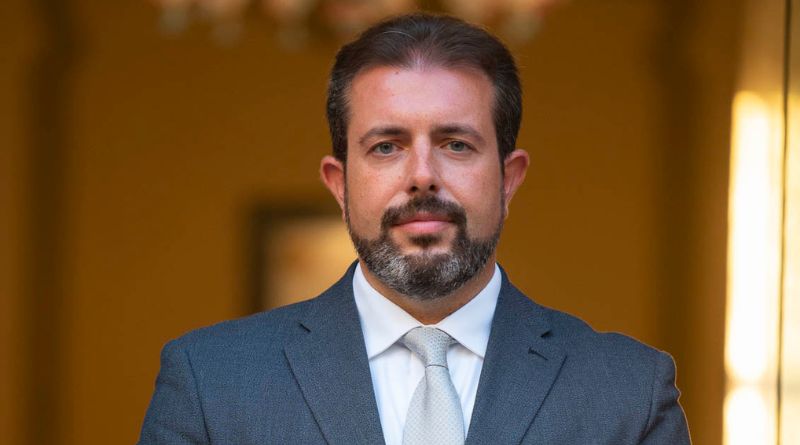
During item 7 of the Grand and General Council (Consiglio Grande e Generale) agenda, dedicated to the ratification of the Association Agreement with the European Union and the related amendment to the Monetary Convention, Gaetano Troina (D-ML) criticised the government and the majority over the absence of a referendum.
Ahead of the session, Domani Motus Liberi had requested that its own bill calling for a public referendum, along with a motion on the transposition of EU rules, be discussed alongside the ratification. The request was turned down.
Troina also questioned how the post-ratification phase is being prepared, asking whether the public administration has trained staff and dedicated offices in place.
Below is his speech in full.
«This is undeniably a very important item on the agenda for this chamber. Before addressing the substance of the ratification, I want to make two preliminary points.
As a political force, we had asked the Bureau of the Presidency to combine two additional documents with this agenda item.
First, our bill, which called for a referendum to be held before proceeding with the ratification of the Agreement, and second, a motion on the subsequent transposition phase, which is already on the Council’s agenda, albeit further down, and which would have made sense to discuss at this point.
It was decided not to accept our request. We regret this, because it could truly have been an important opportunity for the country.
Why do I say this? Because by choosing not to involve the citizens in a historic decision such as this one, this chamber — or rather, a good part of it, allow me to make the necessary distinctions — is taking responsibility for such a decisive step for our country without having gathered the opinion of the public.
So today, or whenever this vote takes place, the majority of this chamber is deciding to bypass the need to ask citizens their opinion on this matter.
A huge missed opportunity for this country’s democracy, a huge missed opportunity for this majority and this government to demonstrate that the country is convinced of the path it intends to take. And honestly, I remain puzzled when, in this chamber today, I hear it said — no offence to the colleagues whose remarks I’m referring to — that now there is studying to be done, now there is work to roll up our sleeves for.
First of all, if there is studying to be done, it should have been done before getting here. It’s not as if, after years of discussing this, there is suddenly studying to do — because saying there’s studying to do means you don’t know what you’re about to apply, or that you’re not prepared for what you’re about to apply. And when I hear that we now need to roll up our sleeves, it means that, until now, this hasn’t been done.
And my political force, gentlemen, has been saying this since 2018. Since 2018, consistently and coherently, we have always publicly called for citizens to be involved and informed about what would change. You made a different choice — we acknowledge that, and it is your right to do so.
Honestly, I am very concerned about how you are setting up the next phase, that of transposition. Let me explain.
The idea of transposing the acquis communautaire through so-called omnibus legislative measures, which annually or periodically incorporate European regulations wholesale, exactly as they are, without examining them one by one, without having understood and explained to the various sectors of our economy what applying these dossiers means for their specific contexts, is a problem.
It is a problem because, once a given directive or regulation is transposed, with all due distinctions, we know perfectly well that in Europe a regulation is immediately enforceable and cannot in any way be adapted to specific circumstances.
It must be taken as it is, whereas directives can be transposed with some degree of variation by member states. But we are not a member state of the European Union — we are a country associated with the European Union.
What does this mean? It means that not only will we be unable to take part in the decision-making stages at the parliamentary level when new rules are being drafted, but we will have to accept them exactly as they are proposed to us, without being able to say anything substantial about them, because European legislation is what it is, and San Marino will not have contributed in any way to its formulation.
This was the choice made — fine. But you cannot expect all of us to sit here applauding and saying “well done, well done,” because we have always said that, from our point of view, the negotiation and the path with Europe could have been managed very differently.
Here it keeps being said that we have so many years to transpose the rules in one sector and so many years for another, but up to now, have we actually prepared for those specific sectors with proposals that take into account the peculiarities and specificities of our system?
We can draw the answer from your own statements, and it is no. Is the public administration ready? Has it been trained? Are there dedicated offices that will handle all this immense workload ahead? The answer is no. And I want to stress once again that this does not mean Domani Motus Liberi is against the Association Agreement or against Europe.
It is against the way you, as the majority and as the government, have chosen to carry all of this forward.
We reiterate this once again here, because we are sorry. There truly was an opportunity to do this properly, there was plenty of time, and it was consciously and deliberately decided not to do so.
Citizens must be informed of this, and they should bear it in mind, because later on, when I fear there will be problems with transposition and implementation, you, gentlemen, will have to take responsibility for them».