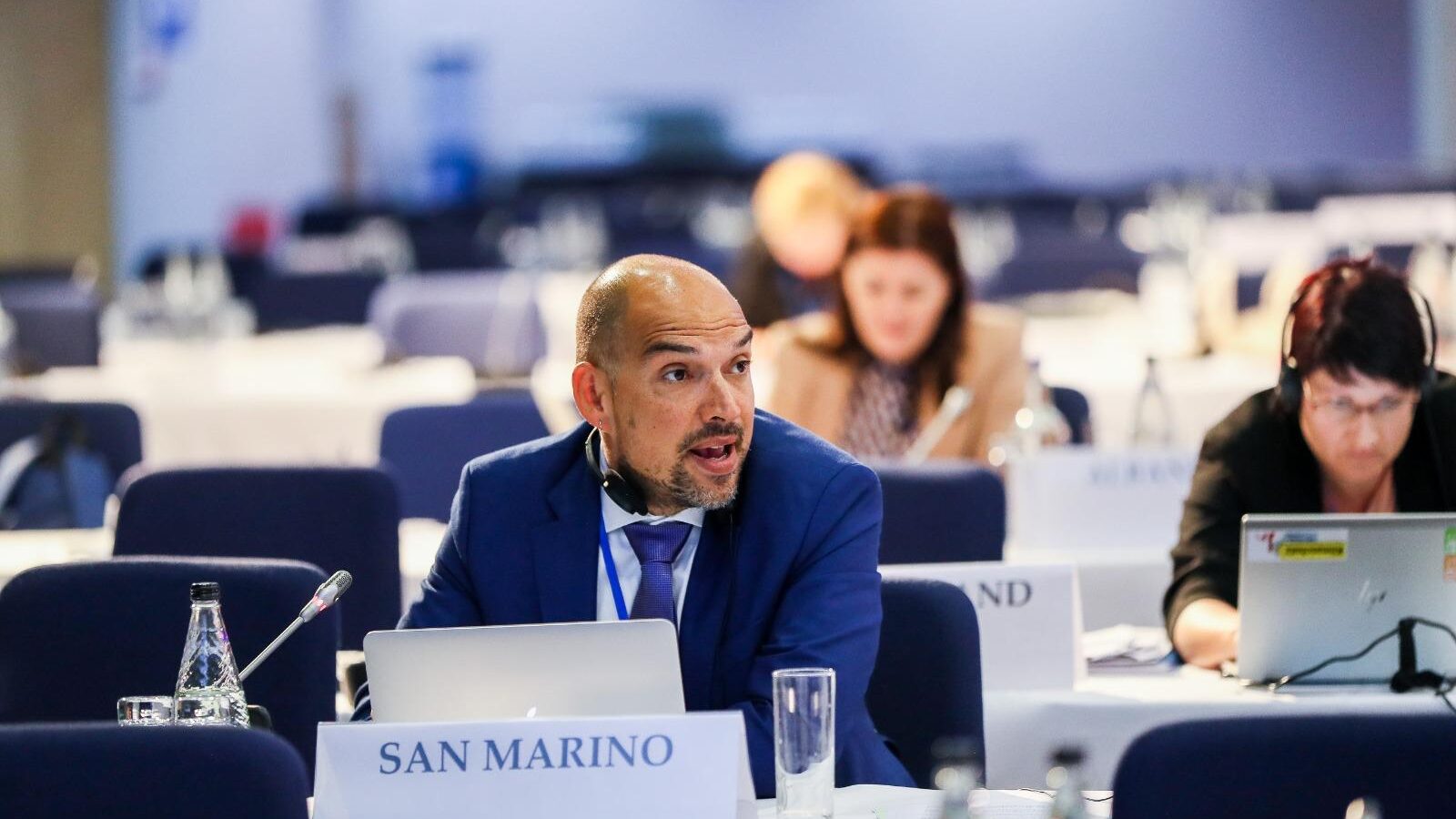
The in-depth column curated by Michele Muratori, group leader of Libera, continues, dedicated to analysing current political affairs, the main institutional challenges and the issues of greatest interest to the Republic of San Marino.
_____
There is a moment, every year, around November 25, when San Marino, Italy and the entire world pause to reflect on one of the most urgent social and cultural challenges of our time.
Benches are painted red, public buildings are lit up, and squares and schools come alive with awareness-raising initiatives.
It is a fundamental civic occasion, one that keeps the spotlight on an issue that can never be relegated to the margins of the public agenda.
However, for these symbolic gestures not to remain confined to a single day, they must be accompanied by steady and clear-eyed commitment, starting with a concrete analysis of a reality that the numbers, in their objectivity, force us to confront.
Violence against women is not a series of isolated tragic occurrences, but a complex, cross-cutting phenomenon that spans latitudes, social classes and generations.
To grasp the scale of this global challenge, one must start from the picture drawn by the United Nations and the World Health Organization.
Worldwide, roughly 736 million women — almost one in three — have experienced physical or sexual violence at least once in their lifetime, most often at the hands of an intimate partner.
According to UNODC data, the United Nations Office on Drugs and Crime, more than 85,000 women and girls are intentionally killed every year.
The most striking figure concerns the context in which these crimes occur, since around sixty percent of these homicides — that is, over 51,000 victims a year, one woman killed every ten minutes — happen within the home, at the hands of partners or family members.
The home, in the collective imagination the ultimate refuge, is unfortunately confirmed to be statistically the most dangerous place for women.
Narrowing the focus to Italy, reports from the Interior Ministry’s Criminal Analysis Service and Istat data paint a picture that demands the utmost attention, as a woman is killed roughly every three days in the country, with a stable average of between 100 and 120 femicides a year.
In more than eighty percent of cases, the perpetrator is a partner, an ex-partner or a very close relative.
But femicide is merely the visible tip of a far larger phenomenon made up of everyday abuse.
According to Istat, 31.5 percent of Italian women aged between 16 and 70 — nearly 7 million people — have experienced some form of physical or sexual violence during their lifetime.
To this must be added psychological and economic violence, harder to measure statistically but equally debilitating, which often undermines victims’ freedom and autonomy.
Behind these percentages lie names, faces and stories that in recent years have deeply shaken public opinion, showing how violence knows no geographic or cultural boundaries.
In Italy, the case of Giulia Cecchettin, killed in November 2023 by her ex-boyfriend Filippo Turetta, marked a generational turning point, exposing the difficulty some men have in accepting a young woman’s freedom and self-determination.
Before her, the story of Giulia Tramontano, killed in her seventh month of pregnancy by her partner Alessandro Impagnatiello, had revealed the devastating reality of emotional manipulation.
And looking further back into the country’s civil history, the memory remains indelible of the Circeo massacre of 1975, which cost Rosaria Lopez her life and left Donatella Colasanti miraculously alive, as does the courage of Franca Viola, who in 1965 in Sicily refused a “reparative marriage,” helping to dismantle a penal code that treated rape as a crime against morality rather than against the person.
Broadening the view beyond national borders, recent events have forced the world to reflect deeply on the themes of consent and respect.
In France, the Mazan trial, in which Gisèle Pelicot waived her anonymity so that the shame would shift where it belonged, brought to light a disturbing case in which, for ten years, her husband had drugged her and offered her to dozens of ordinary men — a stark demonstration of how urgent it is to work on a culture of respect.
In Spain, the case of the non-consensual kiss forced by former football federation president Luis Rubiales on player Jenni Hermoso during the 2023 World Cup final gave rise to the SeAcabó movement, igniting debate on equality and the protection of women’s dignity even within sports and institutional settings.
It is impossible not to look to Iran, where the death of Mahsa Jina Amini in September 2022 at the hands of the morality police sparked an extraordinary women-led mobilization under the banner Woman, Life, Freedom, paid for at a high price in the name of the right to self-determination.
Faced with the complexity of these dynamics, national and international institutions have progressively strengthened their legal and preventive tools.
On the European and international stage, the cornerstone remains the Council of Europe’s Istanbul Convention, the first legally binding instrument to establish a comprehensive regulatory framework against violence against women, built on the four pillars of prevention, protection, prosecution and integrated policies.
In Italy, legislation has made significant strides in recent years, from the 2019 “Red Code” law (“Codice Rosso”), which introduced fast-track procedures for cases of domestic and gender-based violence, to the 2023 tightening of regulations that strengthened precautionary measures, the use of electronic monitoring bracelets, deferred in-flagrante arrest, and formal police warnings (“ammonimento del questore”).
These are complemented by the 1522 anti-violence and anti-stalking helpline, active around the clock, and a widespread network of anti-violence centres and shelters offering protected accommodation, legal advice and psychological support to victims.
A particularly effective model of integrated, close-to-the-ground response can also be found in the Republic of San Marino, which has made the fight against gender-based violence a top institutional priority.
San Marino promptly ratified the Istanbul Convention and has built a cutting-edge legal framework, grounded in the landmark Law No. 97 of 2008 on the prevention and suppression of violence against women and gender-based violence, later expanded and updated through key measures such as Law No. 57 of 2016 and various delegated decrees and national action plans, including the National Comprehensive Plan and the adoption of ILO Convention No. 190 on violence and harassment in the world of work.
The Sammarinese Republic has established a highly cohesive, multidisciplinary Anti-Violence Network, bringing together close cooperation between the Equal Opportunities Authority — which also holds the power to join criminal proceedings as a civil party in defence of victims — the police forces, equipped with innovative tools such as the Tecum app for geolocation and protected recordings, and the Social Security Institute, through the Listening Centre at the Women’s Health Centre.
In San Marino, the system provides dedicated healthcare pathways and free psychological and legal support, guaranteed in partnership with the Bar Association and the Order of Psychologists, alongside a strict mandatory reporting obligation for teachers and healthcare workers — forming a comprehensive protective framework in which no woman is left to face her path out of violence alone.
Despite the significant strengthening of laws and the presence of local support networks, legislative and welfare responses must be constantly accompanied by efforts to overcome certain cultural and practical obstacles.
This is illustrated by the data on how much of the phenomenon remains hidden, since according to Istat, more than eighty-five percent of violence suffered at the hands of a partner still goes unreported.
Women often hesitate to seek help for fear of not being believed, for fear of retaliation, or because they still lack the economic independence needed to start anew.
At the same time, even in San Marino there is a recognised need to make the collection and analysis of data on the phenomenon more systematic and precise, since accurate, up-to-date records are essential to obtaining a true picture of the situation on the ground and to better calibrate prevention and protection measures.
Anti-violence centres do extraordinary work and need continuous, structural support in order to respond to every request for help.
Finally, there is a decisive battleground on which the future will be won: that of education and early prevention.
Strengthening programmes on emotional education, empathy and mutual respect in schools, as is already happening in many virtuous examples, is essential to equip young people with solid tools for building healthy relationships, countering gender stereotypes and the distorted models often spread through the digital world.
Everyday language also plays an essential role, because calling things by their proper name helps recognise warning signs before it is too late.
November 25 thus becomes a precious moment of awareness and shared responsibility.
The laws exist, and the centres and protection networks function and prove every day that they can save lives — but the real turning point depends on each of us committing ourselves daily.
Violence against women will be truly defeated only when the whole of society — from institutions to families, from schools to workplaces — learns to promote, day after day, an authentic culture of respect, equality and freedom.