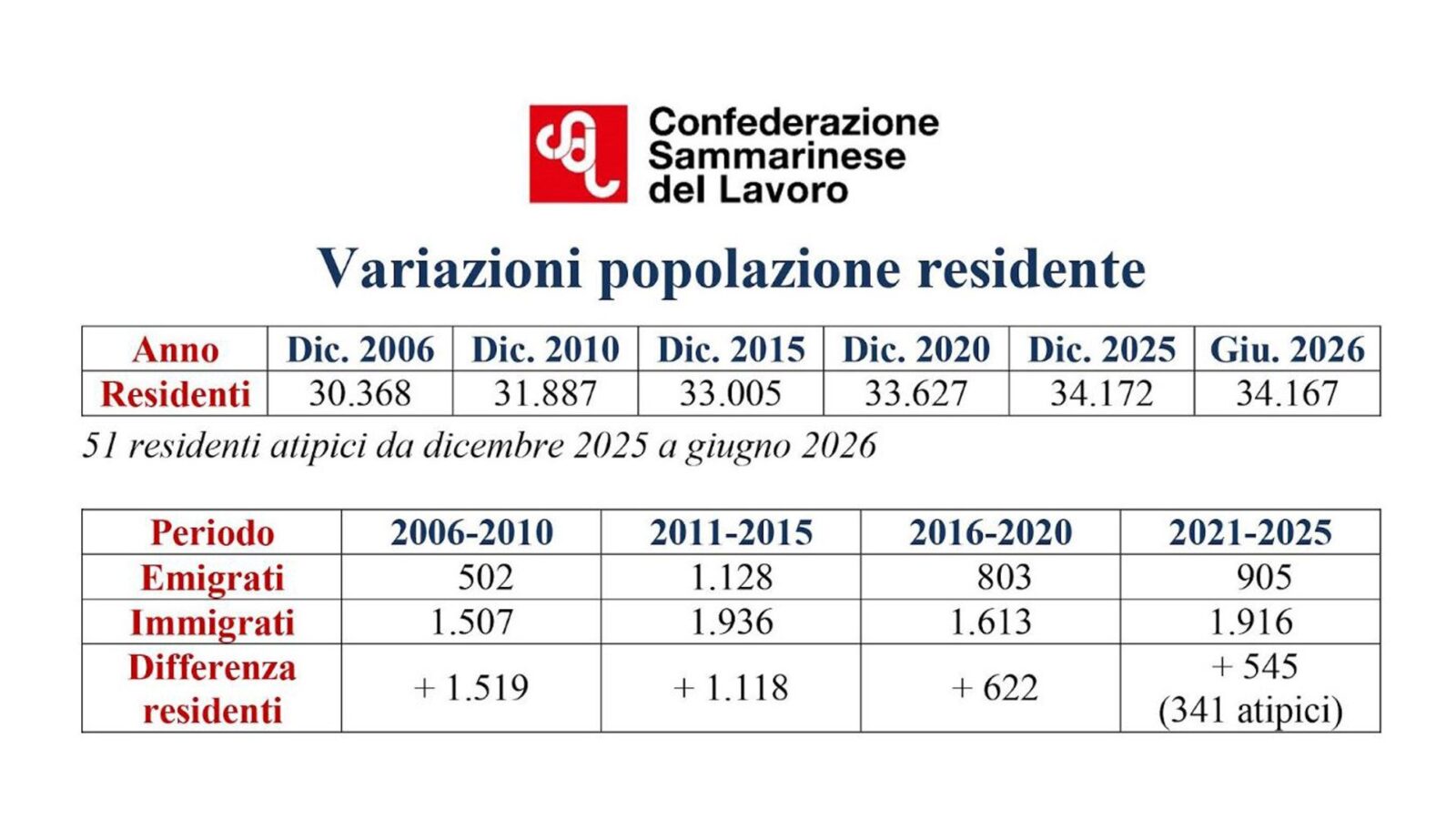
The Confederazione Sammarinese del Lavoro (San Marino Workers’ Confederation) has released figures on the resident population, pointing to a reversal in trend: from 34,172 residents in December 2025, the number fell to 34,167 in June 2026, with the natural balance negative since 2016 and immigration no longer compensating for it. Below is the full press release.
The family law deserves credit for improving and introducing several measures to support parenthood and disability. These were necessary and long awaited, but we believe they represent only a partial response to the birth-rate crisis.
The reasons are in fact manifold, including cultural ones, which must be addressed on multiple levels — starting with an awareness of the long-term consequences, not only in terms of the effects on the healthcare and pension systems, but also with regard to the size and age composition of the resident population, which could continue to shrink steadily.
Attentive observers cannot fail to notice that the natural demographic balance — the difference between births and deaths — has been negative since 2016 and is worsening year by year (-111 in 2025). This factor is no longer offset by the number of immigrants.
Indeed, for the first time in decades the number of residents is declining: as the table shows, the trend turned negative in June 2026 compared with December 2025.
This trend is also being driven by rising emigration (largely made up of young people with high levels of education).
It is worth noting that the number of immigrants is also falling, once we strip out atypical residencies under favourable tax regimes. Without these — which have numbered almost 400 over the past five years — the balance would be even more negative. This means our country is becoming less attractive to “typical” people.
Beyond strictly economic reasons, other factors affecting the decision to forgo having children include job security and quality of employment, childcare services, and the possibility of accessing housing at reasonable cost. On this point, while awaiting the publication and discussion of the data from the questionnaire promoted by the Commission on Demographic Trends (Commissione per l’Andamento Demografico) among young residents of San Marino, some insight can be drawn from the survey on “fertility intentions” published by ISTAT in December 2025, referring to the previous year.
Notably, half of women believe that having a child would worsen their job prospects: for the 18-24 age group, this figure rises to 65%. A concern that is, unfortunately, more than justified.
We have already shown that in San Marino the private sector is rather “ungenerous” towards young people with high qualifications, in terms of professional classification — particularly for women, who, moreover, achieve higher levels of education than men. Nor are there any shortage of problems that arise when women announce a pregnancy, not to mention the difficulties of returning to work after maternity leave.
We will return to the factors affecting the birth rate: in our next statement we will focus on the housing problem. For several years now we have been facing a genuine emergency regarding the cost of renting and buying property, so much so that young people are often forced to look outside the country.
Press release, CSdL