More money in pay packets, but the real clash shifts to the future of the Public Administration. This was one of the central moments of the first day of the new session of the Grand and General Council (Consiglio Grande e Generale), which opened Monday, September 7, and was also marked by tributes to Matteo Fiorini, a former councillor who twice served as Captain Regent and Secretary of State.
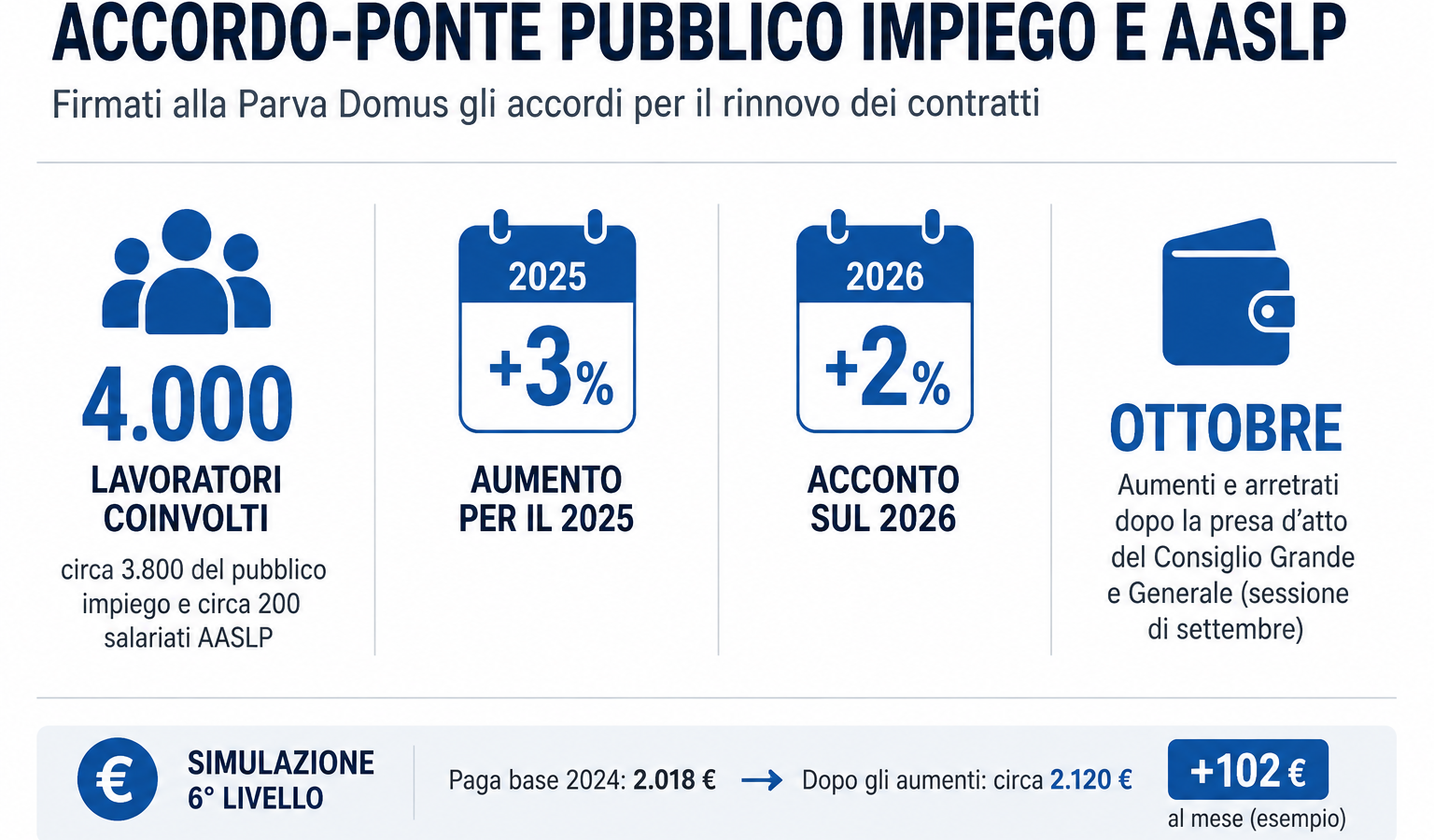
The most concrete measure came with the ratification of agreements between the Government and trade unions covering the broader public sector and wage earners: a 3% increase for 2025 and a 2% advance for 2026. Secretary of State Federico Pedini Amati was quick to clarify that this is not yet the definitive contract renewal, but a bridging measure aimed at recovering at least part of the purchasing power lost to inflation. Negotiations will therefore continue, also addressing mobility, training, career paths, and the public administration’s ability to attract qualified professionals.
This is precisely where the debate heated up. Nicola Renzi (RF) posed a very direct question: “Regardless of whether someone works in the public or private sector, can a person live or plan a life on 1,050 euros a month?” Renzi called for a Public Administration with fewer but more qualified and better-paid staff. Matteo Zeppa (Rete), by contrast, focused on inflation, going so far as to suggest that, as a last resort, the country could even consider reviving a mechanism similar to the scala mobile (automatic wage indexation), linking salaries to price increases. Matteo Rossi (PSD) placed particular emphasis on young people: without adequate salaries, he argued, it becomes difficult to attract and retain top-level professionals.
The issue was also taken up by Antonella Mularoni (RF), who linked wages, cost of living, and the declining birth rate, calling for a Public Administration built more on merit, skills, and motivation. Fabio Righi (D-ML), meanwhile, shifted the focus to the sustainability of the system: raising salaries is not enough, he argued – it is essential to determine whether the current public machinery is truly equipped to meet San Marino’s future needs.
The Government’s response came from Secretary Luca Beccari: the agreement is not a reform of the Public Administration, but a step toward the real contract renewal. One of the problems, according to Beccari, remains the rigidity of the system, to the point that it would be worth considering differentiated pay scales based on professions, responsibilities, and risks. The point is simple: if the public sector offers less than the private sector, both in salary and career prospects, losing some of the best talent becomes inevitable.
Manuel Ciavatta (PDCS), on the other hand, defended the sustainability of the measure. Using the example of a 2,000-euro salary, he calculated the combined effect of the 3% and 2% increases at around 100 euros a month, stressing that the intervention is possible because public finances allow for it. “If this Government is able to spend around 5-6 million euros on this measure, it is not because it has taken on more debt – debt is actually falling – but because it has managed to put the accounts back in order,” he said. At the end of the discussion, both agreements were approved.
Union representation, a new political front
The day’s business did not end with wages, however. A second reading was also held on the bill amending the 2016 legislation on trade union freedom and activity, collective bargaining, and the right to strike. The amendment lowers certain numerical thresholds required for the representativeness of employers’ associations and also affects the Guarantor Committee.
While differences over the substance were limited, the clash erupted over the method. Gaetano Troina (D-ML) described the government’s approach as “authoritarian” for failing to involve the opposition beforehand. Rete chose to abstain, calling for greater clarity on the reasons behind lowering the thresholds. The majority, for its part, stressed that the amendment stemmed from requests made by the social partners themselves and aims, after ten years, to align the law’s parameters with the actual state of representation.