From San Marino to Canada, via Brussels. Countries that could hardly be more different in size, geographic position and international weight, yet which might find themselves, at least in part, travelling the same road: that of deep integration with the European Union without becoming a member state.
The opening extended by European Commission President Ursula von der Leyen towards Canada therefore takes on a particular significance on the Titan as well. In her State of the Union address, von der Leyen proposed working towards making Ottawa the EU’s first “associate member”, dramatically strengthening economic and political ties between the two shores of the Atlantic.
This is a category that, however, does not currently exist in the European treaties. There is no ready-made status that Brussels can simply offer the Canadian government. The arrangements, rights, obligations and degree of participation would all have to be built through a new negotiation.
And this is precisely where San Marino enters the picture.
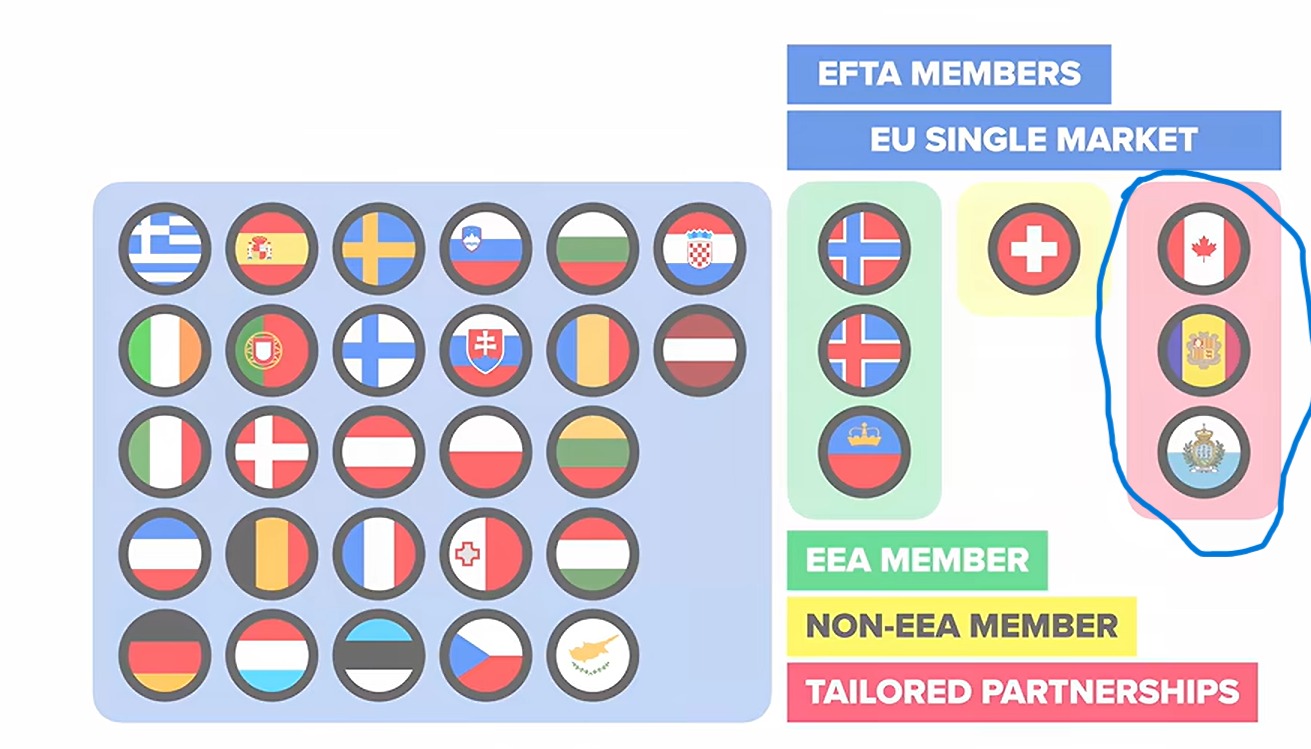
According to an analysis published by The New Union Post, Canada could look to the Association Agreements negotiated by the European Union with San Marino and Andorra as one of the possible models to draw inspiration from. It would not be a matter of copying San Marino’s agreement — the differences between the countries are enormous — but of borrowing its underlying philosophy: entering deeply into the European system without formally joining the Union.
The Titan’s Association Agreement in fact goes well beyond a standard trade treaty. San Marino will remain a third country, but it will progressively enter an extended and homogeneous European internal market, based on the four freedoms of movement for people, goods, services and capital. At the same time, it will need to transpose and apply a substantial body of European legislation linked to the sectors covered by the Agreement.
It is a solution tailor-made for a place with San Marino’s particular characteristics. But that very flexibility could represent the interesting precedent for Ottawa: it demonstrates that Brussels is capable of building highly advanced forms of integration even outside traditional EU membership and the European Economic Area.
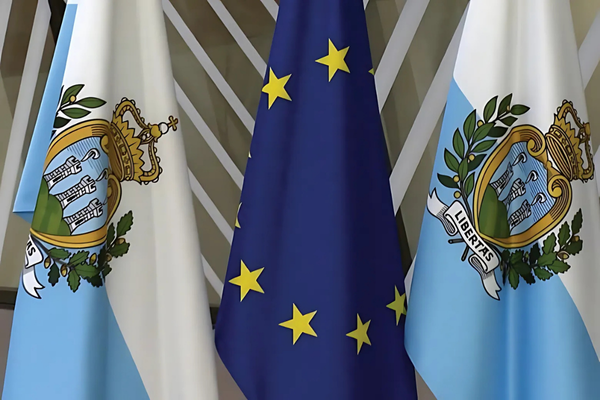
San Marino’s own path, meanwhile, has reached its decisive stage. After negotiations concluded in December 2023, last July the Council of the EU authorised the signing and provisional application of the Agreement with San Marino and Andorra. On the Titan, work is proceeding in parallel to adapt domestic legislation and transpose the European acquis needed to apply the new framework.
The Canadian case nonetheless remains profoundly different. Ottawa already has CETA with Brussels, the trade agreement provisionally applied since 2017, and the idea put forward by von der Leyen aims to build an even broader relationship, potentially covering trade, technology, artificial intelligence, energy, defence, critical raw materials and economic security.
But the political and institutional question is the same: how close can a country get to the European Union without becoming a member? Until a few years ago, San Marino seemed mainly to represent a special case to be managed at the EU’s doorstep. Now the model built for the Titan and Andorra could take on a much broader relevance.
Paradoxically, then, while San Marino looks to Brussels to complete one of the most important international steps in its recent history, even a G7 power like Canada could look to San Marino’s experience to understand just how far a new form of integration with Europe can go.