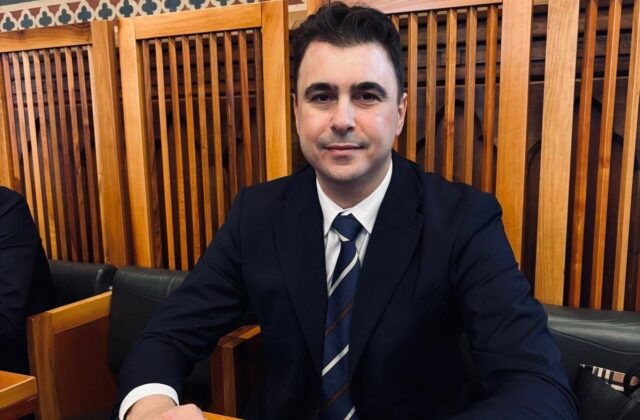
The sitting of the Grand and General Council (Consiglio Grande e Generale) continued on the evening of Wednesday, 25 November 2026, with item 9 on the agenda, dedicated to the bill on the prevention and combating of violence and harassment in the workplace.
During the debate, Fabio Righi (Domani Motus Liberi) spoke in support of the bill’s aims while raising a series of legal, economic and organisational concerns. Among the issues he addressed was the need to guarantee victims the possibility of keeping their jobs and to strengthen preventive tools.
Below is his speech in full.
Fabio Righi (D-ML): The bill we are called upon to examine today addresses an issue on which there should be no particular political divisions, at least as far as the objectives it seeks to achieve are concerned, which are commendable and entirely shareable.
Work represents one of the fundamental elements through which a person fulfils themselves, builds their own independence and contributes to the growth of the community. Ensuring that work can be carried out in conditions of safety, freedom and respect for individual dignity is, I believe, a precise duty of the State.
As Domani Motus Liberi, we certainly share the aims of this bill, not least because it continues a path begun in the previous legislature with the ratification, in March 2022, of International Labour Organization Convention 190, and with the adoption, in March 2024, of the multi-year national plan.
But precisely because we share these aims — and we shared them even while in government — we believe it is necessary to examine the substance of this measure, especially given that an urgent procedure is under way, rather than limiting ourselves to declarations of principle about the merits of the bill.
First of all, Secretary, allow me to say that, in line with the Convention, although previous speakers have focused particularly on women, it is commendable that the measure is actually applicable to all genders.
I believe this is important, especially in a society like today’s, where the weaker party is certainly often the woman, but where men too — because of those who misuse tools such as these — risk becoming victims. If we want to be serious rather than demagogic, this is something we must bear in mind in this Chamber.
A first consideration concerns Article 2 and therefore the definition of violence and harassment in the workplace. It is certainly positive that the legislator intended to include conduct carried out through IT and digital tools, thereby adapting the legislation to the evolving ways in which work and other activities are carried out today.
However, from a strictly legal standpoint, I believe the definition deserves further examination. The provision mainly identifies the context in which such conduct must occur, without fully defining its content, and I believe this is a gap.
Convention No. 190 itself, which forms the basis for this measure, is more detailed in this respect, also referring to threats, single or repeated conduct, and the various forms of physical, psychological, sexual and economic harm.
This is not merely a terminological question. Significant legal and economic effects flow from this definition, both for the worker and the employer, and for the social security system. Legal certainty does not represent — and must not represent — an obstacle to protecting victims; rather, it is itself a tool of protection.
Another point I would like to focus on is resignation for just cause. We support the provision contained in Article 3, which allows a worker who is a victim of violence or harassment to terminate the employment relationship immediately, without having to wait for the conclusion of judicial proceedings.
It would clearly be unreasonable to expect a person to continue working in a context potentially harmful to their dignity or safety while awaiting the timeline of justice.
However, the relationship between filing a complaint, the effects on the employment relationship, and any subsequent outcomes of judicial proceedings needs to be clarified further.
Someone before me raised this point — Councillor Antonella Mularoni — not because the credibility of those who come forward should be questioned, but because, from our point of view, a good law must be able to regulate even the most complex situations, without leaving interpretative gaps.
There is, however, an even more important issue to which I would like to draw the Chamber’s attention: the fact that resignation seems to be the only solution on offer.
We ask ourselves why leaving the job should be the only solution. Resignation for just cause is certainly one tool, but it cannot, in our view, become the only practically viable solution.
We cannot simply guarantee the victim the right to leave. We must also create the conditions for them to exercise the right to stay — not least because otherwise we create a further problem: that of supporting those who decide to leave their job.
For example, pathways could be created to allow a person to keep their job by moving the worker to another department, where organisational measures make this possible.
Another point concerns paid leave and economic sustainability. Article 4 introduces another certainly important tool, granting up to 100 working days of paid leave, which can also be taken in instalments over a three-year period.
We particularly welcome the extension of this measure to self-employed workers. At last they are being taken into account, because when these or other issues are discussed, they are always left out, even though they represent an important category. The provision for full social security and pension contribution coverage is also welcome.
On this article, however, we believe it is necessary to obtain further information. In the report accompanying the bill, for instance, there is no quantification of the potential beneficiaries, no estimate of the economic burden, nor any assessment of the capacity of the ISS fund to which these costs will be charged.
Identifying who will pay does not mean having determined how much they will have to pay, and this is an issue, because measures must also be sustainable in economic terms.
We are obviously not debating whether a person’s dignity has a cost — I want that to be clear. What we are discussing is the legislator’s responsibility to ensure that the rights it recognises can actually be exercised and are financially sustainable.
Some operational aspects also need to be clarified, particularly with regard to self-employed workers and small businesses, who will have to advance the sums involved and recover them later through contributions. I believe further examination of this is necessary precisely to ensure the measure’s full effectiveness.
Mr Secretary of State, allow me to say that we have noticed a major absence in this law, even though it is referred to in the title and provided for through decrees: prevention.
The title of the bill refers to the prevention and combating of violence and harassment in the workplace. Yet if we examine the content of its five articles, we realise that the main measures introduced come into play only after violence has already occurred.
We act by recognising the right to resign, we act by recognising the right to paid leave. But where do we act to prevent that violence from happening in the first place?