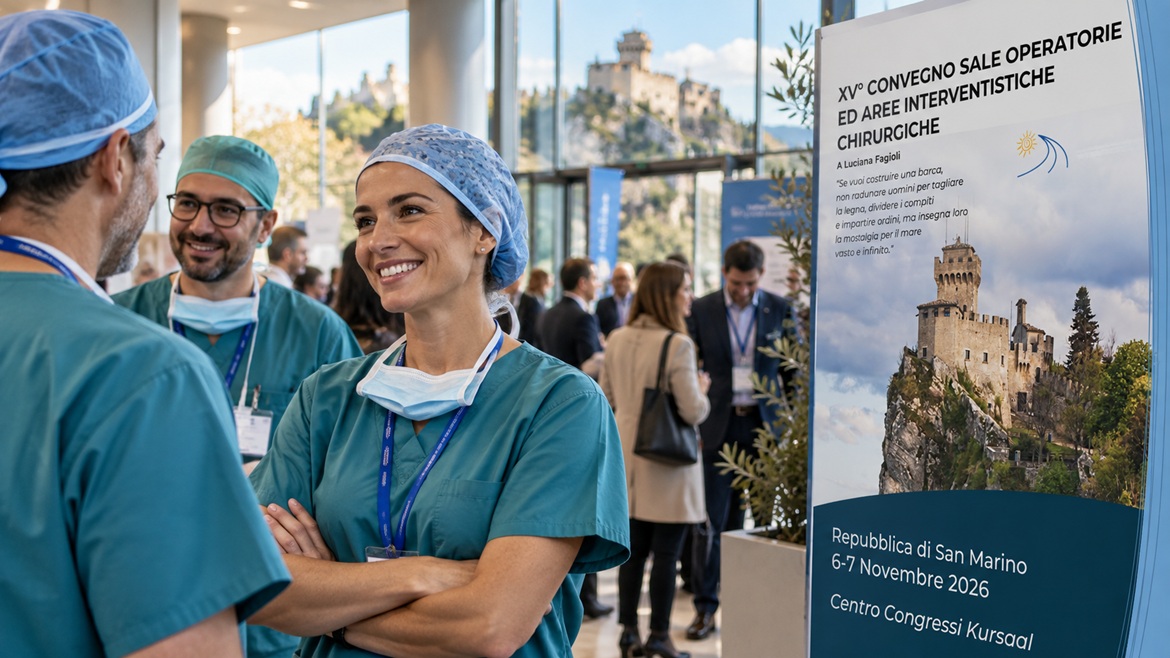
On November 6 and 7, the Kursaal Congress Centre hosts the fifteenth edition of the Conference on Operating Rooms and Surgical Interventional Areas, one of Italy’s leading events for those who work in surgical units. Every year it draws more than 350 participants, is accredited for continuing medical education (ECM) for all healthcare professions, and carries the patronage of the Secretariat of State for Health and the College of Nursing Professions of San Marino.
On Friday at 8am, at the registration desk, the accents of half of Italy will fill the air. Speakers are arriving from Udine, Genoa, Brescia, Salerno and Ancona. In the audience will sit people who have driven for hours on the motorway, or taken the train to Rimini followed by a bus. They will be the guests.
Those who work in San Marino, for two days, get to play host: they know the way, they know where to park, they know where to take their colleagues for dinner.
It’s comfortable being at home, not least because from Milan to Cailungo, operating units are grappling with the very same questions.
A close read of the programme confirms as much.
The organisers frame the new role of the nursing assistant in operating theatres in stark terms: opportunity or difficulty.
Friday opens with Alvisa Palese, full professor of nursing science at the University of Udine, speaking about master’s degrees with a clinical focus — in other words, about where the profession can grow. In his introductory letter, scientific director Pasqualino D’Aloia announces that the conference will also address artificial intelligence and “how to recognise, including financially, the skills and responsibilities nurses exercise.”
Financially, too. It’s usually the kind of conversation held over the coffee machine; this time it gets a microphone.
Then there are the things lived through every day in the operating room that rarely get discussed. The smoke that electrosurgical devices leave in the air, breathed in by the team procedure after procedure.
Deep vein thrombosis, the risk that goes unseen in the operating room. Device traceability in Forlì’s robotic surgery unit. On Saturday morning, Stefania Gurgone, a nurse in Paediatric Surgery in Rimini, will speak about clinical hypnosis in perioperative care. Yes, hypnosis. In the operating room. Around these sessions are workshops run by the companies that supply operating rooms every day, from B. Braun to Stryker, from Mölnlycke to Ansell. It’s the kind of conference from which you return to the ward on Monday with something new to try.
San Marino is already on stage: on Saturday, the session dedicated to departmental projects will be moderated by Nicola Cautero, a surgeon at the State Hospital.
Registration costs 180 euros until September 30, rising to 200 afterwards.
It includes the conference kit, Friday lunch, coffee breaks and an ECM certificate.
Before paying out of pocket, it’s worth checking with the training office.
Registration is also possible on a departmental basis, with a single invoice — which is also the simplest way to attend: together. Anyone with a departmental project they’re proud of can submit it as a poster by September 30, earning a 15% discount on the registration fee.
On November 6 at 8am, the Kursaal will fill with the accents of half of Italy.
And doing the honours, as usual, will be the locals.
The conference is open to nurses, coordinators, surgical technicians, healthcare assistants (OSS), midwives and doctors.
Registration is available online on the AIFPS website, aifps.it, or by submitting the form via email or WhatsApp. For information and group registrations: 338 801 1403 and 335 560 0380.